
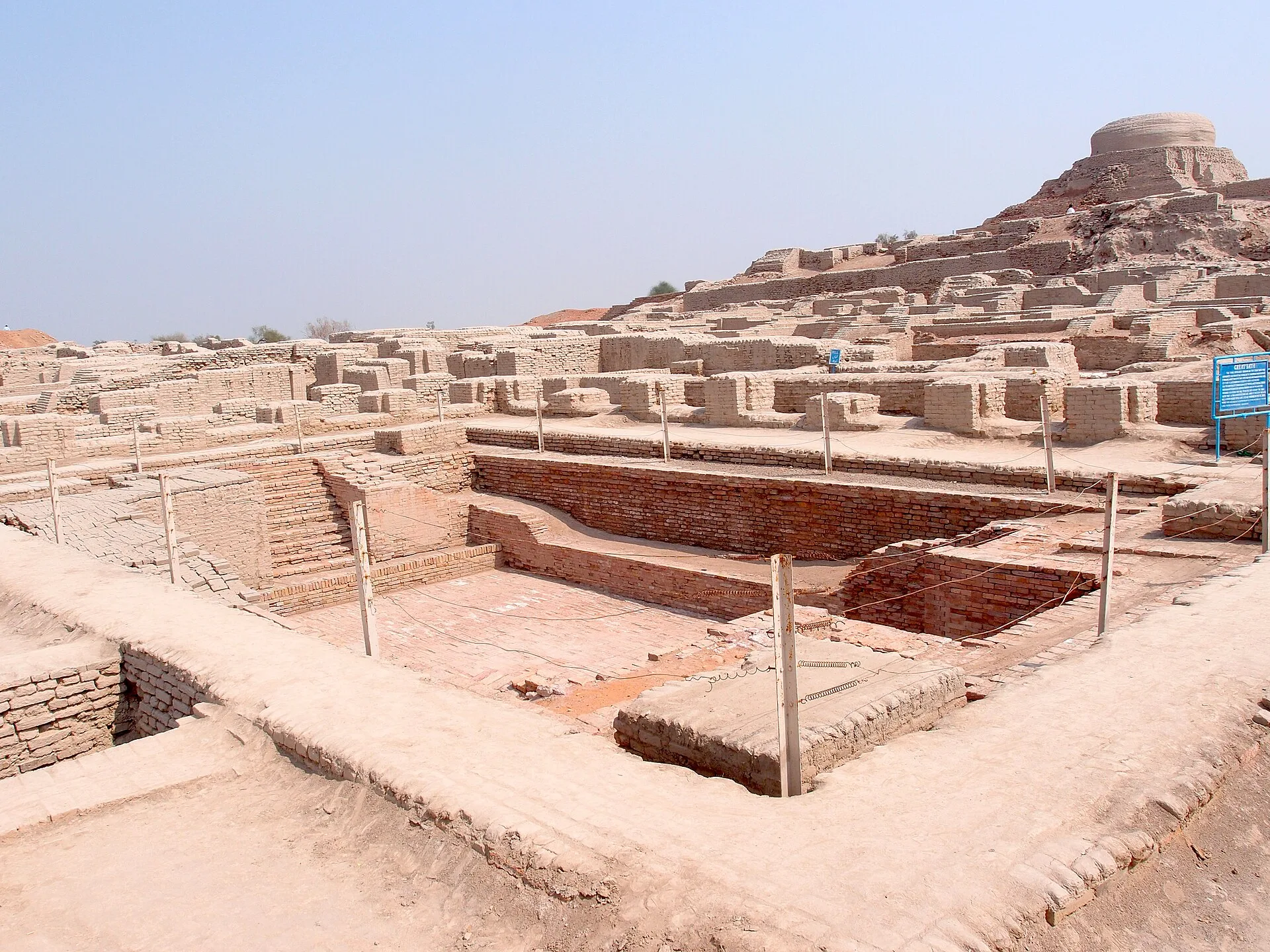
Some 4,500 years ago the most extensive of the world’s first urban civilizations stretched across the plains of the Indus and its neighboring rivers, in what is now Pakistan and northwest India. Its cities, Harappa and Mohenjo-daro the best known among them, had grid-planned streets, standardized bricks and weights, covered drains and wells in private houses. Its people traded with Mesopotamia and wrote in a script that nobody can yet read. Then, over a few centuries after about 1900 BC, the big cities emptied. Writing and seals fell out of use, and life carried on in small farming villages, many of them far to the east of the old heartland. Why it happened is one of the open questions of ancient history.
What happened
The Harappan, or Indus, civilization was only recognized in the 1920s, when British and Indian archaeologists working under Sir John Marshall excavated Harappa in Punjab and Mohenjo-daro in Sindh. At its height it covered more than a million square kilometers, from the Arabian Sea toward the Ganges, according to researchers at the Woods Hole Oceanographic Institution. Its major cities flourished from the middle of the third millennium BC into the early second, linked to hundreds of towns and villages by shared crafts and standards.
What followed was not a single dramatic fall. Cambridge archaeologist Cameron Petrie puts it simply: by the middle of the second millennium BC, all of the great urban centers had shrunk dramatically or been abandoned. People moved east and toward the Himalayan foothills, and the number of small farming settlements grew even as the cities faded.
The investigation
The first popular explanation was violent. Mohenjo-daro’s excavators had found groups of skeletons in houses and lanes, and Sir Mortimer Wheeler later linked them to the hymns of the Rigveda, in which the god Indra smashes the forts of his enemies. “Indra stands accused,” Wheeler wrote, and for a generation the image of Aryan invaders massacring the last Harappans in the streets became the textbook story.
It did not survive scrutiny. In 1964 the archaeologist George F. Dales reexamined the published evidence in the Penn Museum’s Expedition magazine, in an article titled “The Mythical Massacre at Mohenjo-daro.” Nine years of digging had produced only about 37 skeletons attributable to the Indus period. The most famous group, fourteen bodies in a single room, lay partly above the ruins of a collapsed wall and so belonged to a time after the building had decayed. Other groups came from different levels and periods, some looked like ordinary burials, and none could be tied to a final destruction of the city. Marshall himself had separated the end of the Indus cities from the arrival of Vedic peoples by two centuries.
The explanations
Attention moved to climate and rivers. In 2012 a team led by the Woods Hole geologist Liviu Giosan mapped the ancient landscape with satellite images, topographic data and sediment cores, and concluded that a gradual weakening of the summer monsoon first tamed the flood-prone rivers, making the plains ideal for farming, then kept drying until floods that watered the fields became unreliable. The same study argued that the Ghaggar-Hakra, often identified with the lost Sarasvati river of the Vedas, was a monsoon-fed stream rather than a glacier-fed Himalayan river, and that drying reduced it to seasonal flows. In 2014 a Cambridge team including Petrie, studying snail shells from an ancient lake bed at Kotla Dahar in Haryana, found an abrupt drop in monsoon rainfall around 4,100 years ago that lasted about two centuries, broadly coinciding with the start of the decline. A 2018 paper by Giosan and colleagues added a twist: winter rains strengthened over the foothills between about 4,500 and 3,000 years ago, which may explain why people moved there.
Genetics has reframed the invasion story rather than buried it. Two 2019 studies changed the picture. The first ancient genome recovered from an Indus Valley individual, from the site of Rakhigarhi in Haryana, showed a mix of ancestry related to early Iranians and South Asian hunter-gatherers with little if any trace of steppe herders. A companion study of 523 ancient genomes showed that steppe-related ancestry did spread into South Asia starting about 4,000 years ago, and mixed with the descendants of Indus populations after the cities declined. That points to migration and mixing over centuries, not a conquering army.
Where it stands
Most specialists now see the Harappan decline as a transformation driven by environmental stress, with drier summers, wandering rivers and the loss of long-distance trade all playing a part. Petrie has cautioned that much of the older debate was well-argued speculation, and the climate records are still too patchy to show how each region responded. The cities were not sacked; they were gradually left behind.