
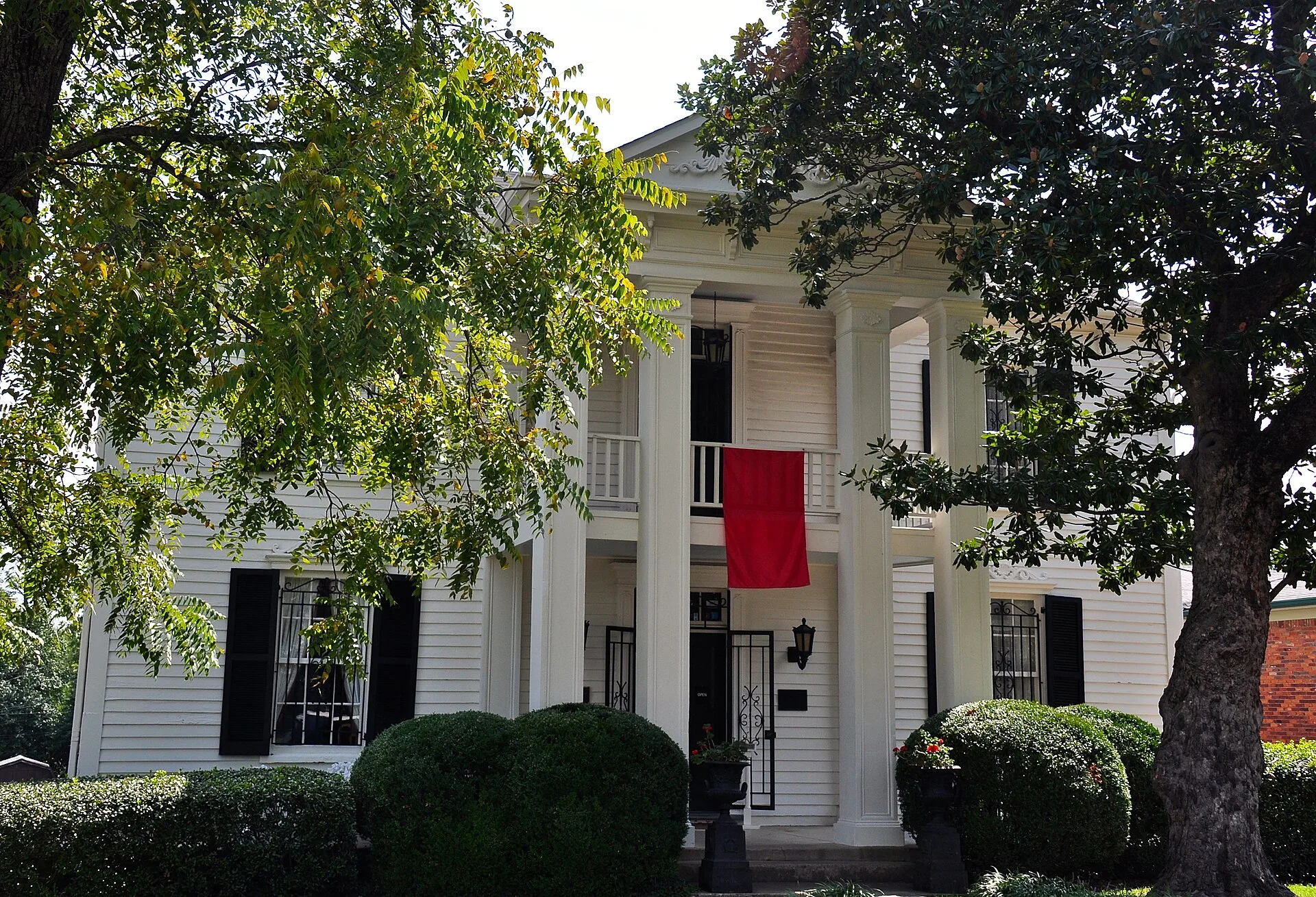
Columbia Avenue runs south out of Franklin, Tennessee, and for a few hundred yards it crosses the ground where the Battle of Franklin was fought on the afternoon and evening of November 30, 1864. On the east side of the road stands a white two-story frame house with carved acorn finials and a deep porch. It was built by a German cabinetmaker as an advertisement for his trade, survived one of the bloodiest hours of the Civil War, and now sells tickets to a ghost tour.
What happened
Johann Albert Lotz, born in 1820, learned the woodworking trade in his native Germany before emigrating. He reached Franklin in 1855, bought five acres from Fountain Branch Carter, whose brick house stood across the road, and finished his own house in 1858. It was a showroom as much as a home: carved mantels, a black walnut staircase and a newel post made from an upturned piano leg, since Lotz also built pianos. His wife Margaretha gave birth to a daughter, Matilda, in the house that year. Two younger children, twins, died before their third birthdays; family tradition blames bad water, and the cause was never settled.
On the night of November 29, 1864, a Union army of roughly 25,000 men under John Schofield fell back from Spring Hill and dug in along the southern edge of Franklin, with its main line about a hundred yards south of the Lotz house. Lotz knew a wooden house would not stop a bullet. He took his family across the road to the Carter family’s brick cellar, where more than twenty civilians waited out the fighting. John Bell Hood’s Confederate army attacked at about four in the afternoon and the fighting ran into the night. Around 10,000 men were killed, wounded or captured, and six Confederate generals were killed or mortally wounded.
The Lotz family came out in the morning to find their house standing but hit. A cannonball had come through the roof and left a charred scar on an upstairs floor, part of the south side was broken open, and seventeen dead horses lay in the yard. Surgeons used the house for the wounded of both armies, and bloodstains on the floorboards are still shown to visitors. Lotz patched the house quickly, but after the war nobody in Tennessee had money for a new piano; a letter of 1868 from the headmaster of the Columbia Athenaeum vouches for him as a tuner and repairer, and that work kept the family going. In 1870 the Lotzes sold up and moved to San Jose, California, where Albert later built carriages and died in 1905. Matilda studied painting in Paris and became a painter of some reputation; she died in 1923.
The investigation
The house passed through a long run of owners and uses, including a law office, a bakery and apartments. In 1974 the local preservation group, the Heritage Foundation of Franklin and Williamson County, stepped in and purchased the house to stop a demolition; that Halloween it staged a haunted-house fundraiser there, which is as early as the ghost theme can be traced. The National Register of Historic Places added it on December 12, 1976. In 2001 J. T. Thompson bought it and spent several years restoring it; it opened as a museum in 2008 with the Lotz family’s furniture, battlefield relics and more than a dozen of Matilda’s paintings.
No historian or parapsychologist has formally investigated the house. The hauntings have been handled by television. In 2010 the Travel Channel’s Most Terrifying Places in America ranked it second in the country on the strength of reports of unexplained activity, and on October 5, 2018, the same network broadcast a live episode of Haunted Live from the house, in which the Tennessee Wraith Chasers ran their equipment through the rooms during a staged reenactment. The museum now offers a 90-minute evening ghost tour alongside its history, cellar and battlefield tours.
The explanations
The stories told on those tours follow the house’s history closely. Visitors describe a child’s face at an upstairs window when the building is empty, and small hands tugging at trouser legs; the guides offer the Lotz twins or a drummer boy. A woman in a long dress is said to carry a candle up the staircase calling for someone named Ann. Others report sobbing, the sounds of orders and gunfire from the road, cold spots, and voices on recordings in English and in what is taken to be German. People standing where the amputations were done say they feel a sudden weight of grief.
None of this has been tested. The house sits beside a busy road, and the cannonball scar and the bloodstains give every visitor the story before anything happens. Old frame houses creak, settle and change temperature from room to room. The battle, the hospital and the dead children are all real, which is exactly why a ghost story here needs no evidence to be believed.
Where it stands
The documented history is not in doubt: the Lotz family did shelter in the Carter cellar, the house was damaged and used as a hospital, and the family left Tennessee ruined. Every November 30 the museum lights luminaries on the lawn for the casualties of the battle. The ghosts belong to the tour script and the television schedule, and there is no record of anyone looking for them with anything more than a camera.