
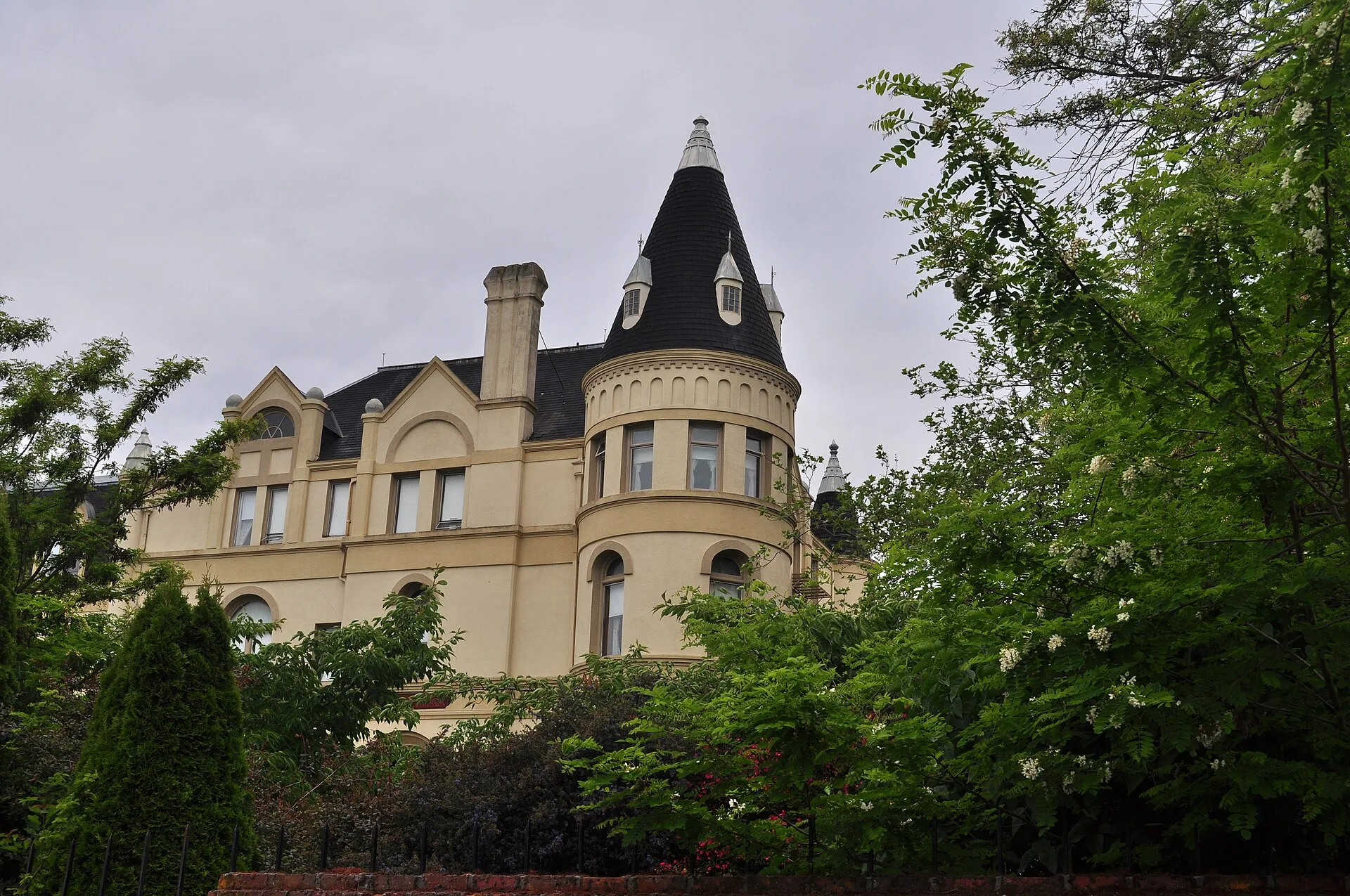
Manresa Castle is a hotel on a hill above Port Townsend, Washington, at the entrance to Puget Sound. It was built in 1892 as the largest private house in a boom town, stood empty for twenty years, spent forty as a Jesuit training college, and has been an inn since 1968. Two of its rooms, 302 and 306, come with a suicide each: a Jesuit who hanged himself in the turret and a young woman who jumped from a window after her fiancé was lost at sea. Both stories were invented by a bartender, who said so.
What happened
Charles Eisenbeis was a Prussian-born master baker who reached Port Townsend in 1858 and opened a shop making crackers and ship’s bread for the sailing trade. He did well: he bought and platted land, put up the first stone building on Water Street in 1873 and the Mount Baker Block in the center of town, and had interests in a brewery, a brickyard, a lumber mill, wharves and banks. When Port Townsend incorporated he was elected its first mayor, in 1878. In the early 1890s the town expected to become the terminus of a transcontinental railroad and the biggest port in the Northwest, and at the height of that boom, in 1892, Eisenbeis built himself a four-story brick and stone house with a slate roof, thirty rooms, tile fireplaces and carved woodwork by German craftsmen, using bricks from his own yard. The town called it Eisenbeis Castle; a hotel he built on the hill at the same time was never occupied, because the railroad went to Seattle instead and the boom collapsed.
Eisenbeis died in 1902. His widow Kate remarried and moved out, and the house stood empty for almost twenty years. In 1925 a Seattle lawyer bought it as a holiday house for teaching nuns, which did not last; the Jesuits acquired it soon after, in 1927 by most accounts, as a training college for the order and named it Manresa Hall after the town in Spain where Ignatius of Loyola spent a year in 1522. In 1928 they added a long wing with a chapel of Italian marble, installed an elevator for $5,400 and coated the whole building in stucco. Manresa Hall had its own laundry, workshops and a library in Latin and Greek, and a steam plant feeding seventy radiators. Late in 1968 the Jesuits sold it to Joshua Norris and his wife, who turned it into an inn; the Jefferson County Historical Society nominated it to the National Register of Historic Places the following year as the Eisenbeis Castle.
The investigation
The ghosts belong to the hotel period. By the 1990s guests were told that a priest had hanged himself in the turret above Room 302, and that a young woman called Kate, a guest in the Eisenbeis years, had thrown herself from the window of Room 306 on learning her fiancé had drowned. Some tellings swap the rooms. Staff and guests reported footsteps in the attic, voices in empty rooms, glasses moving in the bar, light fixtures swaying and a feeling of being tugged in bed, and the hotel kept a journal for visitors to record them; a summer 2009 entry describes photographs full of orbs on a dry, clear night. The castle has since been filmed for Ghost Adventures and Most Terrifying Places in America and hosts an occasional séance.
The investigation was done by the local press. In 2003 the hotel’s former manager told the Peninsula Daily News reporter Jennifer Jackson that both stories had been made up by a bartender, Nick Gael, to satisfy guests who kept asking him to explain the noises. A Seattle Times report on the inn’s sale in May 2004 had the general manager, Roger O’Connor, describe the tales as mostly bunk and say the bartender had a fertile imagination; O’Connor had allowed the stories on condition that they were set in the inn’s two most expensive rooms. The Peninsula Daily News repeated the confession in its Halloween features of 2008 and 2009, and in 2020 the Port Townsend Leader, sending a writer to spend a night in Room 306, noted that the hotel itself now calls the deaths unsubstantiated.
The explanations
No Jesuit is recorded as having died by his own hand at Manresa Hall, and no Kate is recorded as having died at the Eisenbeis house; the Eisenbeis family’s own Kate was the owner’s widow, who left and remarried. What remains after the stories are removed is an 1892 house with a turret, an attic and a 1928 wing, in which guests who have been told it is haunted hear what old buildings produce. The hotel’s rooms 302 and 306 remain its most requested, which was the point.
Where it stands
Eisenbeis, his bakery and his boom-time castle are documented in the National Register nomination; the Jesuit college and the 1968 sale are on record. The two suicides are a bartender’s inventions, confirmed as such by the hotel’s management in 2003 and 2004. Guests still report tugging, footsteps and swaying lights in the two rooms, and the hotel still sells them.