
What happened
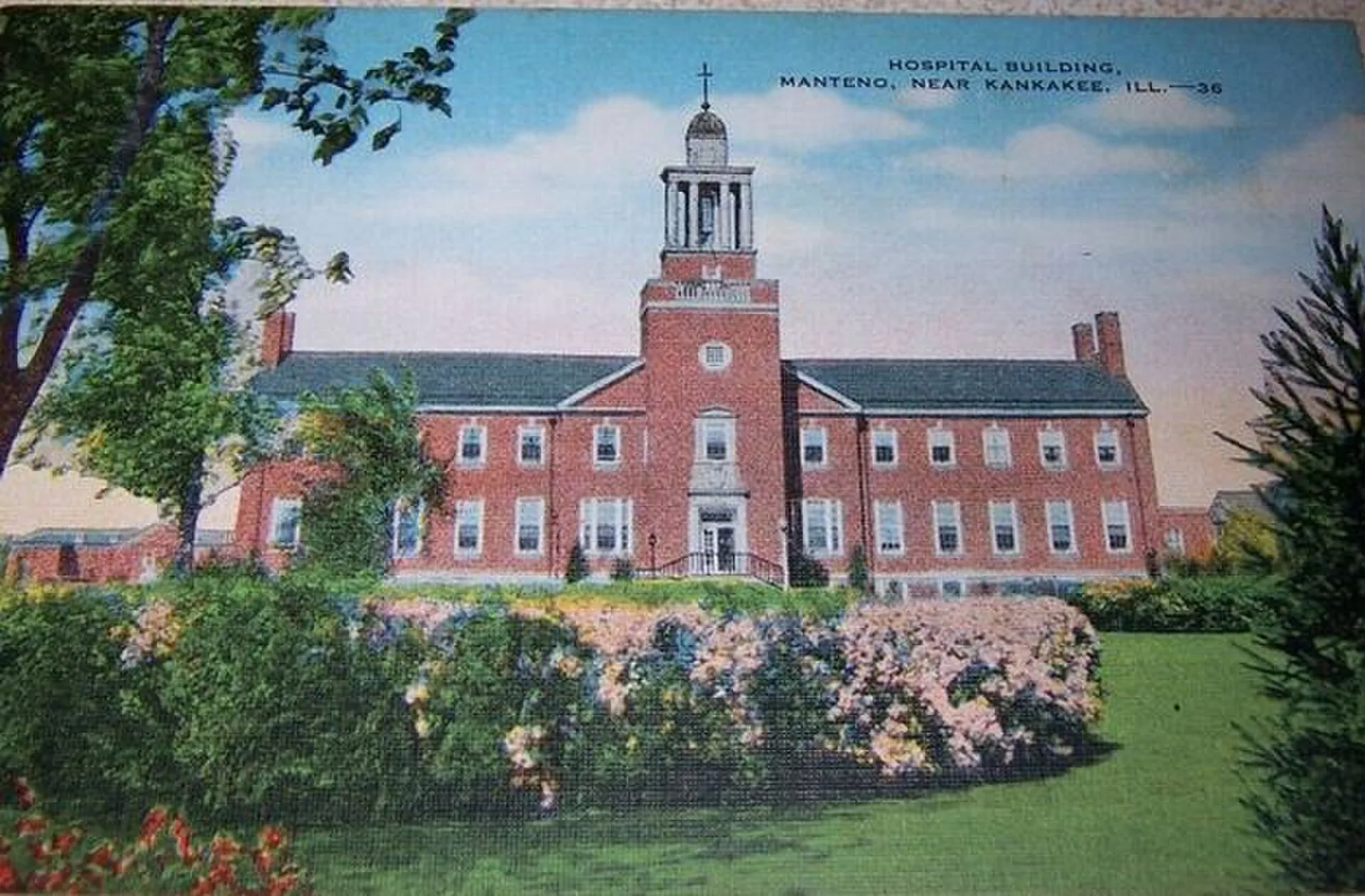
The Illinois General Assembly authorized a new state mental hospital in 1927 to relieve the crowded institutions at Kankakee, Elgin and Chicago, and the state bought farmland on the flat prairie east of the village of Manteno, about 48 miles south of Chicago. Manteno State Hospital took its first patients in December 1930 as the state’s tenth mental hospital. It was built on the cottage plan rather than as a single great building: by 1936 it covered some 1,200 acres with dozens of red-brick ward buildings, a central kitchen, its own power plant, fire department and police, and a working farm where patients labored as therapy. It started with about 800 patients, passed 1,000 in 1934 and held around 5,500 by 1939, with 760 staff.
On July 8, 1939 a male patient who had been at Manteno since 1935 became delirious and was found to have typhoid fever. Over the following weeks diarrhea spread through the wards and was at first recorded as dysentery. The first death, a woman patient, came on August 26; by the end of the month the Kankakee newspaper was reporting eight dead and nearly 200 ill. The hospital began chlorinating its water and the state welfare director, Archie L. Bowen, sent a truckload of typhoid vaccine, too late to stop the outbreak. More than 45 patients and kitchen workers ran away. Time magazine covered the episode under the headline Manteno Madness, with a toll then put at 384 sick and 47 dead. The final count, in a report the Illinois Department of Public Health published in 1945, was 453 cases and 60 deaths, most of them patients but including employees and construction workers.
The investigation
The state’s engineers traced the cause to the ground the hospital stood on. Its four wells drew water from a bed of Niagaran limestone that is cracked, creviced and riddled with solution channels, under a layer of glacial drift only about 18 feet thick at Well No. 4, the one well supplying the whole institution in the month before the outbreak. The hospital’s sewers had been laid in that same cracked rock, and when they blocked and backed up, sewage reached the water the wells were pumping. The Department of Public Health had warned the welfare department about exactly this in formal reports of March 1931, November 1935 and September 1937, the last of which said the hospital was not exercising reasonable care and would be responsible for negligence if a water-borne epidemic occurred. The recommended chlorinator was never installed until the outbreak was under way.
The political reckoning was fierce. In November 1939 a grand jury requested by the Kankakee County state’s attorney, Samuel Shapiro, who later became governor of Illinois, indicted four state officials for malfeasance. Bowen was tried first, found guilty on June 27, 1940, fined $1,000 and removed from office; the charges against the others were dropped. The Illinois Supreme Court later overturned Bowen’s conviction, with the Kankakee paper noting that the prosecution had not proved the epidemic was caused by polluted drinking water.
The hospital went on growing. Its population peaked at more than 8,000 in the mid-1950s, when a short film about its therapy programs, Working and Playing to Health, won an award, and it was chronically overcrowded and understaffed. Numbers fell to about 6,300 in the 1960s and roughly 1,000 by the late 1970s as patients were moved into community care. A 1981 proposal to turn the site into a prison was dropped after local opposition, and on December 31, 1985 Manteno Mental Health Center, as it had been renamed, closed after 55 years.
The explanations
The ghost stories belong to the years after closure. On January 1, 1986 the state deeded more than 200 acres to a local redevelopment council, which marketed the campus as the Illinois Diversatech industrial park; converted ward buildings became the Illinois Veterans Home, dedicated in October 1986; the administration building became a bank; and subdivisions, a golf course and a residential treatment school for teenagers took other parcels. In between, dozens of cottages stood empty for years, and empty asylums draw visitors. Urban explorers and hobby ghost-hunting groups reported apparitions of patients and nurses in the corridors, voices on dead intercom systems and oddities in photographs. The writer Chad Lewis told the Kankakee Daily Journal that people described seeing doctors, nurses and patients still in gowns; Travis Dahlhauser of a Rockford ghost-hunting group called Morgan Cottage, the last derelict building, the most haunted place his group had visited.
None of this was ever examined by anyone outside the hobby. The claims rest on what explorers felt and photographed in dark, decaying buildings they had entered at night expecting to be frightened, and on the real and well-publicized fact that people died there in numbers. A state hospital cemetery east of the site holds patients who had no one to claim them, which has also fed the stories.
Where it stands
Morgan Cottage was demolished in May 2015, leaving the old sewage plant as about the only untouched building. The veterans’ home, the businesses and the houses carry on over the hospital’s street grid. The typhoid epidemic is a matter of record and remains one of the worst institutional outbreaks in American history; the haunting is a legend of the abandoned years, told about buildings that for the most part no longer exist.