
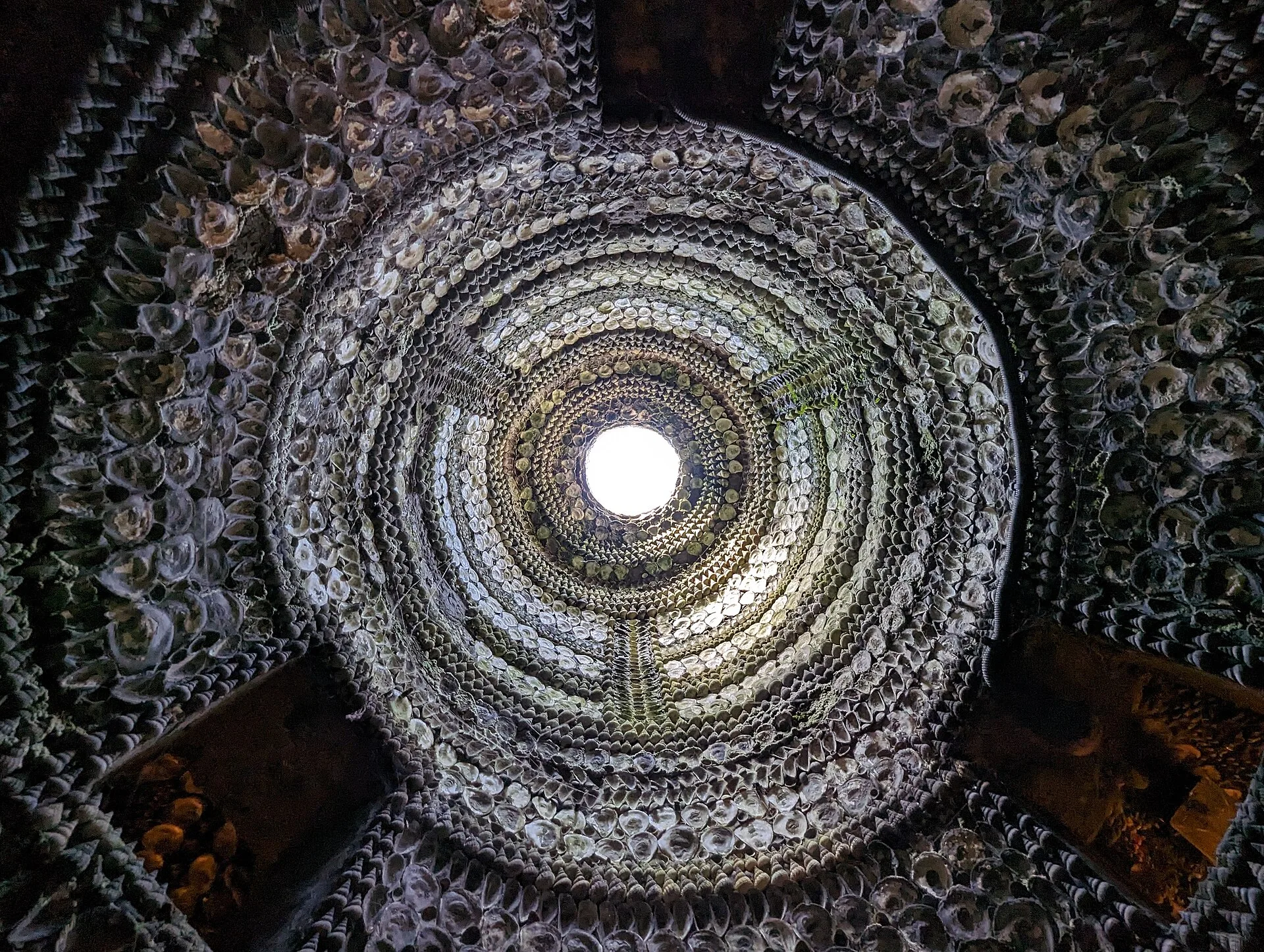
Under a quiet residential street on Grotto Hill in Margate, a set of chalk steps leads down into some 70 feet of curving tunnels whose walls and ceilings are completely covered in shells. By the count of its present owners there are about 4.6 million of them, set into roughly 2,000 square feet of mosaic: flowers, stars, spirals, trees, and shapes that visitors have read as gods, goddesses and an altar. Nobody knows who made it, when, or for what.
What happened
The usual date for the discovery is 1835, though the first written mention comes three years later. On May 22, 1838 the Kentish Gazette announced that a newly opened attraction would soon admit the public, explaining that a gentleman who had bought Belle Vue Cottage had ordered some digging, his workmen had struck a large stone, and the space below had been found. By 1885 a guide’s version, retold by the novelist Marie Corelli, had a workman drop his spade through a hole and a boy lowered down after it.
The fullest account came decades later from Frances Newlove, the daughter of James Newlove, who with his wife ran a small school in the cottage. Interviewed in the 1890s, she said her teenage brother Joshua had found a way into the passages before the adults knew of them, prying out blocks of chalk and crawling through, and that she and other girls had crept in after him with candles. She also said two neighbors urged her father to buy the property outright instead of leasing it, and that the grotto was unfinished when found, so her father hired a bricklayer to complete it. An unsigned lease from February 1835 survives. The Newloves opened the grotto to paying visitors in 1838, and it has been a tourist site ever since.
The investigation
The layout is simple: a winding entrance passage, a circular gallery called the Rotunda, a domed shaft open to the sky, a serpentine passage and a rectangular end room known as the Altar Room. A German bomb hit the house above in October 1940 and destroyed one wall of that room. Most of the shells are common British species such as mussels, cockles, whelks, limpets, oysters and scallops, which could have been gathered from nearby bays. The bright background infill is flat winkle, rare locally and probably brought from beaches west of Southampton. Only two foreign shells appear: Caribbean queen conches and giant clams from the Indo-Pacific.
Dating has proved hard. No map or document before 1835 mentions the site, and nobody then living remembered it being built, which is difficult to square with the labor needed to dig the tunnels and set millions of shells. Gas lamps lit the passages for nearly a century and coated the shells in soot. Mortar samples taken in 2009 turned out to be of several different types, consistent with repairs over many years. The grotto’s operators say radiocarbon dating is possible but would need many samples, to avoid dating a later repair, and is too costly for now. Ground radar surveys in 1988 found no hidden passages beyond those already known.
The explanations
Theories have ranged across three thousand years: a Phoenician or Cretan temple, a Roman shrine to Mithras, a Knights Templar meeting place, a haunt of the Hellfire Club, a Regency folly, or a piece of nineteenth-century folk art. The local historian Mick Twyman argued for a twelfth-century Templar origin and noted that sunlight through the dome could have served as a calendar. Kent’s historic environment record, drawing on the listing description, leans toward the early nineteenth century because a modern brick appears in one of the arches.
The most careful physical study came from R. F. LeGear for the Kent Archaeological Society in 2006. Ignoring the decoration and looking only at the excavation, he found the dome shaft and its three short headings closely matched a denehole, a type of small medieval chalk mine dug to supply chalk for fields. He concluded that an old denehole was probably enlarged and reshaped from the seventeenth century onward, most likely in the eighteenth, and declined to guess at its purpose.
Where it stands
The Shell Grotto has been Grade I listed since 1973 and its custodians have spent years stabilizing the chalk and remaking lost sections of mosaic. Its date is unsettled, its builders unknown and its meaning open to whatever a visitor brings. LeGear’s reworked chalk mine is the best-grounded account of the tunnels, but who covered them in shells, and why, is still undocumented.