
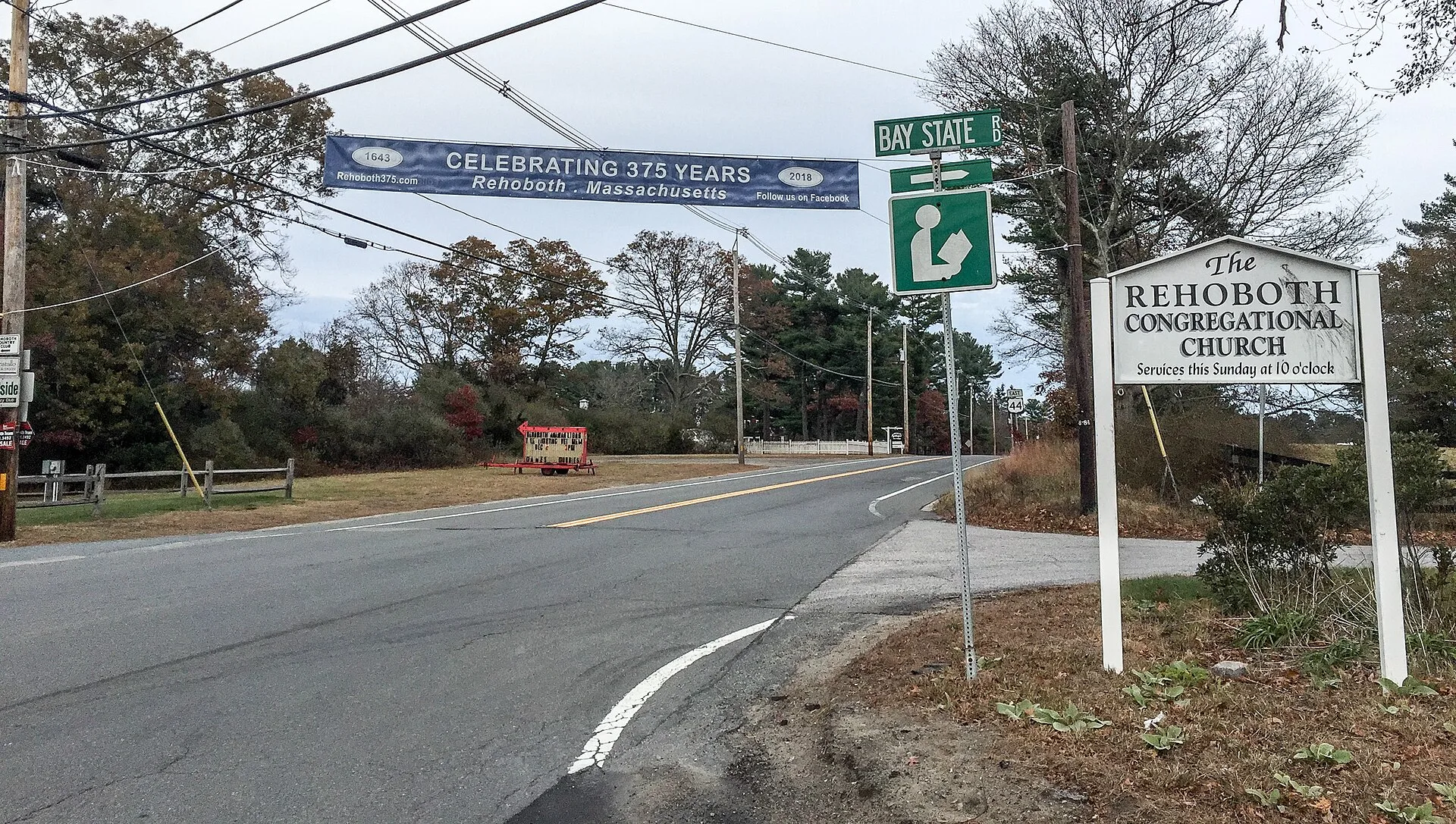
U.S. Route 44 crosses from Rhode Island into Massachusetts at Seekonk and runs east through Rehoboth, a rural town of stone walls, swamps and second-growth woods, on its way to Taunton. On a stretch of a few miles near the Seekonk–Rehoboth line, drivers since the late 1960s have reported a tall man with bushy red hair and a red plaid shirt who appears beside the road, in the road, at the passenger window or in the back seat, and then is not there. He is the best-known of New England’s phantom hitchhikers, and almost everything known about him comes from one book.
What happened
The accounts were gathered by Charles Turek Robinson, a Rehoboth writer, and published in 1994 in The New England Ghost Files, where the red-headed man is Ghost File number seven. According to Robinson, he had been running a series of unrelated ghost stories in a local newspaper when at least six residents of the area contacted him independently to describe meeting a red-haired man on Route 44. Four of their stories make up the file.
The first is dated to the winter of 1969. Joseph Woolfe was driving alone through Seekonk at about 11:30 at night, at around fifty miles an hour, when a grinning man’s face appeared pressed against the passenger window of the moving car. Woolfe could see red hair and a red plaid shirt. He swerved to a stop and the man was gone. In the summer of 1973 Fred Durpis of Seekonk picked up a hitchhiker at about ten in the evening, a man of about forty in jeans and a red plaid shirt, who did not answer questions, only smiled; when Durpis, unnerved, told him to get out, the passenger faded from the seat. On February 25, 1981, Barbara Sutton of Taunton, driving home from Seekonk, saw a man standing in the road, could not stop, and felt no impact as the car passed through him. She heard laughter from the woods, and half a mile on she drove through the same figure again, with the laughter closer. On October 14, 1984, Harry and Sheena Hanson of Swansea broke down just after ten at night near the town line. Harry walked ahead for help and met a disheveled red-haired man in a red shirt whose eyes were clouded white; the man vanished and laughter followed Harry back to the car, where Sheena said a voice had cut into the radio, used her name and mocked her.
The investigation
Robinson’s collection is the investigation. No police report, accident record or newspaper item from 1969 to 1984 mentions a red-haired man on Route 44; the earliest print appearance is the 1994 book, twenty-five years after the first encounter it describes. The witnesses are identified by name and town but have not been traced or interviewed by anyone else. Robinson noted that the stretch had a long record of fatal crashes and left open whether one of them explained the figure, without proposing a candidate.
The story has since gone back into oral tradition. A folklore archive at the University of Southern California holds an interview with a 71-year-old Rehoboth resident who tells the legend as something she learned from her grandmother: a local author investigated it twenty or thirty years ago, the first case was in the late sixties, there were five or six sightings over about fifteen years, the man always wore a red plaid shirt, he laughed, and once, picked up as a hitchhiker, he left the car through the closed door. She did not know anyone who had seen him. Online retellings have added details Robinson did not record: a hitchhiker who vanishes as he reaches for the door handle and stalls the engine, dark lifeless eyes, a warning never to drive Route 44 alone. In October 2024 the legend inspired a short film, reported by CBS Boston as the story of Massachusetts’ most haunted road.
The explanations
The red-headed man is a textbook vanishing hitchhiker, a motif folklorists have traced across the United States since the 1930s and well beyond: a figure accepted into a moving vehicle who disappears, often leaving a sound or a clue behind. The Route 44 version differs in that he is menacing rather than pitiable and never asks to be taken home, but the structure is the same, and the laughter, the vanishing and the passing-through are stock elements. Four private encounters over fifteen years, reported to a single author a decade later and uncheckable since, are a small base for a haunting. A dark two-lane road through woods, a tired driver, a man walking the shoulder in a red shirt and a bad fright supply the rest.
Where it stands
There is no record of who the red-headed man might have been or of any event on Route 44 that explains him. Robinson’s four accounts have been repeated for thirty years without a fifth being added from a named witness, and the story now lives in the way such stories do, told by grandmothers and short films. As a legend it is well established; as a haunting it rests entirely on one book.