
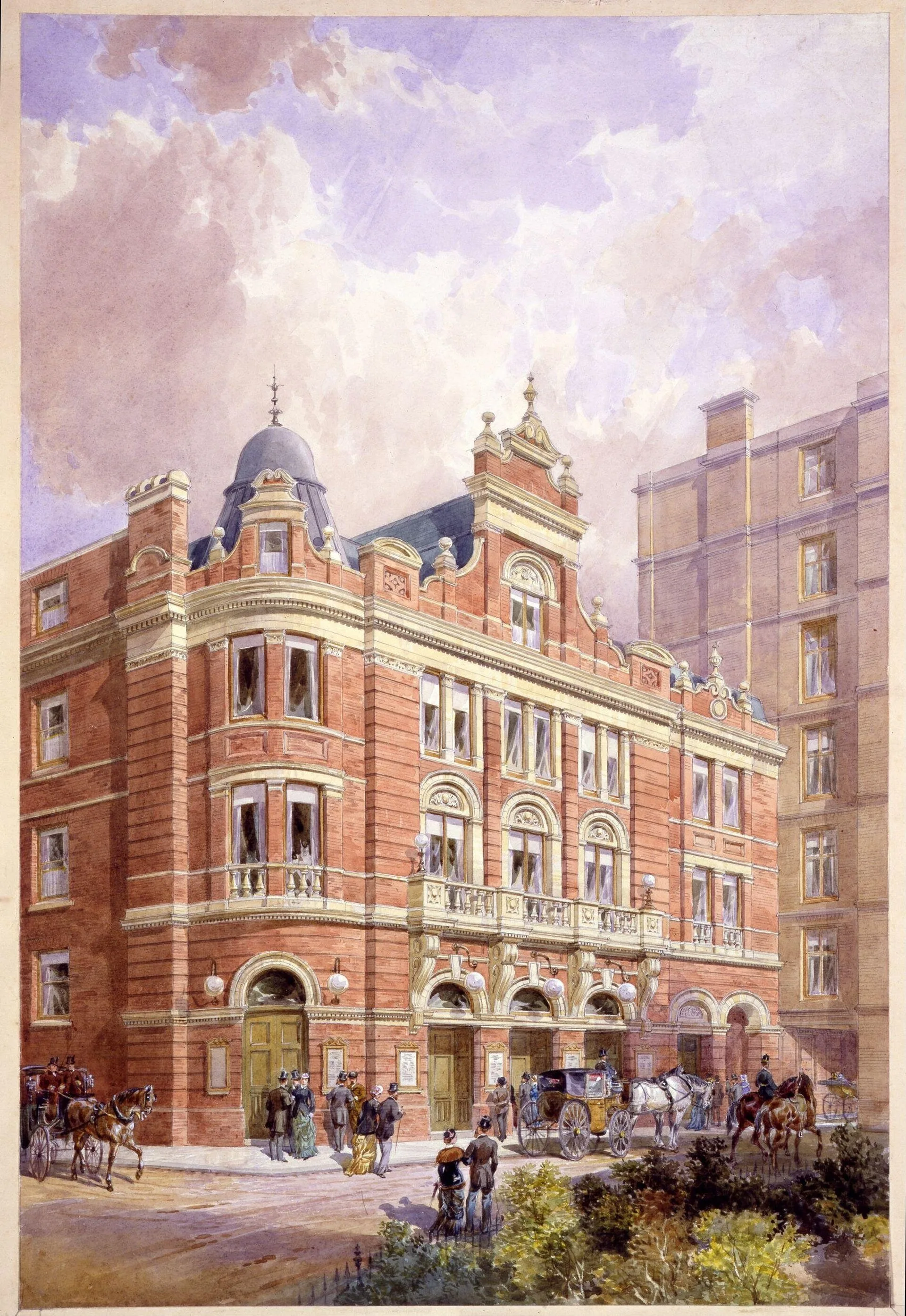
The ground between the Strand and the Thames takes its name from Peter of Savoy, who built a palace there in the 1240s. The palace was burned in the Peasants’ Revolt of 1381 and a Tudor hospital later stood on the site. In 1881 the impresario Richard D’Oyly Carte, who managed the comic operas of W. S. Gilbert and Arthur Sullivan, built a theater there to house them. Its first innovation was not the music.
What happened
The Savoy Theatre, designed by C. J. Phipps, was due to open on October 6, 1881 but was held up by its electrical installation and opened on October 10 with Patience, transferred from the Opera Comique. It was the first public building in the world lit throughout by electricity, a claim still recorded on a green plaque in Carting Lane beside it. The auditorium was lit from opening night by Joseph Swan’s incandescent lamps, fed by a generator on open ground nearby; gas fittings were kept in reserve in case the new system failed. The stage, where the heat and flicker of gas had always been part of the experience, followed on December 28, 1881, when an afternoon performance of Patience ran entirely on electricity.
The Times reported that performance the next morning. The light was steady throughout and the colors of the costumes looked as true as in daylight. Because the lamps could not simply be turned down, the engineers had wired a resistance of open iron-wire coils into the circuit to dim them, a wasteful stopgap the paper expected to be improved. Before the curtain, Carte stepped forward with a lit lamp wrapped in highly inflammable muslin and broke the glass: the vacuum gone, the filament died without so much as singeing the cloth. It was a demonstration aimed at an audience that had watched theaters burn. Iolanthe, opening in November 1882, became the first new production staged under electric light.
The profits of The Mikado paid for what came next. Carte, impressed by the hotels he had seen in America, built the Savoy Hotel beside the theater so that his audiences could dine and stay. Designed by Thomas Edward Collcutt, it opened on August 6, 1889 with electric light throughout, electric lifts the hotel called ascending rooms, hot and cold running water and private bathrooms in most rooms. Carte hired César Ritz as manager and Auguste Escoffier as chef; both were dismissed in 1897 amid a scandal over missing wine and spirits, having set the standard for luxury hotels everywhere. Savoy Court, the short approach from the Strand, is the only road in Britain where traffic drives on the right, so that carriages could set down at both theater and hotel.
The investigation
The hotel’s ghosts have no such paper trail, and the best account of them comes from the person paid to keep the paper. In 2012 the Savoy’s in-house archivist, Susan Scott, told King’s College London’s Strandlines project that the hotel’s history books and archive contain nothing about hauntings. The rumor, she said, began before the 2007 restoration, when an engineer working in a guest room thought he heard a woman sighing; such stories tend to come from staff walking the corridors or the cellars alone at night. One room was kept unlet not because of a ghost but because it sat beside a lift and was noisy.
Scott then created a ghost of her own by accident. She wrote a ghost story about a girl who died in the hotel, and before long colleagues were asking her about the girl, quoting details of the story back to her as though they were history. She was fairly sure, she said, that they did not believe it. The girl has since appeared on lists of London’s haunted hotels with a floor and a phantom lift of her own, details the archive does not contain.
The explanations
A hotel open since 1889 has had deaths in it, and the Savoy’s one well-known piece of superstition is managed rather than feared. After a dinner for thirteen in 1898 at which the guest Woolf Joel was warned of bad luck and was shot dead in Johannesburg weeks later, the hotel took to seating a member of staff at any table of thirteen. In 1926 the designer Basil Ionides carved Kaspar, a black cat in wood, to take the fourteenth chair instead, and he still does. Sighs in an old building with early plumbing and early lifts, late-night staff, a famous name and a story that was never meant as fact are enough to explain the rest. The theater, rebuilt after a fire on February 12, 1990 and reopened on July 19, 1993, collects visitors’ tales of shadowy figures too, as most old theaters do.
Where it stands
The theater is a Grade II* listed building; the hotel reopened on October 10, 2010 after a three-year restoration that cost about £220 million, and is Grade II listed. The electric light of 1881 is history. The ghost of the Savoy is a legend, and unusually for a legend, its author has been interviewed.