
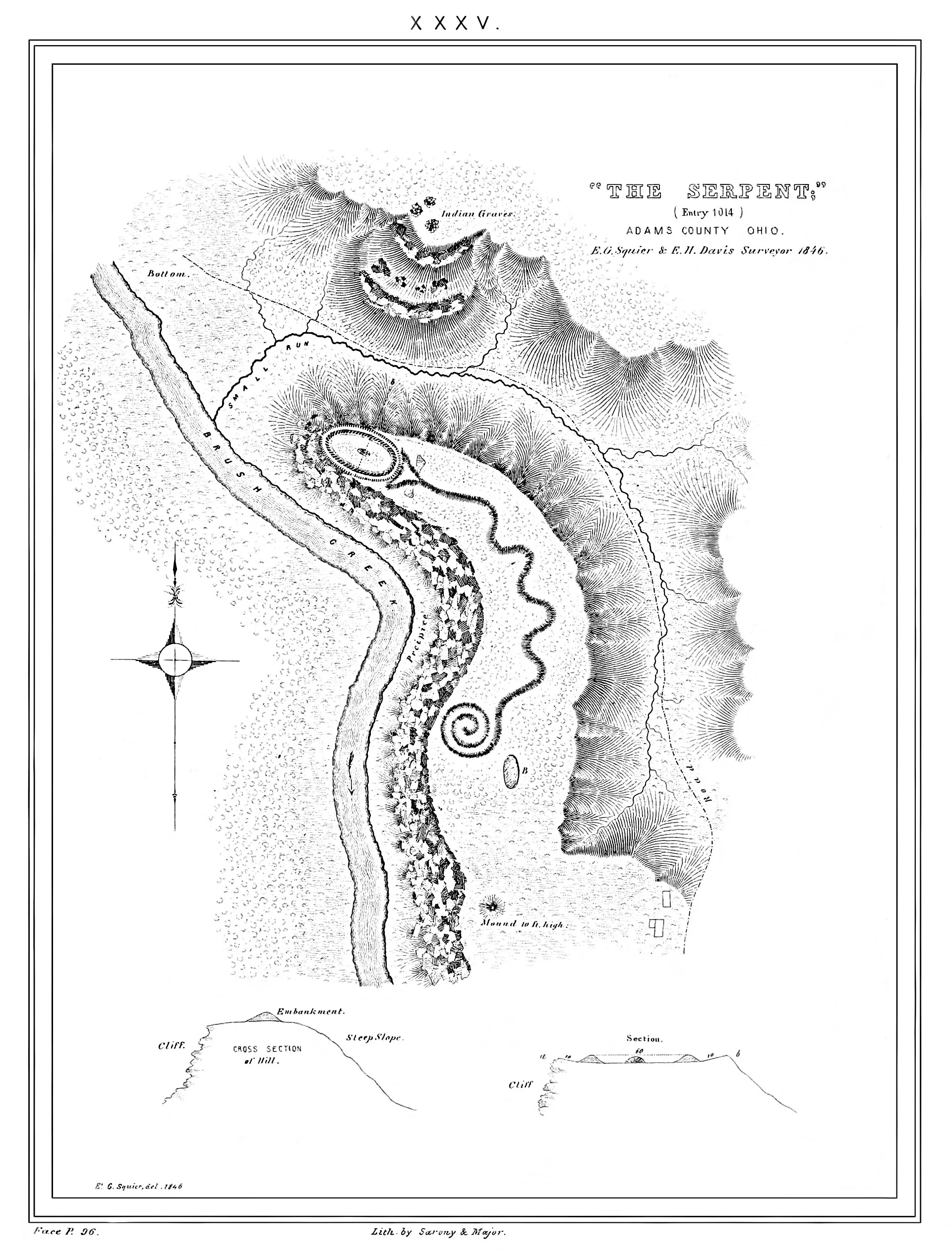
On a narrow plateau above Ohio Brush Creek in Adams County, in the hill country of southern Ohio, a low earthen bank about three feet high winds through the grass for some 1,400 feet. Seen from above, it resolves into a snake: a tightly coiled tail at one end, a run of loose curves along the body, and at the other end an open jaw that seems to grip, or swallow, an oval. Serpent Mound is one of the largest effigy earthworks anywhere, a National Historic Landmark, and a candidate on the United States’ tentative list for World Heritage status. Nobody buried anyone inside it and nobody left artifacts in it, which is why two of the simplest questions about it, who built it and when, are still being argued.
What happened
The mound entered the written record in the 1840s, when Ephraim Squier and Edwin Davis surveyed it for their landmark study of the earthworks of the Mississippi Valley, published by the Smithsonian in 1848. Their plan of the serpent made it famous. In the late 1880s Frederic Ward Putnam of Harvard’s Peabody Museum excavated at the site, and studied the effigy and the burial mounds nearby; the serpent was restored in the early twentieth century and the grounds became a public park.
Because there were Adena burial mounds close by, early archaeologists assumed the serpent was also the work of the Adena people of the Early Woodland period. That assumption rested on proximity, not on any direct date.
The investigation
The first radiocarbon evidence came in 1991, when a team that included Bradley Lepper reopened one of Putnam’s old trenches through the body of the serpent. Charcoal from undisturbed parts of the mound gave two matching dates of about 920 radiocarbon years, placing construction around AD 1070 and pointing to the Fort Ancient culture, farming villagers of the Ohio Valley with ties to the Mississippian world. For two decades that was the accepted answer.
In 2011 a team organized by the independent researcher William Romain drilled 18 soil cores along the effigy and dated organic sediment from at or near its base. Nine dates came back between roughly 2,170 and 2,530 radiocarbon years old, and in 2014 the team concluded that the mound was first raised about 2,300 years ago by the Adena. Supporters of that view suggest Fort Ancient people later lived at the site and repaired the effigy, which would reconcile the two sets of dates. Lepper has rejected that reading. He notes that Putnam saw the builders strip off the topsoil before heaping up the effigy, so old organic material near the base could predate the mound by centuries, and he argues that consistent dates can be consistently wrong if the same soil processes skew them all.
The explanations
With radiocarbon at a stalemate, Lepper and his colleagues turned to imagery. In a 2018 paper they compared the mound with painted panels in Picture Cave, Missouri, dated to around AD 950 to 1025, where a serpent, a female figure and an oval symbol appear together. They argued that the effigy shows the same three elements and so belongs to the early Fort Ancient period, when serpent symbolism was central to Mississippian religion. Lepper also told a reporter that there is little evidence the Adena revered serpents at all. Romain, for his part, has said that an Adena date would show those earlier builders to be more sophisticated than usually assumed. Whoever built it, the head points toward the sunset on the summer solstice, and some observers think the curves of the body line up with solstice and equinox sunrises as well.
The setting adds a further layer. The plateau sits on the Serpent Mound structure, a circular zone of crumpled and uplifted bedrock about five miles in radius. Its origin was disputed for decades, but in 1998 a study of a 903-meter drill core from its center reported quartz grains with microscopic planar deformation features and fragments of impact melt, the signature of a meteorite strike. Later mapping describes a complex crater with a central peak and ring of faulted rock. The impact happened hundreds of millions of years before any people lived in North America, and nothing shows the builders knew of it, though the coincidence has fed plenty of speculation.
Where it stands
Lepper wrote in 2020 that radiocarbon dates from imperfect contexts seemed unable to resolve the dispute and that other approaches would be needed. A large excavation might settle it, but the effigy matters deeply to many people today, and cutting into it again is not a step anyone takes lightly. Until then, Serpent Mound has two plausible builders separated by more than a thousand years, a crater beneath it, and a meaning that can only be inferred.