
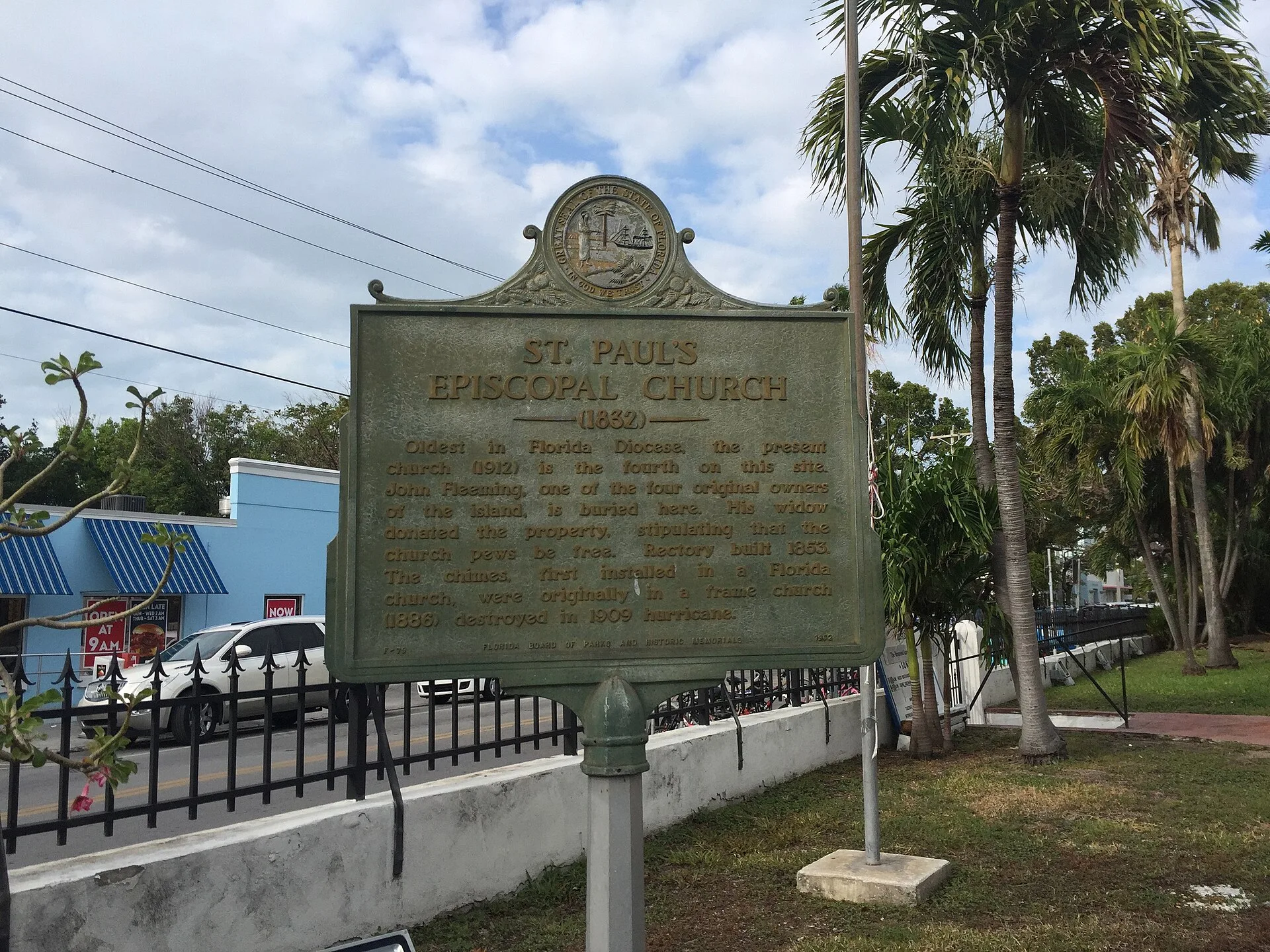
St. Paul’s Episcopal Church stands on Duval Street in Key West, Florida, between Eaton and Fleming Streets, a white concrete church with a small walled yard. It is the oldest Episcopal parish in the diocese of Florida and the fourth church to stand on the lot, the first three having been destroyed by two hurricanes and a fire. The ghost stories told about it on the island’s walking tours are a recent addition to a long and well-documented history.
What happened
Key West was barely a decade old as an American town when its council resolved in 1831 to found an Episcopal church and asked the Bishop of New York for a priest. The Rev. Sanson K. Brunot arrived on December 23, 1832, and held the first service on Christmas Day in the county courthouse on Jackson Square, where the congregation signed an act of association naming the parish St. Paul’s. Brunot lodged with the vestryman William Whitehead because there was no church or rectory; ill with the climate, he left for Pittsburgh in May 1833 and died soon after. The lot on Duval Street came from the widow of John William Charles Fleming, one of the four original proprietors of the island, who had died in 1832. She gave it on condition that her husband’s remains stay where they were and, by the parish’s later account, that the pews be free rather than sold to families. Fleming is still buried on the grounds; the exact spot was lost long ago.
The first church, built of coral rock between 1838 and 1839 at a cost of $6,500, was destroyed by the hurricane of October 11, 1846, which also wrecked much of the town. A wooden church followed, with services from June 1848 and consecration in January 1851, and a rectory was added at Duval and Eaton in 1857. The Great Fire of March 1886 burned the church and spared the rectory. The third church, again of wood and facing Eaton Street, was finished in 1887, and in 1891 the parish hung a chime of bells cast by the McShane foundry of Baltimore, rung for the first time on Palm Sunday, March 22, 1891; it was the first chime in Florida. A parish hall went up in 1904. On October 11, 1909, sixty-three years to the day after the 1846 storm, a hurricane flattened the third church and left the hall and rectory standing.
The vestry decided in 1911 to build something a storm could not take, and the present church was built of concrete, with the rectory moved beside it in 1914. The first service was held on June 8, 1919, and the 1891 bells were rehung. The stained glass, ordered from 1920 onward and hinged to swing open for the breeze, was installed over decades; the organ arrived in 1931. A statue near the Lady Chapel remembers two members of the Ingraham family, a mother and daughter both named Mary, killed in the Labor Day hurricane of 1935 in the Upper Keys. The concrete, mixed with seawater and beach sand, rusted its steel from within, and a restoration in 1991–93 cost close to a million dollars. The bells are silent today because the tower is unsound.
The investigation
Nobody has investigated the hauntings at St. Paul’s, and the parish’s own detailed history, which runs from the 1831 council resolution to the present rector, says nothing about them. The stories appear on the websites and scripts of the commercial ghost walks that pass the church every evening, several of which run along Duval Street. They describe footsteps in empty rooms, hymns sung when no service is on, shadowy figures in the nave, pews that creak as though someone has sat down, and in the churchyard a figure in old-fashioned clothes taken to be a sea captain or John Fleming himself. One version has the souls of hurricane victims heard crying, praying and running during storm season; another says the church was built on a burial ground, which is true only in the sense that the parish buried its dead in its own yard from the 1830s. Visitors on the tours report cold spots, orbs in photographs and meters that spike near the older graves.
The explanations
The claims have the shape of ghost-tour copy rather than of reports. No witness is named, no date is given for any sighting, and the parish does not endorse them. Fleming’s grave cannot be visited, because no one knows where in the yard it is. Duval Street is one of the noisiest streets in Florida at night, with bars on both sides, so unexplained footsteps and singing near an open-windowed church are not hard to come by. The concrete church, the hurricanes and the fire are real, and they give the tours an atmosphere that does the work the evidence cannot.
Where it stands
St. Paul’s is a working parish with a restoration to pay for and a history it has recorded carefully. The ghosts of its churchyard belong to the tour companies, which have every reason to keep them. As a haunting the case has no witnesses, no investigation and no record; as a monument to what the island’s weather can do to a building, the four churches on this lot are hard to beat.