
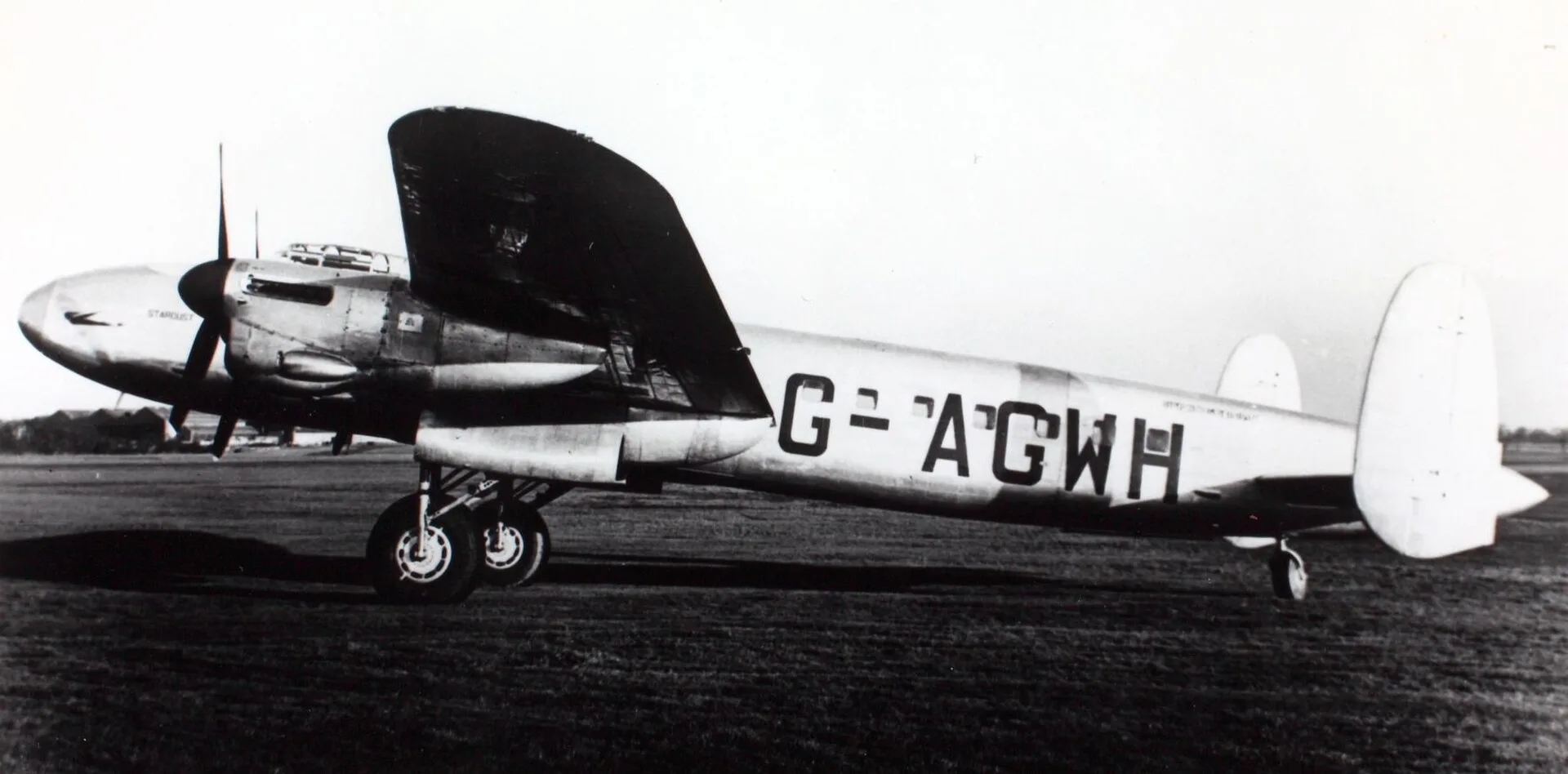
For half a century the word STENDEC stood for one of aviation’s great disappearances. It was the last thing heard from Star Dust, a British airliner that set out across the Andes in 1947 and was never seen again, and it seemed to mean nothing at all. The aircraft has since been found, and with it the explanation for why it vanished. The word is still unexplained.
What happened
Star Dust was an Avro Lancastrian, a converted Lancaster bomber registered G-AGWH and operated by British South American Airways on the last leg of its London to Santiago service. On August 2, 1947 it left Buenos Aires for the Chilean capital with five crew and six passengers, among them a King’s Messenger carrying diplomatic papers. The captain, Reginald Cook, was a much-decorated wartime RAF pilot, and the radio operator, Dennis Harmer, was experienced. Weather over the mountains was poor, and the crew radioed that they would climb to 24,000 feet to cross above it.
Position reports through the afternoon were routine. At 17:41 GMT the Santiago radio station received a Morse signal giving an arrival time of 17:45, ending with the letters S-T-E-N-D-E-C. The Chilean Air Force operator said it came through loudly but very fast. He asked for a repeat and got the same word twice more. Then the aircraft fell silent and never arrived.
The search and the rumors
Argentine and Chilean troops and airline crews searched the passes for days and found nothing. The British accident report, dated December 1947, could say only that the wreck was thought to lie in the mountains within about forty miles east of Santiago, and that no one had solved STENDEC. The vacuum filled with theories: sabotage aimed at the diplomatic bag, at a time of friction between Britain and Argentina; a hijacking; even abduction by a UFO. Suspicion deepened when two more of the airline’s aircraft disappeared over the following months. A Spanish UFO magazine took the name Stendek.
The glacier gives it back
Then, in 1998, a pair of Argentine climbers on Mount Tupungato, a 21,500-foot volcano on the border about fifty miles east of Santiago, came across a Rolls-Royce Merlin engine lying on a glacier at around 15,000 feet, with human remains nearby. In early 2000 an Argentine Army expedition reached the site with the air accident investigator Carlos Bauza and logged every fragment it could find. The debris was confined to roughly a square mile and all of it was crushed, the signature of an aircraft that flew into the ground at speed rather than one that broke up in the air. A propeller had its tips bent back, showing the engine had been turning under power, and the main wheels had been retracted, so the crew was not attempting a forced landing.
The glaciologist Juan Carlos Leiva supplied the rest. The wreck was not lying where it had hit. Star Dust had struck the snowfield high under the mountain’s east face; the impact probably set off an avalanche that buried it within moments, which is why the 1947 searchers saw nothing. Over the following decades the ice carried the wreckage slowly downhill inside the glacier until it reached the lower, warmer section, where melting brought pieces to the surface. Most of the aircraft is presumably still in the ice. In 2002 the remains of eight people were brought down from the glacier, and five were identified through DNA.
Why it crashed
Investigators then turned to the weather. In 1947 the jet stream was barely understood, and few aircraft flew high enough over South America to meet it. Reconstructing the conditions of that day, the Argentine team concluded that once Star Dust climbed into cloud it ran into a powerful headwind that cut its ground speed far below what the crew assumed. Navigating by dead reckoning with no view of the ground, they calculated that they had crossed the range, reported their arrival time and began to descend toward Santiago. They were still on the Argentine side, heading into Tupungato. Nothing in the wreckage pointed to a bomb, a fire or a mechanical failure.
The word
STENDEC remains open. It is an anagram of “descent,” but scrambling it in Morse code is much harder than on paper, and the operator repeated it identically three times; the crew also had oxygen, which weighs against confusion from altitude. Other readings treat it as a Morse garble. Respacing the dots and dashes can yield ETA LATE, and the final letters resemble the end-of-message signal AR. None has been confirmed. The disappearance has a well-supported ordinary explanation; the last word does not, and probably never will.