
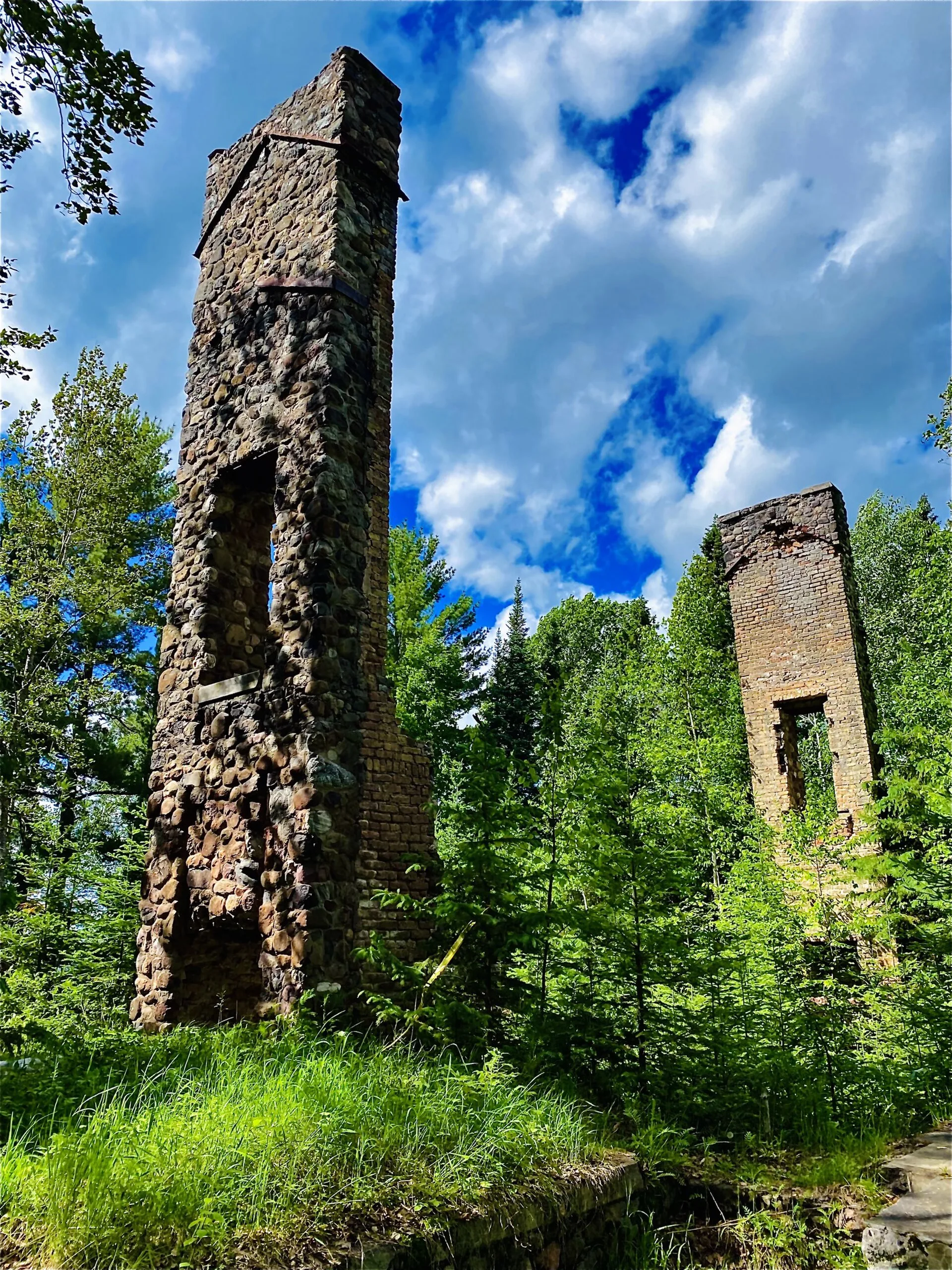
On the shore of West Bay Lake, near Land O’ Lakes in Vilas County, Wisconsin, a pair of tall brick chimneys and a stone terrace stand in the woods on private land. They are what is left of a summer mansion that burned in 1988, and of a ghost story that turned a rich man’s lake house into one of the most famous haunted sites in the Midwest. Its haunted name, Summerwind, was given to it late in its life.
The house
Around 1916 Robert Patterson Lamont, a Chicago steel executive who would later serve as Secretary of Commerce under President Herbert Hoover, bought a fishing resort on the lake and had the Chicago firm Tallmadge and Watson design a large two-story summer house there. It was finished about 1918, at a reported cost of $125,000. Lamont died in 1948, and the house passed through other hands over the following decades, standing empty for long stretches as its condition declined.
The story
The haunting is told in layers. The oldest layer concerns Lamont himself: servants complaining of noises and smells, and a night when a dark figure came up from the basement during dinner and Lamont fired two pistol shots at it, leaving holes in a door, after which the family left for good. No contemporary source for this incident has been produced, and Lamont kept the property until his death.
The central layer concerns Arnold and Ginger Hinshaw, who bought the run-down house in the 1970s and moved in with their six children intending to restore it. In the version that made the house famous, contractors would not take the work, voices and figures filled the rooms, the rooms themselves seemed to change size, and a family member who crawled into a hidden space behind a closet drawer found what looked like a human corpse, which was never reported to the authorities. Arnold Hinshaw is said to have spent his nights playing the organ to keep the spirits quiet, and the strain on the family is said to have become severe within about six months, after which they left.
The final layer belongs to Ginger Hinshaw’s father, Raymond Bober, who then acquired the property with plans for a restaurant or inn. In 1979, under the name Wolfgang von Bober, he published The Carver Effect, which claimed the house was haunted by the eighteenth-century explorer Jonathan Carver, searching for a deed to vast lands in the region supposedly buried in the foundation. It was Bober who called the place Summerwind. In 1980 Life magazine included it in a photo feature on nine haunted houses in America, and the story went national.
The explanations
Almost everything supernatural about Summerwind traces back to a single family and a single book. People in Land O’ Lakes generally called the house the Lamont mansion, and local accounts collected by journalists and later writers say the ghost stories were not part of local lore before The Carver Effect appeared. A neighbor said Bober never actually lived in the mansion or spent a night there but kept a trailer on the grounds; at least two earlier occupants reportedly said they had never found it haunted. The Jonathan Carver deed is itself a long-running frontier legend, unconnected to the house until Bober connected them. None of this proves what the Hinshaws did or did not experience, but none of the major incidents has independent documentation either.
Where it stands
By the 1980s the empty mansion had become a magnet for curious visitors and for teenagers, and the town sought to have it torn down in 1985 after the sheriff described it as a base for local break-ins. In June 1988 it burned. Fire officials attributed the blaze to a lightning strike during a storm, while rumors of arson circulated in the area. Only the chimneys, the foundation and the terrace survived. The site remains private and monitored, though a ghost-hunting group leads occasional permitted visits, and Summerwind continues to appear in television series and lists of the most haunted places in America.