
What happened
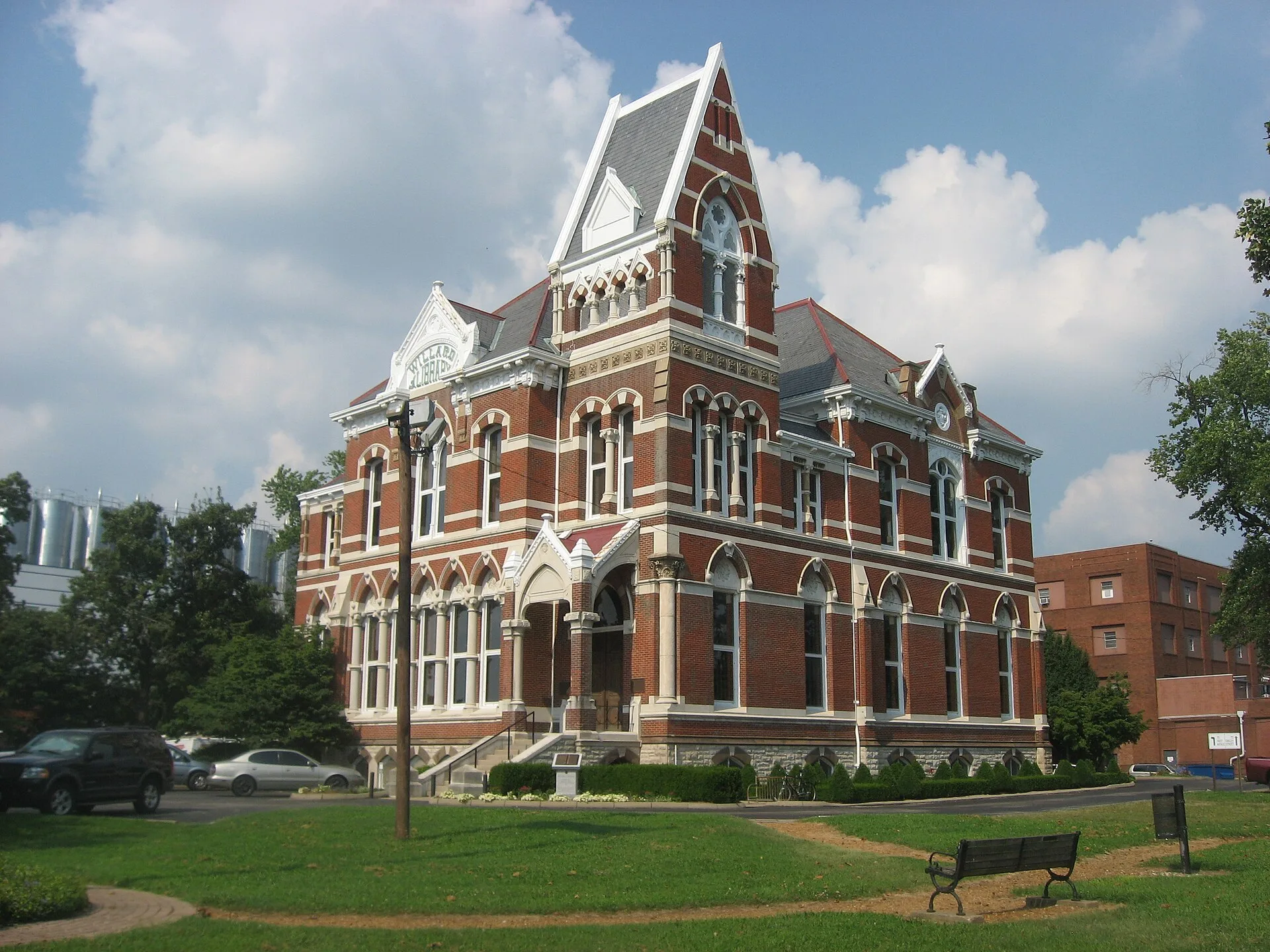
Willard Carpenter made his money in Evansville in the mid-nineteenth century in trade, real estate and railroads, and by his own account helped runaway slaves through the city. He first planned a women’s college, to be named for the educator Emma Willard, then changed his mind. On August 23, 1876 he and his wife Lucina deeded a site, a park and an endowment to a board of trustees for a free public library, open, in the words of his letter, to people of every class, race and sex. Ground was broken on May 16, 1877; the stonework was finished that September and then the money ran short and work stopped for five years. Carpenter pushed for it to resume in 1882 so that he might see it done, and did not: he died on November 3, 1883, days after a stroke, and the building opened in bad weather on March 28, 1885. It was designed in Victorian Gothic by James and Merritt Reid, brothers then practicing in Evansville who went on to build the Hotel del Coronado in San Diego, and its terra cotta carries owls for wisdom. It is the oldest public library building in Indiana still in use and has been on the National Register of Historic Places since 1972.
Carpenter left the bulk of his estate to the library and other charities rather than to his children. In August 1896 his daughter Louise sued the trustees to recover the property, arguing that her father had been of unsound mind and unduly influenced when he made the gift. The court found for the library. Her portrait now hangs on the first floor above the copy machine.
The ghost arrived in 1937. The library’s own telling is that a night custodian, making his three a.m. round to check the furnace, came face to face in a basement corridor with a woman in a long dress and gray veil, dropped his flashlight, watched her dissolve into the dark, and quit soon afterward. Reports have continued since: the smell of lilac or old-fashioned perfume, books sliding off shelves, chairs pulled out from under readers, taps turning on in a locked basement restroom, an elevator that moves on its own at night, and footsteps on the wooden floors. Margaret Maier, the children’s librarian, said the Grey Lady followed her home during the renovations of the 1980s. A police officer called to an alarm one night said he saw a woman and a shadowy figure in an upstairs window while his colleagues searched an empty building. When the television meteorologist Jeff Lyons filmed there, books slid off a top-floor shelf on cue. The 2015 underground expansion brought toilets that flushed by themselves and a projector that moved, which plumbers and technicians could not explain.
The investigation
Lorraine Warren visited in the 1970s, fell into a trance in the children’s story pit and announced that the sorrowful woman was tied to the land rather than the building. In the early 2000s the library installed cameras in the children’s room, the story room, the research room, the first floor, the basement hallway and the stairway, and streamed them to the public around the clock; the Grey Lady was last reported on the basement hallway camera on August 10, 2010. The library now hosts paid after-hours investigations by amateur groups from six in the evening to two in the morning, with a suggested minimum donation of $250 and more at Halloween.
The explanations
Willard Library is a 140-year-old building with steam heat, old plumbing, uneven shelving, a temperamental elevator and a basement, all of which produce the effects reported. The 1937 custodian is unnamed, and his story reached print through the staff. Every subsequent report comes from people who already knew the building was supposed to be haunted and, in most cases, from the institution that benefits from the story: the ghost cams, the handout, the campfire nights and the investigation fees are part of how a small library pays its bills. The library is candid about this. Its ghost cam page says it makes no claim that viewers will see anything other than Willie, the resident hamster.
The identification with Louise Carpenter is a later gloss that fits the story of the lawsuit neatly, which is probably why it stuck. The library says nobody knows who the Grey Lady is.
Where it stands
The building, the bequest, the lawsuit and the Reid brothers are all matters of record. The Grey Lady is a well-kept local legend that the library has turned into a civic institution, and after more than twenty years of cameras, the best anyone has captured is a hamster.