
Artur Berlet was a municipal tractor driver and part-time traveling photographer in Sarandi, a farming town in the north of Rio Grande do Sul, Brazil’s southernmost state. Born in 1931 in the rural part of the municipality, he grew up speaking German, the language of the local settler families, before he learned Portuguese, and he had only a year or so of primary school. In the 1960s he became the source of one of the most detailed abduction narratives in Brazilian ufology: a claim that in May 1958 he had been carried off to another planet, which he called Acart, and brought home again more than a week later.
What happened
Berlet’s own account, written in pencil in 14 school notebooks, begins on the evening of May 14, 1958. He was walking back toward Sarandi from the road junction known as Natalino, about 18 kilometers out, after his ride had gone on without him. At around seven o’clock, passing a farm, he noticed a strange light at the edge of a patch of woods some 200 meters from the road. His first thought, he wrote, was the regional folk belief that such lights mark buried treasure. He climbed through the wire fence and found a round object about 30 meters across, shaped like two trays laid rim to rim and glowing a dull red. Figures appeared, a powerful beam of light struck him, and he passed out.
He woke strapped to a bed in a curved room. The crew ignored his attempts to speak several languages until he tried German, which one of them understood. His guide, a man he called Acorc, took him to Acart, where he describes cities of tens of millions, factories that made a material he called solar steel, vehicles powered by sunlight, a screen on which people spoke face to face, and a society without money governed by a leader chosen for a fixed term and known as the Son of the Sun. Through a giant telescope he was shown South America and a blue Earth wrapped in a band of light. Eventually he was set down in a field at night about five kilometers from town, told not to look back or speak to anyone, and walked home, arriving at dawn as people were leaving early Mass.
The investigation
Nothing about the story appears in print for years. According to the introduction to his book, a small group of local enthusiasts, among them the manager of the Bank of Brazil branch in Sarandi and a reserve air force officer named Jorge Geisel, heard rumors of a strange experience involving a town tractor driver and invited Berlet to talk in 1965, seven years after the events. They questioned him for seven and a half hours and came away convinced. In August 1965 Walter Buhler, a physician in Rio de Janeiro who led the Brazilian Society for the Study of Flying Saucers (SBEDV), visited the region and took up the case. Berlet was taken to Porto Alegre for television appearances, which his supporters said left him mocked as a madman; at home, the standing joke was that he had driven to the Moon on a road grader.
The notebooks were edited and published in Rio de Janeiro in 1967 as Os Discos Voadores: Da Utopia à Realidade, in a run of 1,000 copies with closing remarks by Buhler. German and Finnish translations followed in the 1970s, a second Brazilian edition in 1978, and an English version issued in Tucson, Arizona, by the American contactee researcher Wendelle Stevens in 1989.
The explanations
The case rests entirely on Berlet’s testimony. None of the published accounts, from the book’s own editors to recent news coverage, cites a contemporary police report, newspaper item or medical record of a disappearance in May 1958, and Berlet’s account says he avoided being seen on his way home. Even the length of his absence varies: his own narrative says he got home after eight days, the introduction gives nine, from May 14 to May 23, and a 2025 regional news report says eleven.
Supporters point to details that seemed advanced for a farm laborer, especially the solar technology and the blue Earth seen from space years before Yuri Gagarin’s flight in 1961. That argument depends on when the text was written, and the only evidence for a 1958 date is Berlet’s word; the book first appeared in 1967. The editors themselves conceded that his figures for the planet did not match any known world, and that Berlet hinted it might be Mars. Buhler’s own afterword placed the story alongside the claims of 1950s contactees such as George Adamski, whose humanlike visitors from other worlds closely resemble the people of Acart.
Where it stands
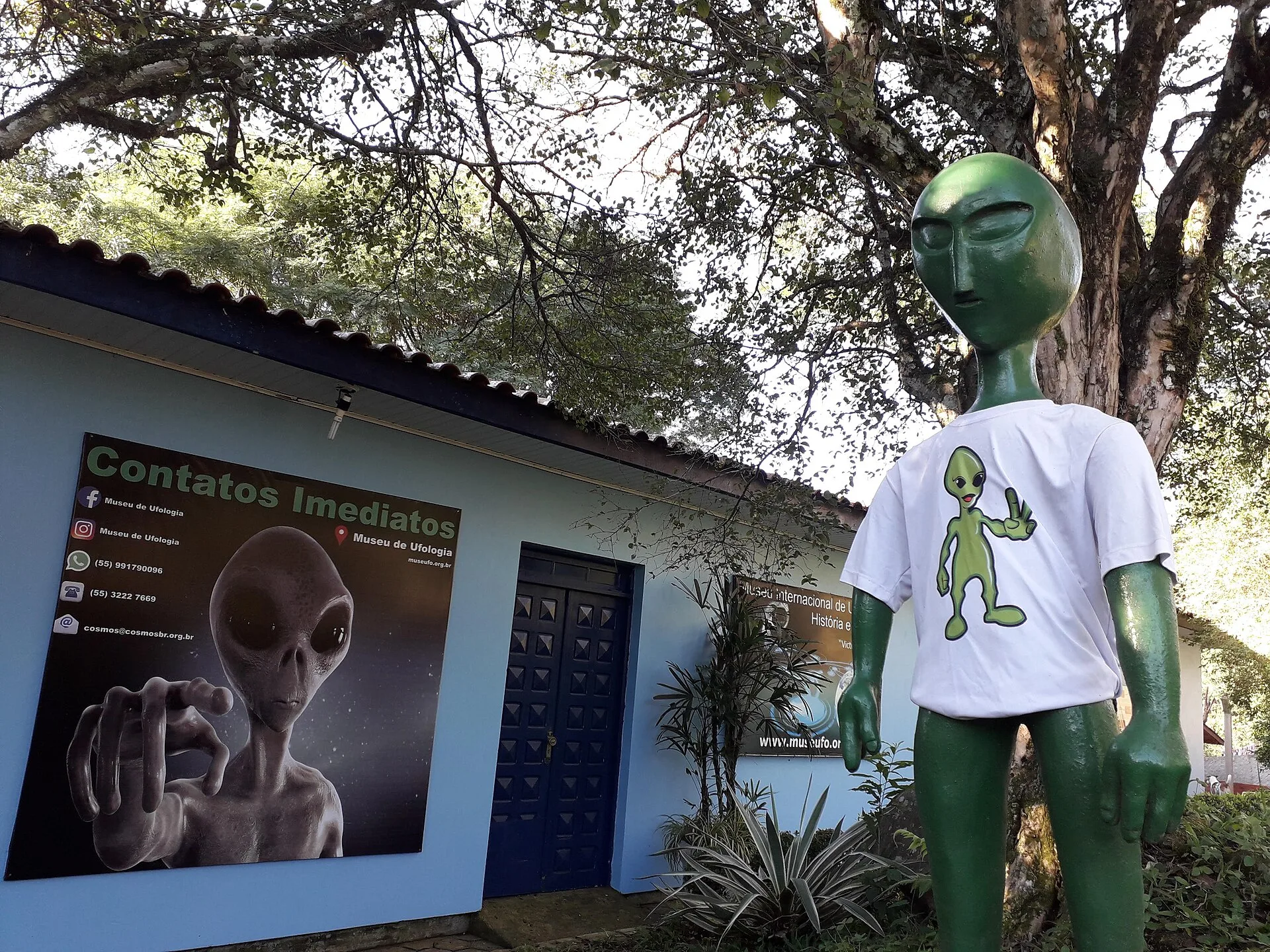
Berlet lost a leg in a quarry explosion and later had to leave his job. He died of cancer in 1994. His family gave his manuscripts to the International Museum of Ufology, History and Science in Itaara, Rio Grande do Sul, in 2001, and Sarandi has built a monument shaped like a flying saucer in his honor. He never changed his story, and there is no sign he profited from it. But without any independent record of the disappearance itself, the journey to Acart remains an unverified personal account.