
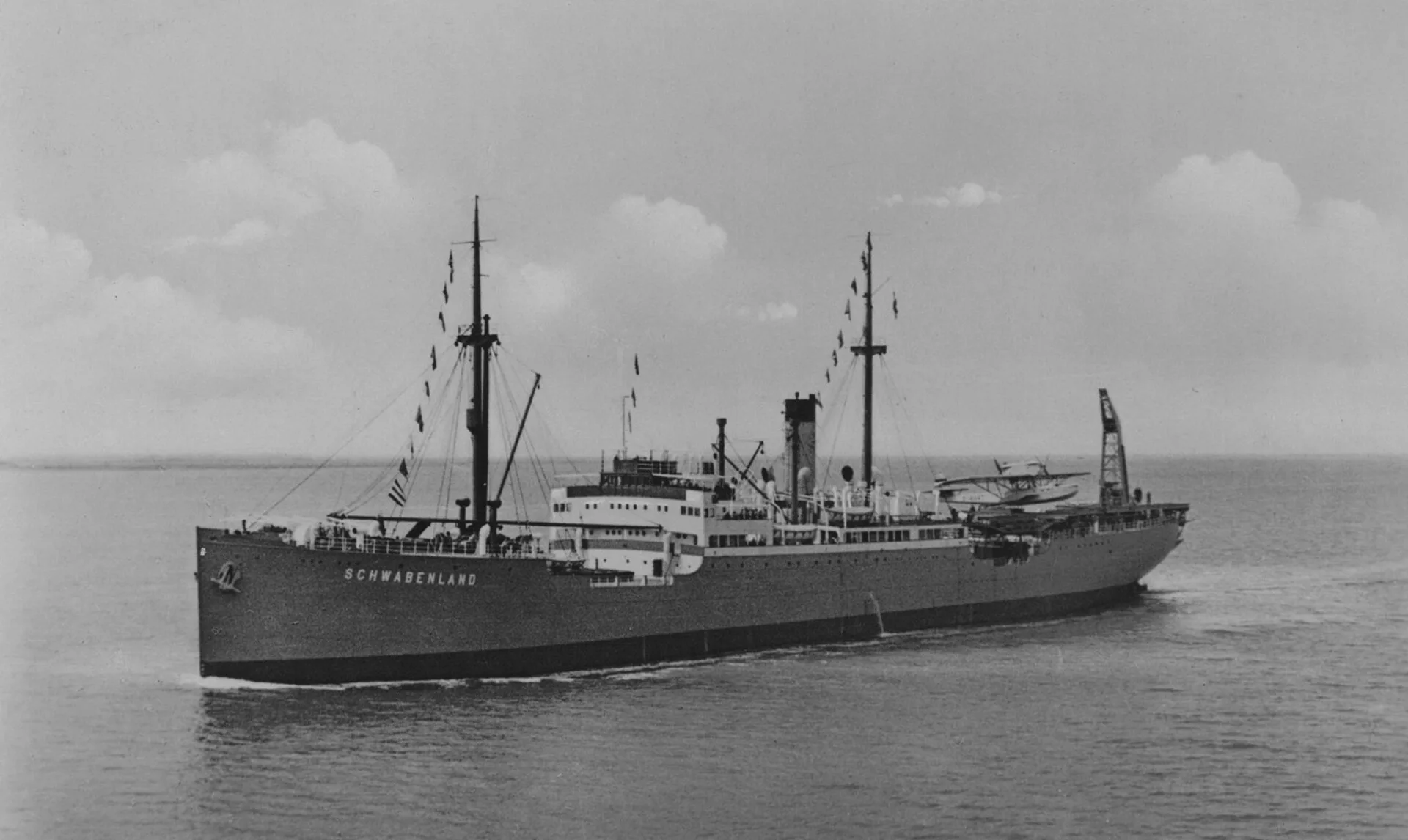
New Swabia is the name a German expedition gave, in early 1939, to a wedge of East Antarctica lying roughly between 10 degrees west and 15 degrees east of Greenwich. It is ice sheet, nunataks and coastal ice shelf, now inside the Norwegian dependency of Queen Maud Land. Over the following eighty years it acquired a second, imaginary geography: a buried Nazi city, warmed by hot springs, that outlasted the Third Reich.
What happened
The expedition was commissioned under Hermann Göring’s Four Year Plan, which wanted Germany to depend less on imported whale oil, then a key ingredient of margarine and soap. Its leader, the naval captain Alfred Ritscher, had a few months to prepare. He took over the Schwabenland, a Lufthansa catapult ship built to launch mail planes across the Atlantic, and two Dornier Wal flying boats named Boreas and Passat. With 82 men aboard it sailed from Hamburg on December 17, 1938, the date Ritscher himself gave when he described the voyage in the journal Polarforschung in 1951.
The ship reached the ice edge off the Princess Martha Coast on January 19, 1939. Over the next three weeks the seaplanes flew long survey loops inland, photographing mountain ranges nobody had seen and an ice-free lake district later named the Schirmacher Oasis. At turning points the crews dropped metal darts marked with swastikas as markers of a claim. Norway, alerted to the voyage, had declared the whole sector its territory on January 14. The Schwabenland left the coast on February 6 and was back in Hamburg on April 11. A second season was planned and then canceled when war began. Germany never formally pressed its claim, and many of the aerial photographs were lost in the war.
How the base was built on paper
The legend took its first shape in 1945. When the submarine U-530 surrendered at Mar del Plata, Argentina, in July, two months after Germany’s capitulation, and U-977 followed in August, newspapers asked where they had been. The Hungarian writer Ladislas Szabo, living in Argentina, answered that they had carried Hitler and his treasure to an Antarctic stronghold prepared by the Schwabenland, and expanded the idea into a 1947 book. Later writers added a geothermal cavern city, sometimes called New Berlin or Base 211, Nazi flying saucers, and a run of Allied assaults on it.
Those assaults are built from real events. Britain’s wartime Operation Tabarin put small scientific parties on the Antarctic Peninsula. The US Navy’s Operation Highjump of 1946–47 brought 13 ships and about 4,700 men to the continent. In 1958 the United States detonated three small nuclear weapons at very high altitude over the South Atlantic in Operation Argus. In the conspiracy version these become a British commando raid, an American invasion repulsed by flying discs, and a final atomic strike on the base.
The investigation
In 2007 the geologist Colin Summerhayes of the Scott Polar Research Institute and Peter Beeching published a 21-page examination of the story in the journal Polar Record. Using records published since the 1940s, they found that the German party had spent only brief periods on the ice shelf and built nothing; that the two U-boats were at sea in the southern winter, when pack ice would have kept them hundreds of miles from the coast; that the Tabarin men were few, far away and busy with weather and survey work; that Highjump went mainly to the Ross Sea side of the continent to train for cold-weather operations; and that the Argus bursts happened more than 2,000 kilometers north of Queen Maud Land.
Writing in Nature, John Whitfield noted another weakness: the supposed location of the base drifts across most of the Norwegian sector depending on who tells it, and versions disagree over whether the submarines carried Hitler or only his ashes. Brian Dunning of Skeptoid traced the core of the tale back to Szabo’s postwar articles.
Where it stands
The Schwabenland voyage is a documented, modest piece of polar exploration whose secrecy and lost photographs left a vacuum. The base filled that vacuum and has since been absorbed into Nazi UFO lore, some of it spread by far-right writers. Germany’s only permanent presence in the region is scientific: the Georg von Neumayer research station opened there in 1981, and its successor, Neumayer III, still operates on the Ekström Ice Shelf. No trace of Base 211 has ever been found, and the records leave no room for one.