
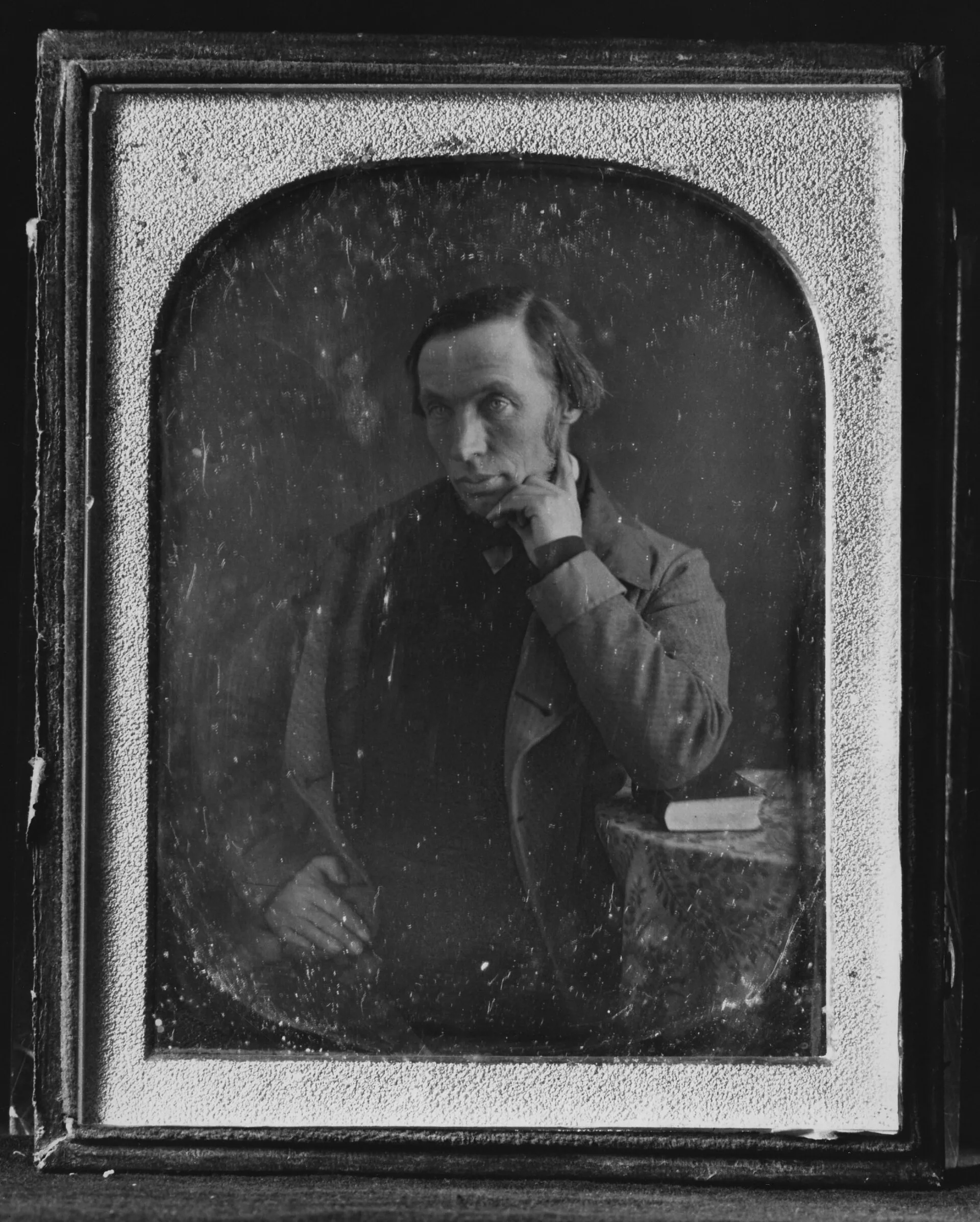
Few ghost stories are cited as often in books on the paranormal as that of Émilie Sagée, the French schoolteacher whose double was supposedly seen by an entire class. It is usually presented as one of the best-witnessed cases of its kind: dozens of observers, named people, a real school. Looked at closely, almost all of that rests on one woman’s memory, reported once, fifteen years after the events, by a writer who was already convinced.
What happened
The story appeared in 1860 in Footfalls on the Boundary of Another World, a book by Robert Dale Owen, the Scottish-born American congressman, diplomat and reformer who had turned to spiritualism. Owen said he had it directly from Julie von Güldenstubbe, daughter of a Baltic baron, who had been a 13-year-old boarder at a Moravian-run girls’ school called Neuwelcke, in Livonia near the town of Wolmar, now Valmiera in Latvia, in 1845.
According to her, one of the teachers was Émilie Sagée, a 32-year-old Frenchwoman from Dijon, fair, slim, conscientious and somewhat nervous. Within weeks of her arrival, pupils began contradicting each other about where she was, one having just seen her in a classroom, another on the stairs. Then a class of thirteen girls watched two identical Sagées at the blackboard, the real one writing with chalk and the copy miming the movement with an empty hand. A pupil named Antonie von Wrangel, being helped into a dress, saw two Sagées in the mirror fastening the hooks and fainted. The double was said to appear behind the teacher’s chair at meals, copying her movements without a knife or fork.
The set piece came when all 42 pupils were doing needlework in a hall overlooking the garden. Sagée could be seen outside picking flowers. The teacher in charge of the room stepped out, and a figure of Sagée appeared in her empty armchair, motionless, while the woman in the garden moved slowly as if half asleep. Two pupils went up to it; one said it felt like thin muslin, and one walked partly through it. When the figure faded, the Sagée outside went briskly back to her flowers.
Over eighteen months, the account continues, nervous parents withdrew their daughters until enrollment fell from 42 to 12, and the directors reluctantly let her go. She was said to have told Julie that this was the nineteenth post she had lost the same way since she began teaching at sixteen. She went to stay with a sister-in-law, whose small children reportedly spoke of seeing two Aunt Emilies, and then left for the Russian interior. Nothing more was heard of her.
The investigation
There never was one at the time. No letter, school record, diary or newspaper item from 1845 or 1846 has been produced, and none of the other 41 pupils, the staff, the servants or the eighteen earlier employers is known to have left an account. Owen named the school and invited readers to write to its directors for corroboration, but did not say that he had done so. When the London spiritualist weekly Light ran the case in August 1883, it reprinted Owen’s text almost word for word.
The informant matters. Julie von Güldenstubbe and her brother, Baron Ludwig von Güldenstubbe, were well-known figures in Paris spiritualist circles. When the baron died in 1873, the Spiritual Magazine’s obituary credited his book on direct spirit writing to experiments carried out through his own mediumship and his sister’s.
The astronomer Camille Flammarion, who had met the pair in 1862 and vouched for their sincerity, tried in 1895 to trace the teacher. The Dijon registers showed nobody of that surname, only the birth on January 3, 1813 of an illegitimate girl named Octavie Saget. He suggested that a misremembered first name, a misspelled surname or a deliberate change could account for the gap. It may be the right woman; it may not.
The explanations
Believers have treated the case as evidence of bilocation, an astral body or a doppelgänger. Skeptics point to the shape of the evidence instead. A single, secondhand account told years later by a person raised among spiritualists cannot carry the weight of 42 witnesses, because the other 41 never spoke. Schoolgirl rumor, a teacher who unsettled her pupils, and an adult’s reconstruction of childhood memories would explain much of it; the more theatrical scenes, such as the walk-through apparition, are the kind of detail that tends to sharpen with retelling. None of this proves the story false, but none of it can be tested.
Where it stands
The exact site of the Neuwelcke school has never been pinned down, and a Dijon birth record offers only a possible Émilie. The double rests on one witness’s word, relayed by an author who called it the most conclusive case he knew. It survives as a durable legend of the paranormal, and the original Owen chapter remains the only source anyone has.