
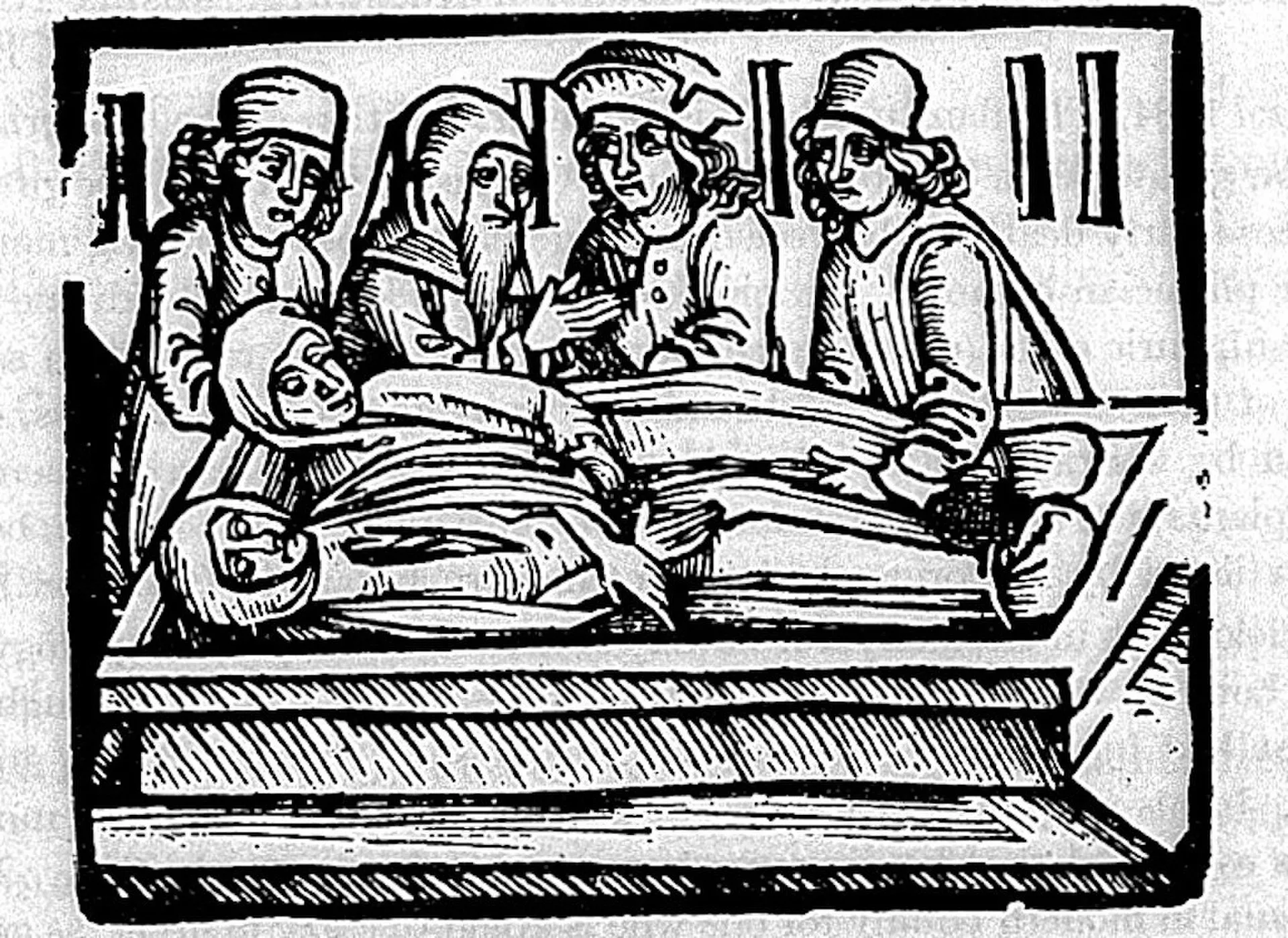
Five times between 1485 and 1551, England was struck by an illness that physicians of the day insisted was unlike plague, smallpox or any fever they knew. It arrived in summer, killed within a day, favored the comfortable over the poor, and then vanished for good. Contemporaries called it the sweating sickness, or simply the sweat; abroad it was the English sweat. Nearly five centuries later, no one has identified what caused it.
Five outbreaks
The first appeared in August 1485, in the weeks after Henry Tudor landed at Milford Haven and took the throne at Bosworth. The physician John Caius, writing after the last epidemic, dated it from shortly after August 7 and said it ran through the rest of that month and September; later writers put London’s toll that autumn at 15,000. It returned in the first decade of the sixteenth century (sources disagree between 1506, 1507 and 1508), again in 1517 from July into December, and in 1528, beginning in London in late May. That fourth outbreak was the only one to leave England in force. In July 1529 it reached Hamburg aboard a ship from England and spread through northern Germany, the Low Countries, the Baltic and Scandinavia, and eastward as far as Russia, while France, apart from the Calais area, was spared, as by most accounts were Italy and Spain.
The last epidemic began at Shrewsbury in mid-April 1551, moved through the Welsh border towns, Chester, Coventry and Oxford, and reached London on July 7. Caius recorded 761 deaths there in the single week from 9 to July 16, not counting the first two days, when no register was kept, and 142 more before the month was out. It then swept through eastern and northern England and was gone by the end of September. Among its victims were two young brothers, Henry Brandon, Duke of Suffolk, and his younger brother Charles, whom Caius singled out for their promise. After that the English sweat was essentially never seen again; a few later local reports, such as one at Colchester in 1578, are uncertain.
What it did
Caius, who studied medicine in Padua and later refounded a Cambridge college, wrote the only full contemporary medical account in English, his 1552 Boke or Counseill against the sweat. He described a sudden onset with pains in the back or shoulder and the limbs, then pain around the liver and stomach, headache and delirium, palpitations, an overwhelming heaviness and craving for sleep, and the drenching sweat that gave the disease its name. Its defining feature was speed. Some victims, he wrote, died in an hour, many in two; a man who dined cheerfully could be dead by supper. He proposed calling it Ephemera, a fever of one day, because the crisis lasted about twenty-four hours: those who survived it usually recovered. Mortality estimates range widely, from a few percent in some London counts to 30 to 50 percent in others.
The candidates
Almost every infectious disease has been proposed and most have been ruled out. Influenza fits poorly, since the sweat showed no prominent cough or pneumonia and moved through Europe in a different direction from flu epidemics. Plague, typhus and smallpox were distinguished from it by the physicians who knew them well. Ergot poisoning from moldy grain, botulism, anthrax, and insect- or tick-borne viruses have all had advocates, the last because outbreaks seemed to follow long spells of rain and, by some accounts, to stop at the Scottish and Welsh borders.
The leading modern suggestion is a hantavirus, a family of viruses carried by rodents and other small mammals. In 1997 and 1998 Guy Thwaites, Mark Taviner and Vanya Gant argued in the New England Journal of Medicine and Medical History that the sweat resembled hantavirus pulmonary syndrome, which also starts abruptly and can kill within a day. In 2014 Paul Heyman and colleagues at the Belgian military’s hantavirus reference laboratory reviewed the record and called hantavirus the most likely cause of both the English sweat and the later Picardy sweat, which produced 196 localized outbreaks in France between 1718 and 1861. They noted the summer timing, the high toll among monks in well-stocked religious houses, and the way the disease seemed to need an abundant animal source rather than spreading person to person. They also conceded the weak points: very few hantavirus infections have been recorded in Britain in modern times, and the hantaviruses circulating in Europe today rarely kill.
Where it stands
The problem is evidence. No tissue, DNA or RNA from a confirmed victim has been tested, so every diagnosis rests on sixteenth-century descriptions written within a humoral theory of disease. Heyman’s group, returning to the question in 2018, found scattered reports of sweating sickness before, between and after the five great epidemics, and suggested a pathogen that has not been identified could in principle return. Until a burial of known victims yields genetic material, the English sweat remains one of the few major epidemics in recorded history with no known cause.