
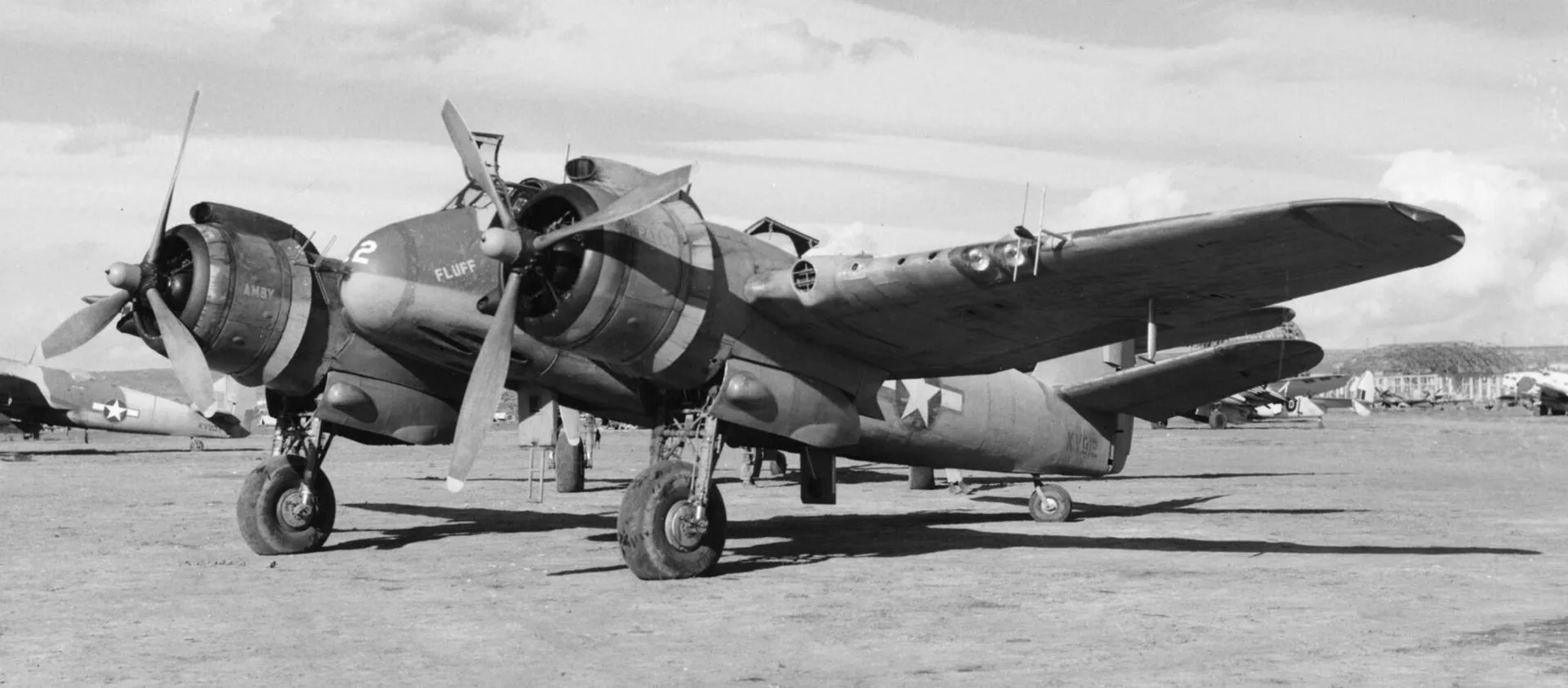
The American reports began in a single unit. In the winter of 1944 the 415th Night Fighter Squadron of the US Army Air Forces flew twin-engine Bristol Beaufighters from bases in eastern France, hunting German aircraft over the Rhine valley in the dark. Its crews knew what flak, searchlights, flares and burning aircraft looked like. What they began describing in late November was something else.
What happened
Toward the end of November 1944 a Beaufighter flown by Lt. Ed Schlueter, with Lt. Donald J. Meiers on the radar set and the squadron intelligence officer, Lt. Fred Ringwald, along as an observer, was patrolling north of Strasbourg when the crew saw eight or ten glowing orange lights off one wing above the hills. Schlueter turned toward them and they went out. Ground radar reported nothing in the area. In December the reports multiplied. Near Breisach on December 17 a pilot flying at about 800 feet described five or six red and green lights that seemed to close on his aircraft before disappearing, and on December 22 two more crews near Hagenau reported lights in an orange glow that trailed them for a couple of minutes before peeling away.
Meiers, a reader of Bill Holman’s comic strip Smokey Stover, whose firefighter hero liked to say that where there’s foo there’s fire, is generally credited with the name, and foo fighters stuck. An Associated Press reporter spent time with the squadron, and his story ran in American papers on January 1, 1945. Time followed in mid-January, reporting that balls of fire had been shadowing night fighters over Germany for more than a month, that the pilots took them for some kind of psychological weapon, and that one pair of red balls had stayed off a pilot’s wingtips until he dove at 360 miles an hour.
The term soon covered sightings well beyond the 415th. RAF crews had described lights following their aircraft since 1942, and bomber crews over the Balkans and later in the Pacific reported glowing spheres that hung in the sky or kept pace with them. None was reported to have attacked anyone.
The investigation
Ringwald sent a list of incidents up to XII Tactical Air Command, which asked Supreme Headquarters Allied Expeditionary Force in Paris; SHAEF in turn asked the British Air Ministry. The British reply in March 1945 suggested jet aircraft for a few cases and flak rockets for the rest, while conceding that the evidence was thin and varied and the matter still a mystery. In the autumn of 1945, US intelligence officers in Europe questioned German scientists, engineers and senior Luftwaffe officers; none knew of a weapon that matched the reports, and German and Japanese pilots turned out to have reported similar lights.
In January 1953 the CIA convened a panel of scientists chaired by the physicist H. P. Robertson to review the UFO problem. The record kept by its secretary, F. C. Durant, notes that foo fighters came up as an example of something unexplained but not dangerous: balls of light, seen in both the European and Far East theaters, that flew close to aircraft and maneuvered quickly. They were thought to be electrostatic, like St. Elmo’s fire, or electromagnetic, or perhaps reflections from ice crystals, but their cause was never established. The panel added that had the phrase flying saucers been current in 1943 to 1945, these would have been called by it. Robertson and Luis Alvarez had both been involved in the wartime inquiries.
The explanations
No single cause covers every report. St. Elmo’s fire, a glowing electrical discharge that collects on wingtips and propellers, accounts for lights that seem to ride along with an aircraft, and some descriptions resemble ball lightning. A night battlefield also offered afterimages from flak bursts, flares, reflections and the lights of other aircraft, and pilots at night are prone to illusions of motion and position; the US Navy began a study of aviators’ disorientation in 1945 partly because of the volume of strange reports. Later writers have pointed to German rocket work, including the V-2, but the V-2 could not maneuver the way crews described, and no dedicated weapon has ever come to light.
Where it stands
The foo fighters are among the best-documented aerial puzzles of the war, recorded in squadron histories, press reports and official correspondence by aircrews with no obvious reason to invent them, and the sightings faded with the end of the fighting. That record shows that experienced airmen saw lights they could not identify. It does not show what the lights were, and nothing in it points to piloted or remotely controlled craft.