
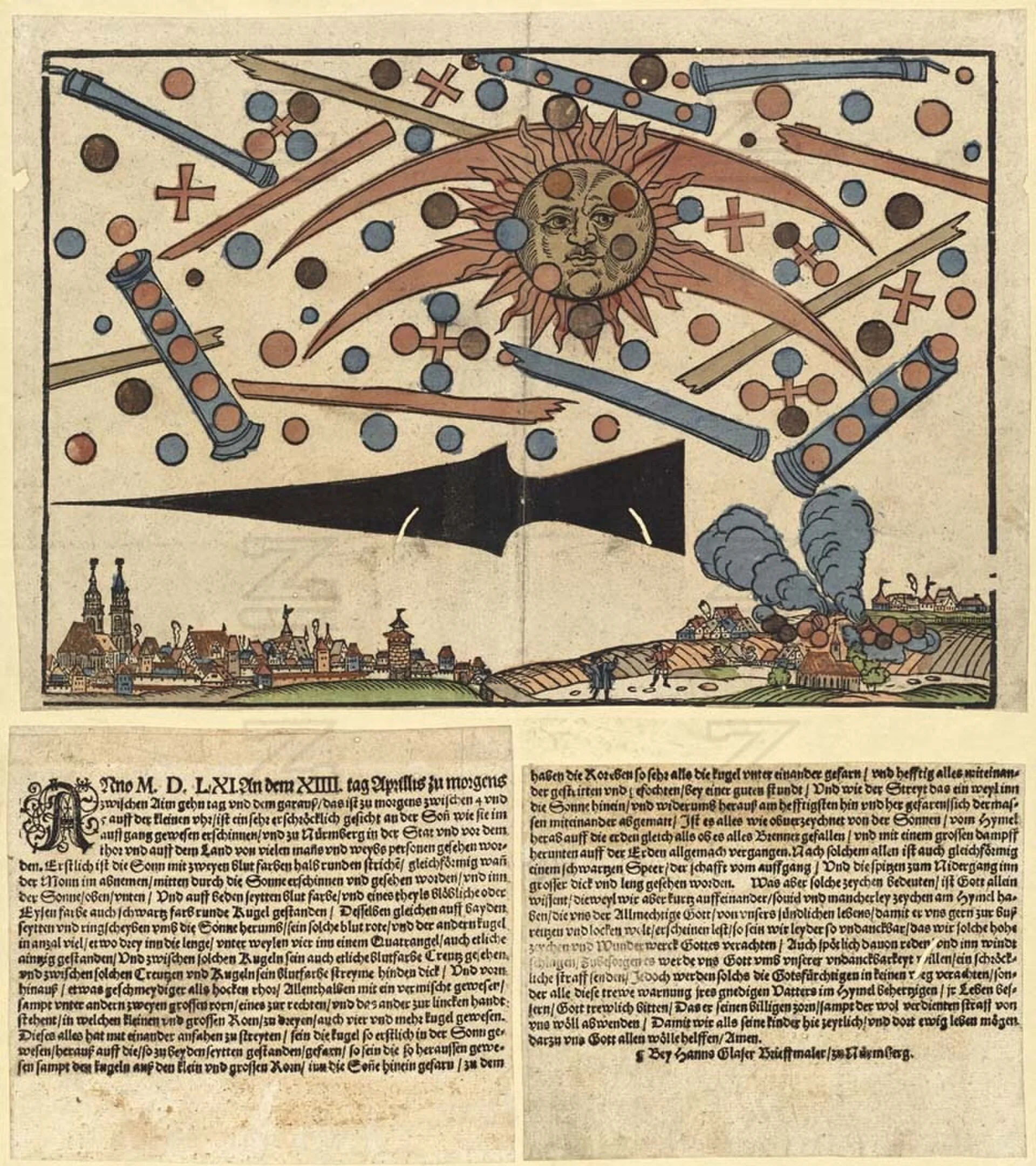
In the sixteenth century, news that would not fill a pamphlet was printed on a single sheet: a woodcut across the top, a block of text beneath, sold cheaply in the street. Many such sheets reported wonder-signs, strange sights in the sky, and presented them as messages from God. Two of them, from Nuremberg in 1561 and Basel in 1566, have had a second life since the middle of the twentieth century as supposed eyewitness records of aerial combat between unidentified craft.
What happened
The Nuremberg sheet came from Hans Glaser, a local printer and painter of lettering, in April 1561. Its text reports that at daybreak on April 14 many men and women in the city and the surrounding country saw a terrible sight in and around the sun. First came two blood-red arcs like a waning moon; then large numbers of dark and red balls, crosses, and long rods holding several balls each. These, it says, flew in and out of the sun as if fighting for more than an hour, then dropped to the ground as though burning and wasted away in smoke, after which a long black shape like a spear appeared. Glaser drew it all above a view of the town and closed by saying that only God knew what such signs meant, urging readers to repent.
The Basel sheet, printed by Samuel Apiarius with design help from the young Samuel Coccius, covers three days in 1566. On the evening of July 27, it says, the setting sun lost its brilliance and turned blood-red, and the nearly full moon looked red that night. The next morning the sun rose red and bathed the city in a fiery light. At dawn on August 7 people saw black balls moving fast in front of the sun as if in battle, some turning fiery before breaking up. The woodcut shows the cathedral square under a sky crowded with spheres. Neither printer claimed to have seen any of it himself.
The investigation
Both sheets survive because a Zurich clergyman, Johann Jakob Wick, collected news for almost thirty years, from about 1560 until his death in 1588. His collection, the Wickiana, fills 24 handwritten volumes with more than a thousand drawings and hundreds of printed items. It is now in the Zentralbibliothek Zürich, where the large broadsheets have been stored separately since 1925 and the whole collection has been digitized. Portents were one of Wick’s main interests: comets, deformed births, storms, epidemics and signs in the heavens.
Set against that collection, the two sheets look ordinary for their time. German and Swiss printers produced dozens of similar reports of halos, northern lights, blood rain and armies in the clouds, nearly all framed as calls to repentance or warnings about war, the Ottoman threat or the Last Judgment. The Swiss National Museum describes these sheets as the tabloids of their age: illustrated for a largely illiterate public, drawn to sensation, and uninterested in separating what happened from what made a good sermon.
The UFO reading is modern. Carl Jung discussed the Nuremberg sheet in his 1958 book on flying saucers, treating it as a natural event clothed in the religious and military imagery its viewers knew, and from there it passed into UFO literature as a dawn dogfight.
The explanations
The Nuremberg text places everything in and around the rising sun, which is exactly where halo effects form. When the sun is low and thin cloud holds ice crystals, it can be flanked by bright patches called sun dogs, or parhelia, and crossed by arcs, rings and pillars that brighten, fade and shift as the cloud moves. Red arcs, balls standing on either side of the sun and rods running through it fit a strong halo display described by frightened, devout observers and redrawn by a printer working from their accounts.
For Basel, the Swiss National Museum notes that most scholars favor natural causes, listing meteors or a bright fireball, an aurora, and unusual atmospheric conditions such as dust from the Sahara. A sun and moon turned red point to haze or dust high in the air. Neither text describes anything built or piloted; the balls, crosses and spears are the visual vocabulary of the genre.
Where it stands
Both sheets are authentic sixteenth-century prints, and both can be viewed in the Zurich library’s digitized collection. Something unusual was probably seen in each city, and the simplest candidates are optical effects of sunlight passing through ice, haze or dust. What turned them into battles was the way printers of the period described the sky, not anything found in it.