
On the afternoon of Thursday, August 2, 1100, King William II of England, the ruddy, unmarried and widely disliked son of William the Conqueror, rode out to hunt in the New Forest in Hampshire. By evening he was dead, struck in the chest by an arrow. His companions scattered, his body was left where it fell, and within three days his younger brother Henry had seized the treasury and been crowned. More than nine hundred years later, nobody can say for certain who fired the shot, or whether it was an accident.
What the chroniclers wrote
The earliest record is the Anglo-Saxon Chronicle, compiled by monks who loathed the king. It says only that he was shot while hunting by an arrow from one of his own men, taken to Winchester for burial in the cathedral, and then spends far longer listing his sins: the sale of church offices, the heavy taxes, the bishoprics and abbeys he kept vacant so he could pocket their income.
The name of the archer appears a generation later. William of Malmesbury, writing in the 1120s, tells the story most people know. The king had a disturbing dream the night before, and a monk had reported another. The hunt set out late, after dinner. As the sun dropped, Rufus was left with only a few companions, among them his friend Walter Tirel, lord of Poix in Picardy. The king wounded a stag and stood watching it run, shading his eyes against the low light, and at that moment Tirel loosed at a second deer and hit the king instead. Rufus snapped off the shaft, fell and died without a word. Tirel mounted his horse and fled to France, while countrymen loaded the body onto a cart and took it to Winchester. Orderic Vitalis, writing around 1135, gives a similar account in which the stag ran between the two men and Tirel’s arrow passed over its back and into the king. Later tellers added a tree from which the arrow glanced.
Why it looks suspicious
Several details have kept the question alive. Henry, the Conqueror’s youngest son, was hunting in the same forest that day. He rode straight to Winchester and took control of the royal treasury over the objections of William of Breteuil, who argued that it belonged to the eldest brother, Robert Curthose. Robert had pawned Normandy to Rufus to fund his part in the First Crusade and was on his way home; he reached Normandy in September. Henry did not wait. He was crowned at Westminster on August 5. Tirel’s wife was a daughter of Richard fitz Gilbert, head of the Clare family, and two of her brothers were in the hunting party. Conspiracy writers point out that the Clares did well under Henry, although historians disagree about how much.
Against the official story stands Tirel himself. Abbot Suger of Saint-Denis, who knew him in France, wrote that he had often heard Tirel swear, at a time when he had nothing to gain or fear, that he had never entered the stretch of woodland where Rufus was hunting that day and had not so much as caught sight of him. John of Salisbury, writing later in the century, recorded that Tirel maintained his innocence even on his deathbed. If he was telling the truth, the man who shot the king is unknown.
The theories
The case for murder is that Henry, or friends acting for him, arranged the shot so he could take the crown while Robert was still abroad, with Tirel either the hired archer or a convenient scapegoat. The medieval historian A. L. Poole judged that the facts looked ugly and seemed to point to a plot, and several twentieth-century writers built whole books on the idea. Legend helped: one story has Tirel reversing his horse’s shoes to throw pursuers off his trail. Most modern scholars of the period are more cautious. Hunting accidents were common, and Rufus’s brother Richard and a nephew had both died in the same forest. The biographer Frank Barlow concluded that there was too little hard evidence to prove murder, and John Gillingham has noted that a plotting Henry would have done better to wait for the war between Rufus and Robert that seemed to be coming, which might have removed one rival for him.
Where it stands
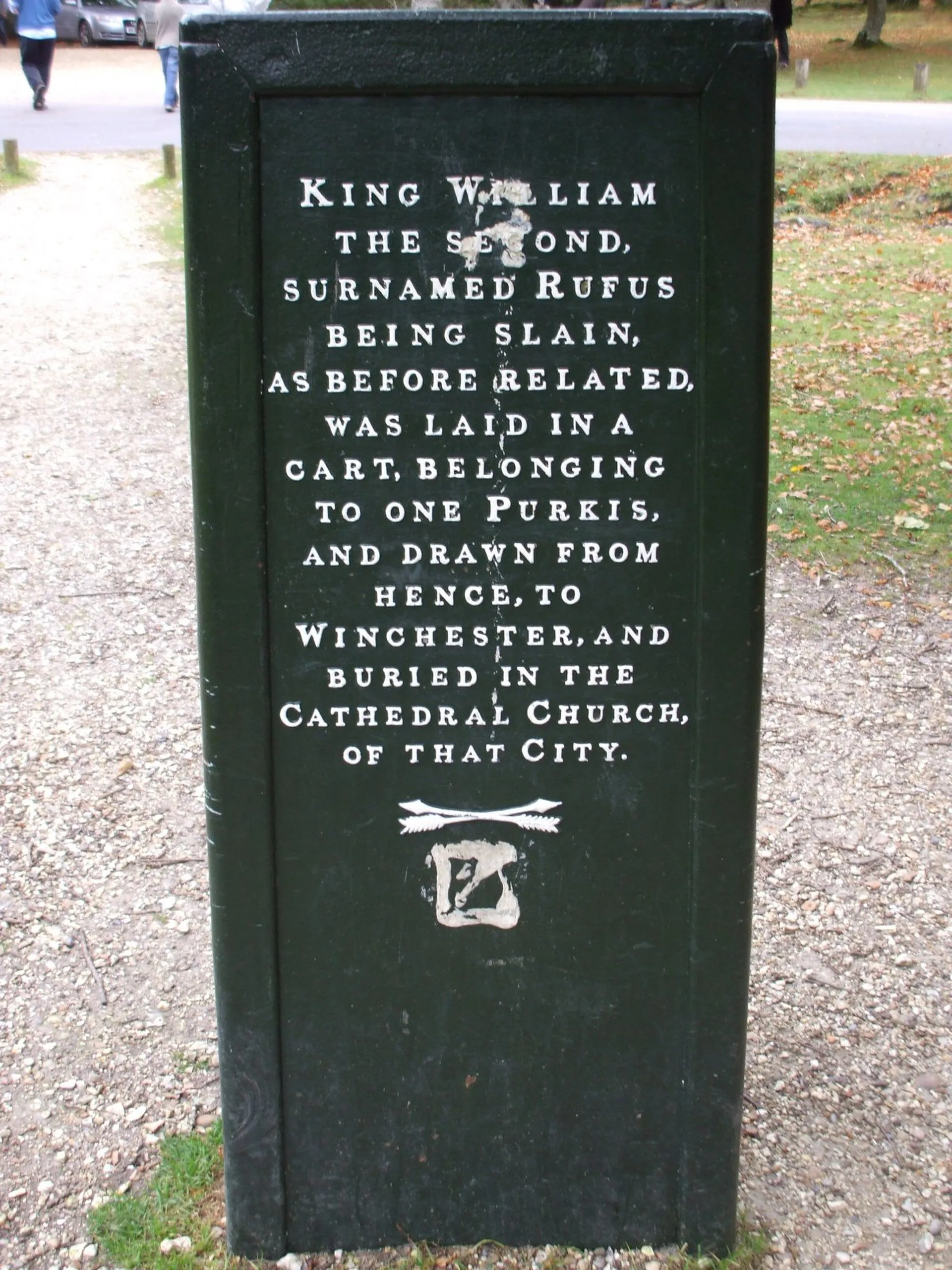
The Rufus Stone near Minstead, set up in the eighteenth century by Lord De La Warr and encased in cast iron in 1841, marks the traditional spot, although the location seems to rest on a tradition no older than the seventeenth century. The king’s bones lie among the mortuary chests in Winchester Cathedral, whose tower collapsed in 1107, a disaster some contemporaries blamed on his burial beneath it. The facts that can be established are that Rufus was killed by an arrow, that the chroniclers named Tirel, that Tirel denied it, and that Henry moved with remarkable speed. Whether that adds up to an assassination is a question the surviving sources cannot settle.