
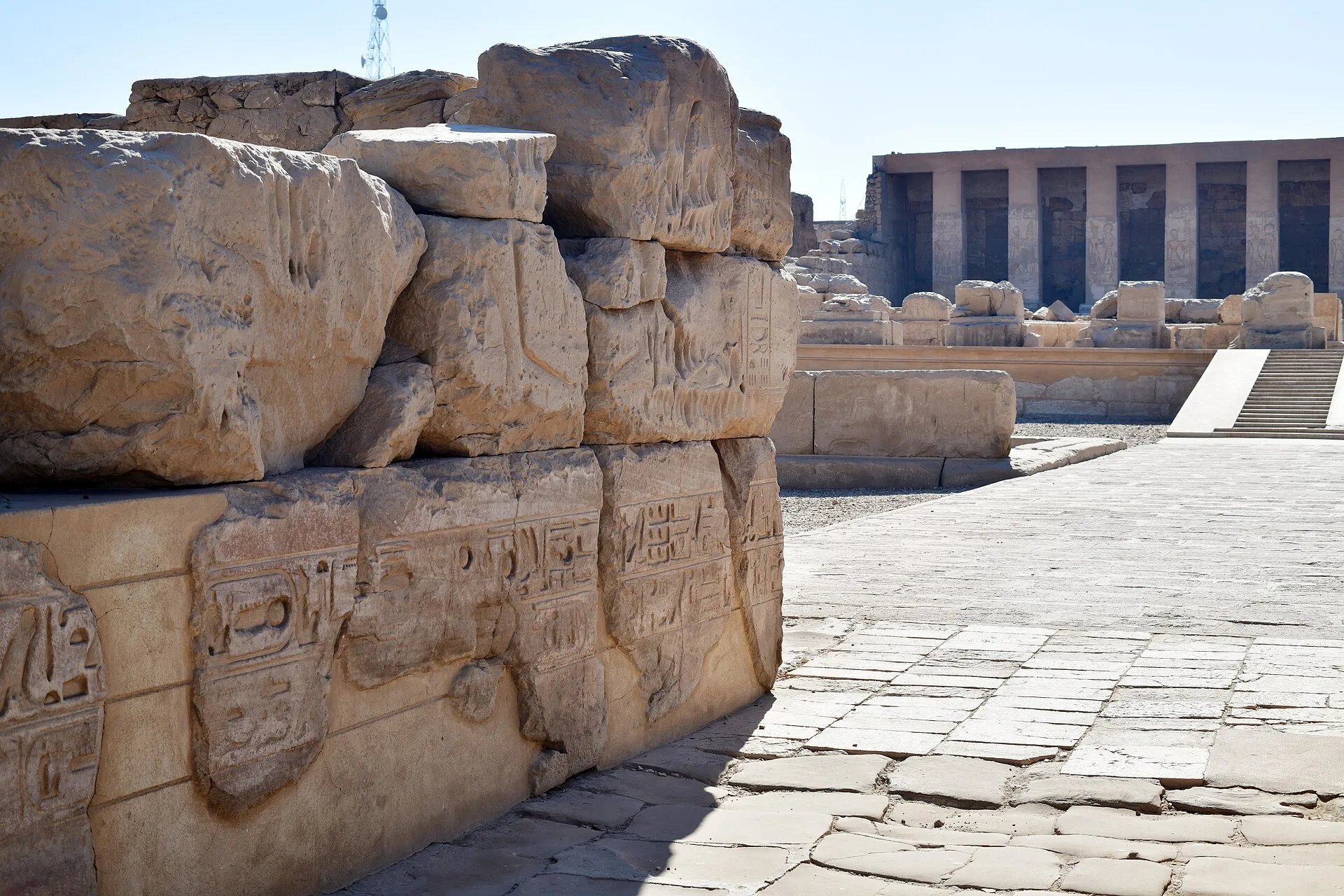
For the last twenty-five years of her life an Englishwoman named Dorothy Eady lived in a simple village house at Abydos in Upper Egypt, a short walk from the temple that the pharaoh Seti I built there in the thirteenth century BCE. The villagers called her Omm Sety, mother of Sety, after her son. Egyptologists knew her as a skilled draftswoman and a tireless guide to the temple. She told a few close friends something more: that she had lived at Abydos before, more than three thousand years earlier, as a temple girl who had been Seti’s lover.
What happened
Dorothy Louise Eady was born in Blackheath, in southeast London, in January 1904, the daughter of a tailor who later went into the cinema business in Plymouth. Her own account, repeated in later biographies, begins with a fall down a flight of stairs at the age of three, after which a doctor thought she had died. She recovered, but began to dream of a great columned building and a garden and to cry that she wanted to go home. Taken to the British Museum, she raced around the Egyptian galleries kissing the feet of the statues. When she saw a photograph of Seti’s temple at Abydos in a children’s encyclopedia, she said it was her home. The keeper of Egyptian antiquities, E. A. Wallis Budge, is said to have encouraged her and helped her with hieroglyphs. As a teenager she suffered nightmares and sleepwalking, and according to the Egyptologist Barbara Lesko she was placed in a mental hospital for observation more than once.
In her late twenties, working in London for an Egyptian publicity magazine, she met an Egyptian student, Imam Abdel Meguid. They married, and in 1933 she sailed for Egypt. The marriage did not last. After the couple separated in the mid-1930s she moved to a village beside the pyramids of Giza with their young son, Sety, and took a job with the Egyptian Department of Antiquities, which, according to Lesko, had never before hired a woman. For years she worked for the archaeologist Selim Hassan, who acknowledged her drawings, editing, proofreading and indexing in three of the ten volumes of his Excavations at Giza, and later for Ahmed Fakhry on his project at Dahshur. Colleagues described her as eccentric and devout toward the old gods, but rigorous in her scholarship.
She first reached Abydos in 1952. When Fakhry’s project ended in 1956 she took a modest post there and moved to the village for good, cataloging and drawing at the temple of Seti and copying inscriptions at the nearby temple of Ramesses II. She stayed on past the civil service retirement age, retired in 1969, and kept guiding visitors until shortly before her death on April 21, 1981. With the chemist and amateur Egyptologist Hanny El Zeini she wrote Abydos: Holy City of Ancient Egypt, and she contributed articles on village customs with ancient roots to the American Research Center in Egypt.
The claim
The past life emerged in pieces. Eady said that from her teens Seti himself visited her, and that during her marriage a being called Hor-Ra dictated the story of her earlier existence over many nights, which she wrote down in hieroglyphs. In that life she was Bentreshyt, a girl of humble birth raised in the temple, who became pregnant by the king and killed herself rather than name him. In Abydos she was said to have passed a test set by a chief inspector of antiquities, finding particular wall scenes in the dark, and to have pointed out where the temple garden had stood, a spot where digging later reportedly turned up ancient tree stumps.
The explanations
Nobody investigated the case systematically in her lifetime. The writer Jonathan Cott gathered her story in The Search for Omm Sety in 1987, drawing largely on her diaries and on El Zeini, the one friend in whom she confided. As the Society for Psychical Research’s encyclopedia notes, almost every corroborating detail comes through Eady herself. Carl Sagan, asked by Cott, made the same point: there was no independent record of her childhood claims, and nothing she knew about ancient Egypt required more than a sharp mind devoted to the subject for decades. A psychiatrist consulted by Cott speculated that the childhood fall may have left a lasting injury that she coped with by building an all-consuming identity, one she then lived out with remarkable discipline.
Where it stands
Omm Sety’s work is real and respected; she is remembered in histories of women in Egyptology and in the memories of the scholars and tourists she guided. Her past life is a different matter. It rests on her own testimony, and the few apparent confirmations at Abydos were reported by friends rather than documented by investigators. The case remains unproven.