
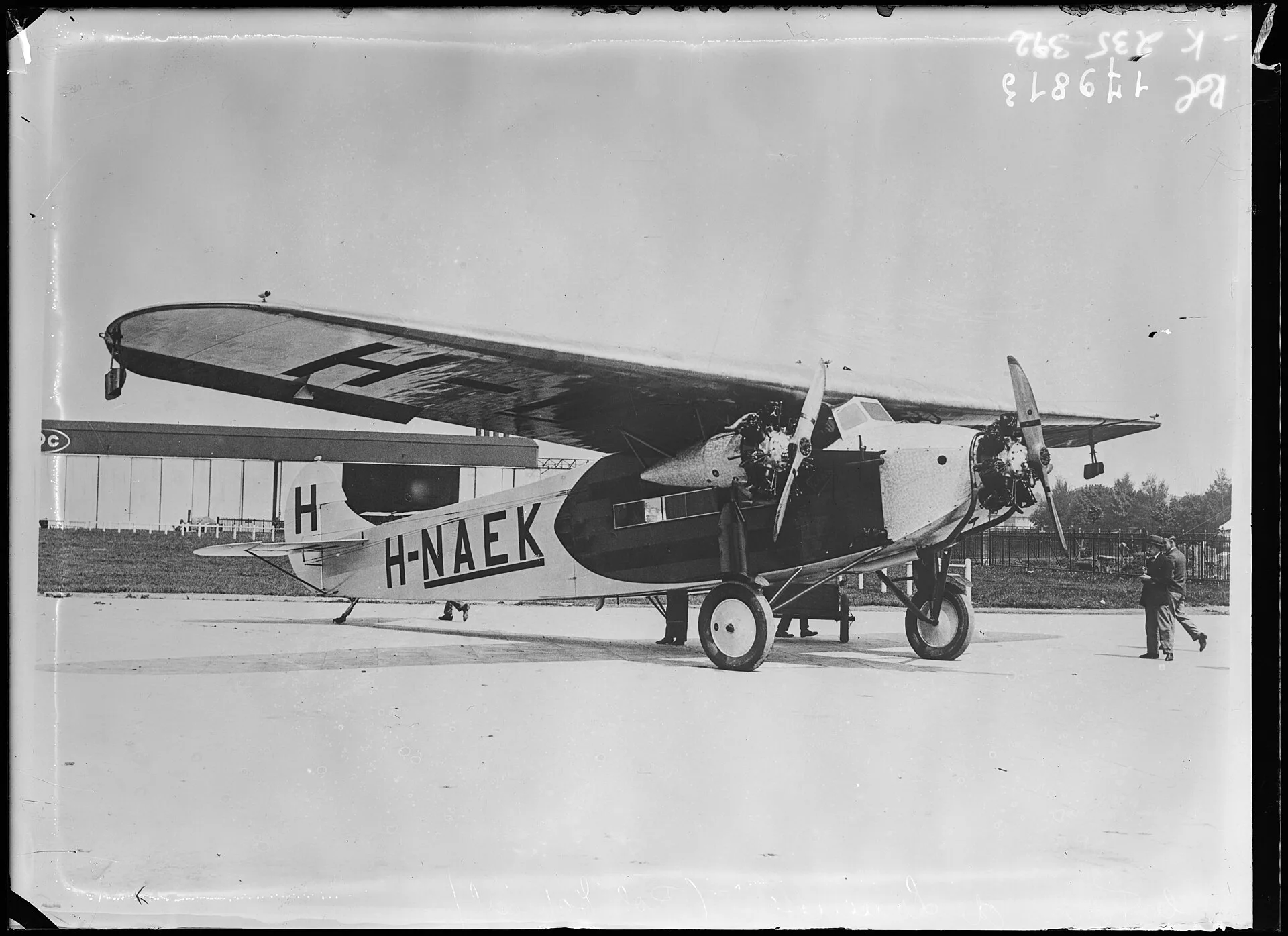
Alfred Loewenstein was born in Brussels in 1877, the son of a banker, and by the 1920s had become one of the most talked-about financiers in Europe. He made his fortune in hydroelectric and power companies in the developing world and in the new artificial silk industry, and in 1926 he launched an investment trust, International Holdings and Investments, that drew in large sums from wealthy backers. Newspapers called him the flying financier: he kept a small fleet of aircraft and commuted between his homes in Belgium, England and Biarritz by air with a retinue of secretaries.
What happened
A little after six in the evening on July 4, 1928, Loewenstein took off from Croydon airport, south of London, for Brussels in his Fokker F.VII trimotor. With him in the cabin were his valet, Fred Baxter, his secretary, Arthur Hodgson, and two stenographers. The pilot, Donald Drew, and the mechanic, Robert Little, sat in a closed cockpit with no direct way into the cabin. The weather was fair, and the plane climbed to about 4,000 feet over the Kent coast and headed out across the Channel.
At the back of the cabin a door opened onto a small passage. On one side was the lavatory; on the other was the aircraft’s outer door. Loewenstein went back to the lavatory and did not return. When one of his staff went to check, the lavatory was empty and the outer door was open, swinging in the slipstream. The crew did not head for the nearest airfield but put the Fokker down on a beach near Dunkirk, where soldiers training nearby ran over to meet it, before flying on to the airfield at Saint-Inglevert.
The investigation
The news broke the next day and sent shares in Loewenstein’s companies tumbling across Europe. The New York Times reported a London mood of baffled speculation and an early theory of suicide. French and British authorities quickly tried to test the obvious explanation, that he had simply opened the wrong door. On July 6 mechanics at Le Bourget outside Paris experimented on a similar Fokker and found the door very hard to open in flight, and on July 12 the British Air Ministry ran trials with Loewenstein’s own aircraft. According to press reports of the British test, a man thrown against the door in the air could barely push it open before the airflow slammed it shut again. Officials doubted that he could have fallen out by accident.
On July 19 fishermen recovered a body from the sea near Boulogne. It was identified as Loewenstein’s partly by his wristwatch. A post-mortem examination found a fractured skull and broken bones; the doctors judged that he was still living at the moment of impact. He was buried near Brussels in his wife’s family tomb, under a slab that never bore his name. No charges were brought against anyone.
The explanations
Loewenstein’s secretary told reporters he believed his employer had absent-mindedly opened the wrong door, a habit he was said to have. Suicide was suggested from the first day, on the theory that his heavily borrowed empire was in trouble; reports noted that investors had recently insured his life with a policy that covered suicide. Murder became the favorite of later writers. In his 1987 book The Man Who Fell From the Sky, the journalist William Norris argued that Loewenstein was thrown out by people on board on behalf of business associates, and that the door was removed in flight and replaced on the beach. The historian Giles Milton has suggested the valet and secretary acted with the knowledge of the others aboard. Some crime writers have even proposed that he faked his death. None of these theories has been supported by documents, confessions or physical evidence.
Where it stands
The case has been revisited in books and broadcasts, including a 2014 BBC Radio 4 investigation by Steve Punt, without resolution. What can be established is narrow: Loewenstein went through the rear door of his own aircraft over the Channel and died in the sea. Whether he fell, jumped or was pushed is unproven.