
In the forested foothills of the Cordillera del Cóndor in southeastern Ecuador, on a plateau between the Santiago and Coangos rivers, a hole in the jungle floor drops some fifty to sixty-five meters into darkness. The Shuar people who own the land have long climbed down it on ladders of poles and lianas to harvest young oilbirds, the nocturnal, cave-nesting birds called tayos, and the cave takes its name from them. It is a real and impressive place, about 4.6 kilometers of passages descending around 200 meters to a sump, and among the longest caves in the country. It is also the setting for one of the most durable treasure legends in South America.
The claim
The legend’s modern form comes from János, or Juan, Móricz, a Hungarian-born adventurer who emigrated to Argentina in 1950 and settled in Ecuador in 1967. He held theories that humanity originated in Ecuador and that the region’s Indigenous peoples spoke a form of Hungarian, and in the late 1960s he began telling people that tunnels beneath the region held mounds of gold, strange sculptures and a library of metal plates. He never gave an exact location, and Mormon explorers he led in 1968 in the hope of finding scriptural golden plates came back with nothing. Móricz drew on the collection of Carlo Crespi, an Italian priest in Cuenca whose church museum was filled with metal objects said to have come from the Shuar, and on stories later told by Petronio Jaramillo, who said he had been shown the library as a boy.
The cave became world famous in 1972 with Erich von Däniken’s Gold of the Gods, which described being taken into it by Móricz and seeing machine-cut tunnels, furniture of gold, and thousands of etched plates recording a forgotten history, implicitly of extraterrestrial origin. Móricz soon told the German magazine Der Spiegel that von Däniken had misrepresented his work, and in a 1974 Playboy interview von Däniken admitted dramatizing his visit.
The 1976 expedition
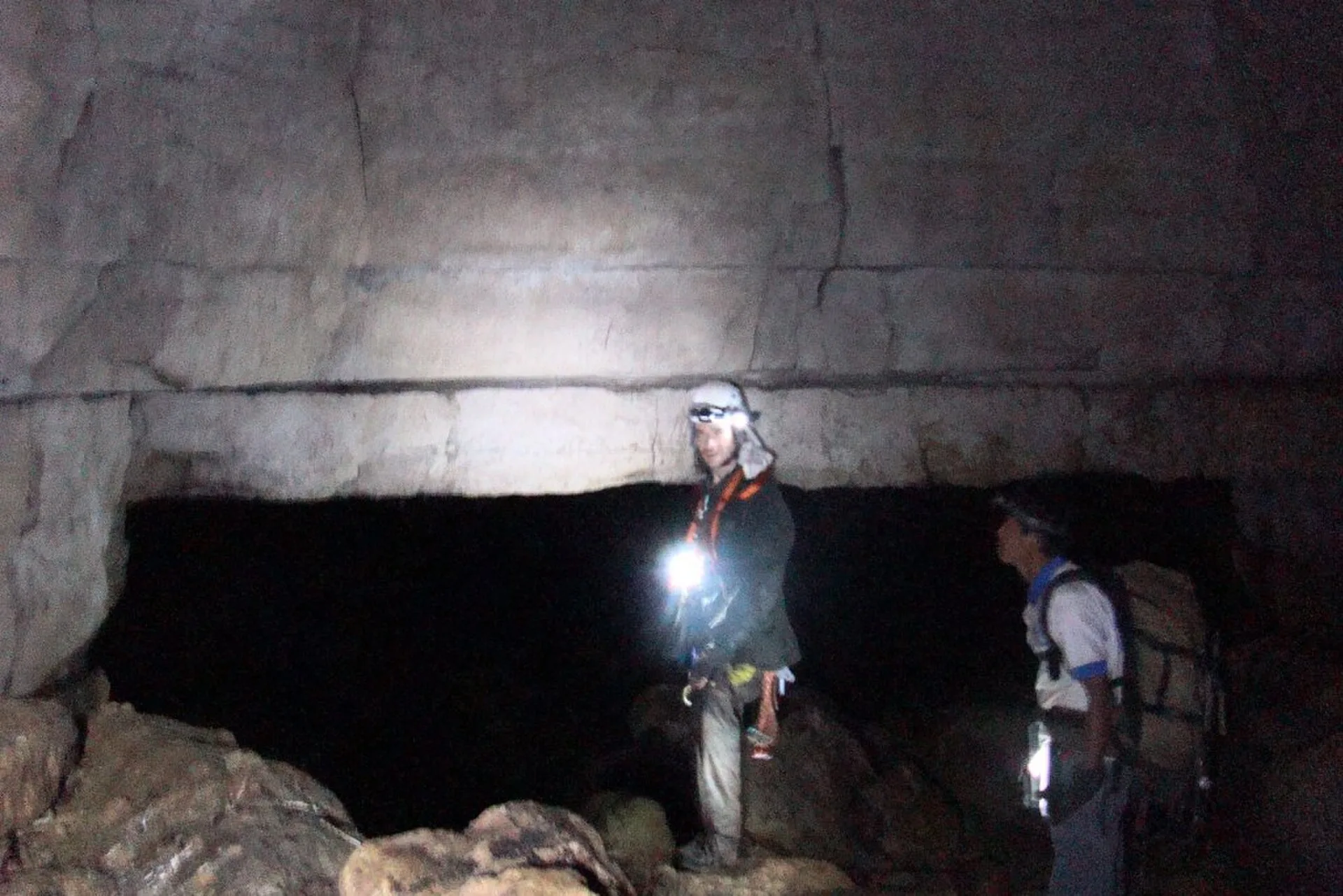
Stan Hall, a British amateur archaeologist from Dollar in Scotland who had read von Däniken, organized the largest investigation of the cave. Run by Major Chris Browne of the British Army with the Ecuadorian military, it brought more than a hundred people to the cave in the summer of 1976, including more than twenty scientists, mostly zoologists and botanists, with as many Ecuadorian colleagues, a team of eight British cavers and, as honorary president, Neil Armstrong, whose family roots lay in Hall’s hometown. The cavers descended the entrance shaft, rigged a winch to lower scientists and soldiers, and surveyed the system down to the sump. One of them, J. C. Whalley, later wrote that the supposed molten rock and giant masonry in von Däniken’s photographs were simply flowstone and the natural joints of limestone. Armstrong, flown in near the end, was taken down to the sump and back up in a single hurried trip.
The scientists cataloged bats, insects, spiders and seedlings sprouting from oilbird droppings. Near the foot of a second daylight shaft the team found pottery fragments and seashells that the Ecuadorian archaeologist Pedro Porras judged to be thousands of years old, and later accounts describe burials dating to about 1500 BC. Armstrong’s verdict, as later quoted, was that the expedition had concluded the caves were natural formations, and the Ecuadorian government’s report classified Tayos as a karst cave rather than an archaeological site.
The aftermath
Von Däniken and Móricz said Hall had searched the wrong cave, a response repeated after every empty-handed expedition since. Hall and Móricz fell out over who deserved credit as discoverer. Móricz died in 1991 without having shown anyone the treasure, and Jaramillo was killed in 1998, also without revealing his site. In 2005 Hall published coordinates for the true treasure cave, a spot about two kilometers upriver where no cave has been found, and he died in 2008. Crespi’s collection, which even skeptics grant held some interesting pieces, was later lost or sold off and is known today mostly from photographs.
Where it stands
Expeditions keep coming. A Polish expedition explored the cave in 2012, Ecuadorian cavers returned in 2019, and in 2018 the television series Expedition Unknown visited with Hall’s daughter Eileen. Visits require permission from the Shuar federation. The cave is fully mapped limestone with an Indigenous and prehistoric past of real interest. The metal library has never produced a single plate.