
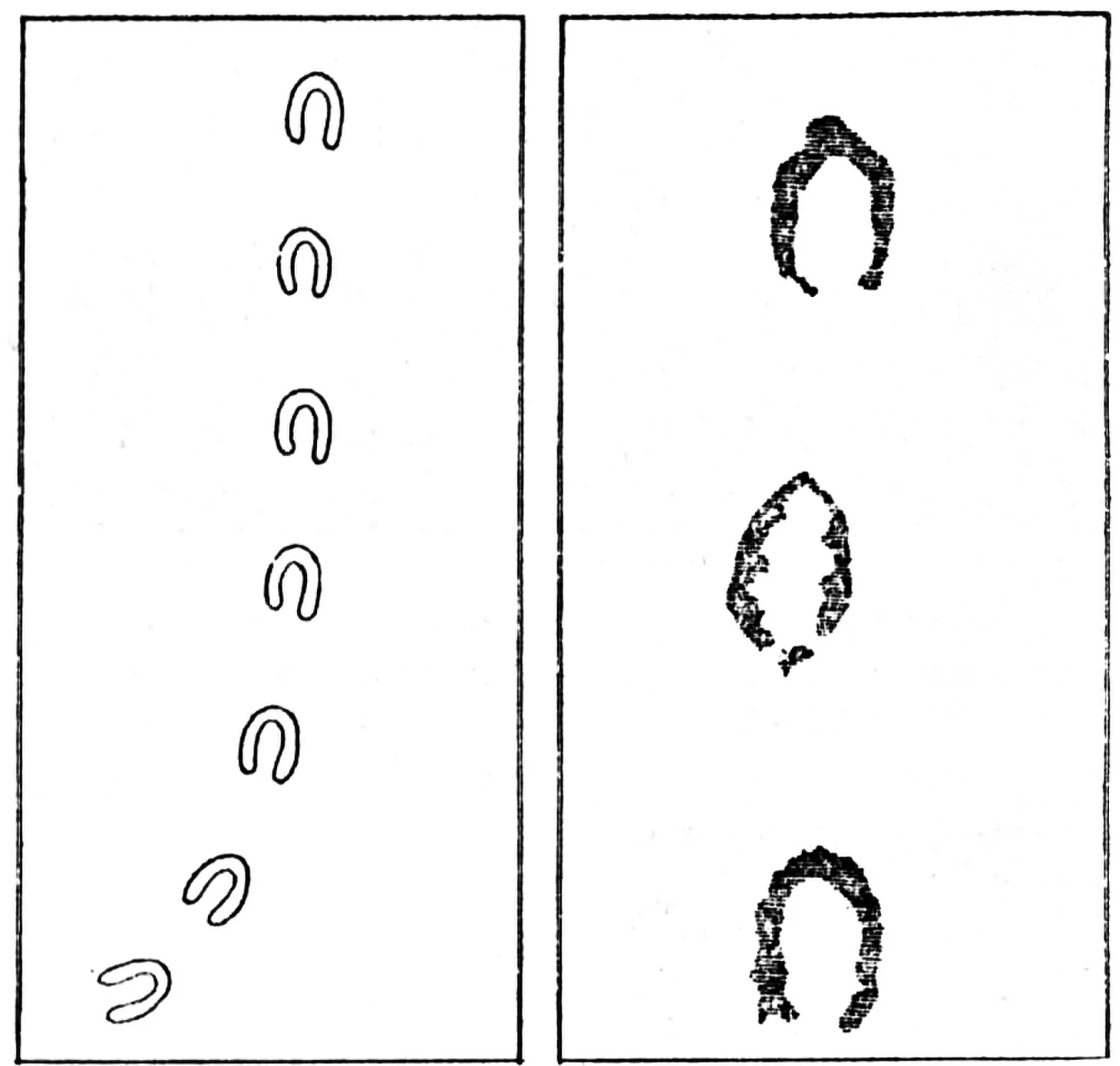
In February 1855 south Devon lay under an unusually heavy fall of snow. On the morning of February 9 people in Topsham, Exmouth and a string of other places on both sides of the Exe estuary found tracks in it that they could not identify. Within days the marks had acquired a name, the Devil’s footprints, and within months the story was being reprinted as far away as Sydney.
What happened
Descriptions written at the time agree on the basics. Each print was about four inches long and three across, shaped like a small hoof or horseshoe, and set in a single line eight to sixteen inches apart, as if left by something walking on two legs rather than four. Witnesses said the line ignored obstacles: it went up and over snow-covered roofs, along the tops of high walls, across haystacks, and in and out of drainpipes only four inches wide. Reports eventually came from more than thirty places in Devon, from Exmouth and Topsham across the estuary to Dawlish and Teignmouth. Added together, the trails were said to run for anywhere between 40 and 100 miles.
The Times reported the marks on February 16, local papers such as the Western Times followed, and the Illustrated London News printed letters about them into March. Some accounts had the line crossing the Exe estuary, a stretch of water about two miles wide. The vicar of Withycombe Raleigh suggested escaped kangaroos from a private collection, and later admitted he had floated the idea mainly to calm his anxious parishioners.
The investigation
No one followed a trail from end to end, and there was no official inquiry. The most useful evidence surfaced almost a century later. After the folklorist Theo Brown published an article on the case in 1950, papers belonging to Henry Thomas Ellacombe, vicar of Clyst St George, came to light. They included letters from other clergy, a draft letter to the Illustrated London News marked not for publication, and tracings of the prints. The skeptic Joe Nickell later pointed out that witnesses’ descriptions of the marks differ noticeably. In 1994 the historian Mike Dash collected every known primary and secondary source in a long study for the journal Fortean Studies. Investigators have since argued that nobody could have walked the whole supposed route in a day, and that the single hundred-mile line was assembled by joining separate local reports.
The explanations
Naturalists offered candidates almost at once. The anatomist Richard Owen argued in the Illustrated London News that the prints were a badger’s, enlarged and blurred as the snow thawed and refroze. In the issue of March 10 a correspondent, Thomas Fox, proposed a small rodent: a wood mouse bounding through snow lands with its feet together and can leave a mark like a tiny cloven hoof, and it climbs walls and runs through pipes with ease. Other suggestions over the years have included otters, rats, swans and a stray balloon from Devonport dockyard trailing its mooring shackles, the last based on a later and unverified story. Dash concluded that no single cause fits. Some tracks were probably hoaxes, others came from ordinary animals, ponies and donkeys among them, and a share from small rodents such as wood mice, and he conceded that these explanations do not account for every report.
Where it stands
Similar marks have been reported elsewhere, in the Glenorchy area of Scotland in 1840 and at Girvan on the Ayrshire coast in 2013. The Devon prints of 1855 were real, and many people saw them across a wide area on the same morning. What is not supported is the version that made them famous, of one creature striding a hundred miles through walls and over rivers in a single night. That part is the product of retelling. The rest is a collection of ordinary marks in the snow that were never fully sorted out.