
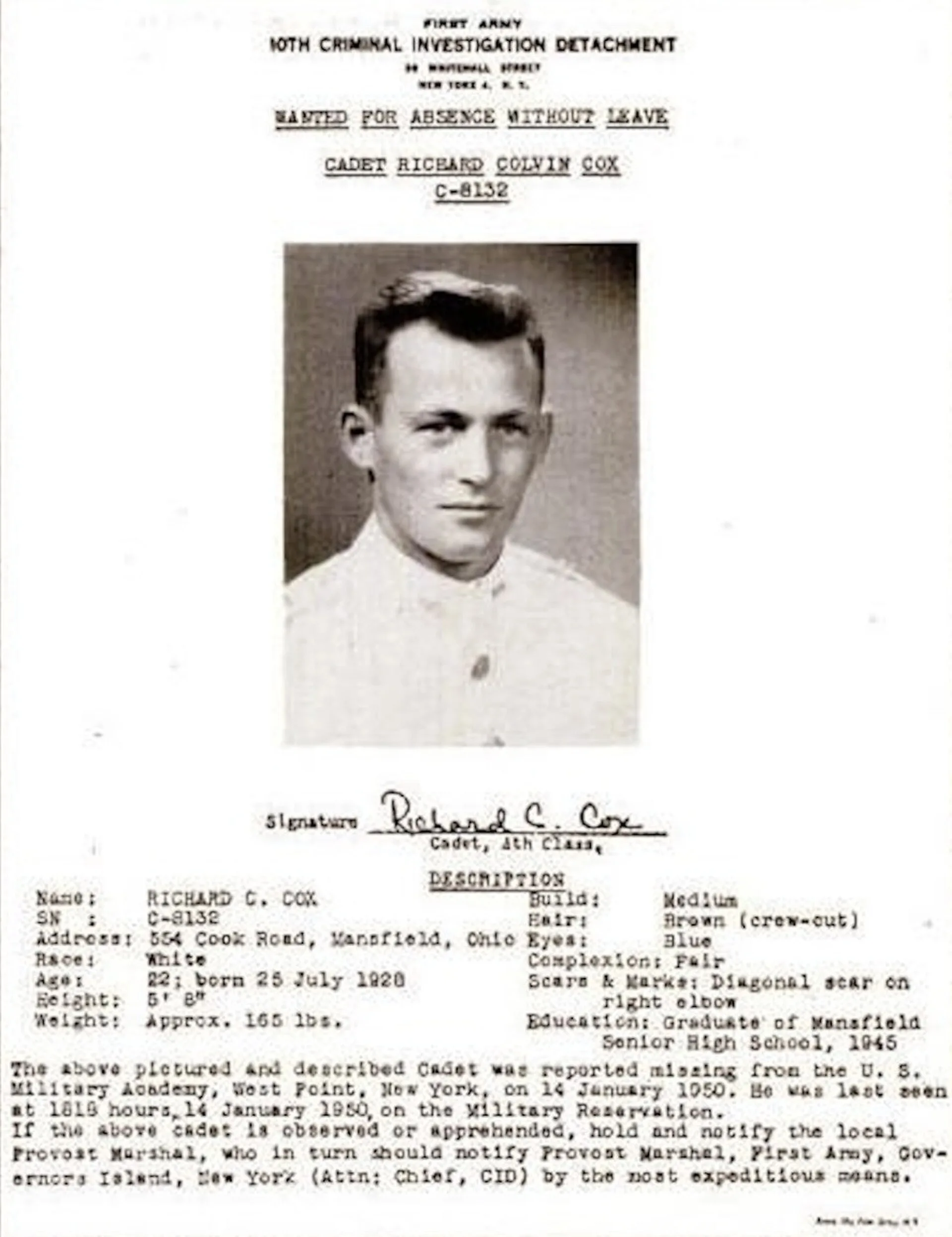
The West Point Register of Graduates and Former Cadets runs to more than 70,000 entries. One of them, filed with the Class of 1952, reads simply that Richard Colvin Cox “mysteriously disappeared 14Jan50.” In the history of the United States Military Academy he is the only cadet to have walked off the post and never been found, alive or dead.
The cadet
A Mansfield, Ohio, boy born on July 25, 1928, Cox was a class officer and honor student at Mansfield High School. After graduating in 1946 he enlisted, served in occupied Germany with the 27th Constabulary Squadron in an intelligence office and made sergeant, then won an appointment to West Point and entered in July 1948. He stood in the upper third academically, ran cross-country and was voted the outstanding second-year cadet in his company. At home in Ohio his girlfriend, Betty Timmons, was planning their wedding for after graduation.
The visitor
Late on the afternoon of Saturday, January 7, 1950, the cadet on duty in Cox’s company took a phone call from a man with a rough, offhand manner. Tell Cox that George called, the man said; they had known each other in Germany, and he wanted to buy him dinner at the hotel. When Cox got the message he seemed puzzled and said he did not remember anyone called George. Shortly afterward a man in a belted trench coat came into Grant Hall and asked for him. The two shook hands and joked like old acquaintances, and Cox signed out for dinner.
He was back in his room after 7 p.m., cheerful, and soon passed out at his desk. When the bugle sounded at lights-out he woke with a start, ran into the hallway and shouted something like “Alice!” down the stairwell. The next day he told his roommates that they had never eaten. They had sat in the man’s car drinking whiskey, and the visitor would not let him go until the bottle was finished, then made him promise to meet again that afternoon, which Cox did reluctantly. Over the week he added more: the man had been in his unit in Germany, was a former Ranger, bragged about mutilating German soldiers during the war and claimed to have killed a German woman he had made pregnant. “The morbid guy,” Cox called him, adding that he hoped this was the last of him. Investigators later found that he had also doctored the sign-in book that evening to hide a missed supper formation, an honor-code breach that could have ended his career.
On Saturday, January 14, after watching Army beat Rutgers at basketball, Cox was seen talking with a man near his barracks. He changed into his full-dress uniform and long gray overcoat, told his roommate Deane Welch he expected to be back by nine or nine-thirty, and left at 6:18 p.m. Nobody at West Point saw him again.
The investigation
By the next afternoon a 13-state alarm had gone out, and New York state troopers and the Army’s Criminal Investigation Division were on the case. Troops searched buildings and walked the trails, Delafield Pond was drained and Lusk Reservoir dragged. The FBI soon joined, on J. Edgar Hoover’s instructions. Investigators traced soldiers named George who had served with Cox and found that almost none could have been at West Point that week. Cox had left behind $87 in cash, two civilian suits and the gold watch he prized, which argued against a planned departure; but an unfinished letter to his fiancée had a little sketched face spitting on the academy’s printed name. On March 15, 1950, he was dropped from the rolls.
In 1954 a former prep-school classmate, Ernest Shotwell, told the FBI he had met Cox at a Washington, D.C., bus station restaurant in March 1952; the man answered to the name, said he had quit the academy and was heading for a job in Germany, and left after a few minutes. In 1960 an informant described a man in a Florida bar, calling himself R. C. Mansfield, who claimed to be Cox. A prisoner named Cox reported in a Soviet labor camp proved to be someone else. Ohio declared Cox legally dead on January 14, 1957, and the Army closed its file.
The explanations
From 1985 a retired Florida history teacher, Marshall Jacobs, obtained some 1,500 pages of FBI and Army files and interviewed dozens of people. His conclusions, set out in Harry Maihafer’s 1996 book Oblivion, shifted over time. In 1988 he favored the idea that Cox had obtained a false identity and simply started a new life. By the mid-1990s he believed “George” was a soldier from Cox’s unit in Germany with a shadowy career, possibly a recruiter for the CIA, and he was told by an unnamed retired CIA officer that Cox had spent a career smuggling people out of the Soviet bloc. None of this was ever confirmed. Other possibilities raised over the years, murder by the visitor or revenge for testimony Cox claimed to have given at a trial in Germany, are equally unproved.
Where it stands
No theory cleanly explains both the money and watch left behind and the sightings after 1950. With some files missing and others heavily redacted, even Jacobs accepted that the full story would probably never be known.