
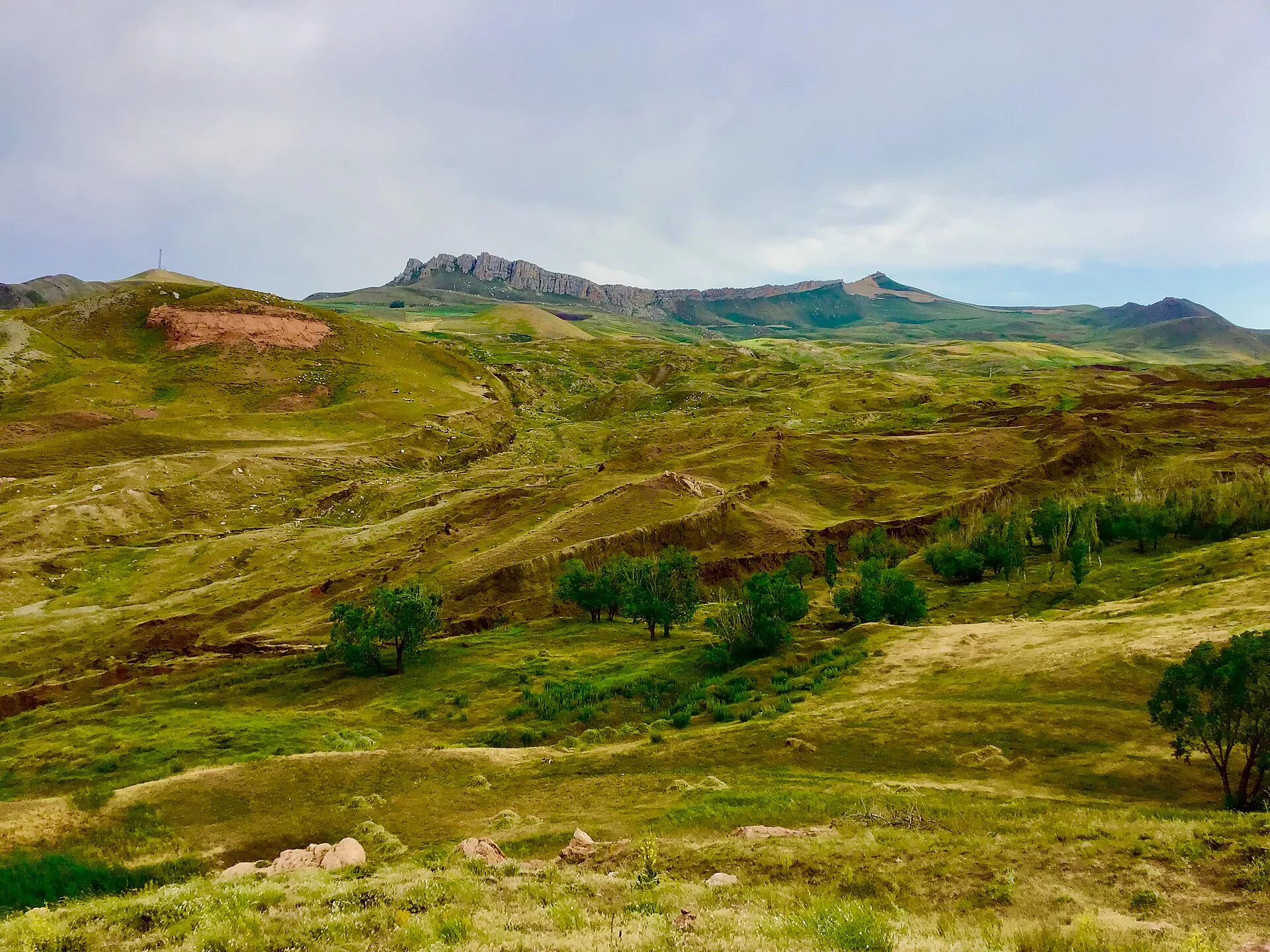
Genesis says the ark came to rest on the mountains of Ararat, and the tallest peak in the region, the 5,137-meter volcano in far eastern Turkey that now carries that name, has drawn ark hunters for centuries. About 29 kilometers to its south, beside the village of Üzengili and a few kilometers from the Iranian border, lies a different candidate: an oval, pointed mound roughly 160 meters long at an elevation of about 2,000 meters, standing out from a slope of mud and rubble like a ship run aground. Since 1959 it has been promoted, more persistently than any other spot, as the ark’s true resting place.
How it was found
Local accounts say heavy rains and earthquakes in May 1948 washed away the mud around the formation. It came to wider notice in October 1959, when İlhan Durupınar, a Turkish army captain, spotted its outline on aerial photographs taken by the Turkish Air Force for a NATO mapping survey, and the site took his name. The next year he went back with an American team sponsored by the Archaeological Research Foundation, led by the television evangelist George Vandeman with the photogrammetry specialist Arthur Brandenberger. LIFE magazine covered the trip in its issue of September 5, 1960. One member said he could not see how nature had produced such symmetry, but after two days of digging and blasting the team found only soil and stone and concluded the object was not man-made.
The ark claim
Interest revived in 1977, when Ron Wyatt, a nurse anesthetist and amateur archaeologist who had read the LIFE story, began visiting the site. Wyatt said metal detector and radar surveys showed internal walls, decks and thousands of iron fittings in a regular pattern, that he had found petrified ship’s timbers, and that large holed stones in a village some distance away were drogue anchors hung from the vessel. In 1985 he was joined by David Fasold, an American marine salvage specialist, and the geophysicist John Baumgardner. Fasold calculated that the mound’s length matched the Bible’s 300 cubits if measured with the Egyptian cubit, counted nine internal divisions like those of the boat in the Epic of Gilgamesh, and published The Ark of Noah in 1988. Turkish cultural authorities, responding to the publicity, declared the area a national park.
The geology
The claim fell apart from inside. After nine trips, Fasold grew uneasy that Turkish authorities would not excavate and asked the geologist Lorence Collins of California State University, Northridge, to examine his samples. Their joint paper, published in the Journal of Geoscience Education in 1996, reported that the prize iron bracket recovered in 1985 was a lump of limonite granules mixed with clay, quartz and calcite, its composition varying from point to point in a way smelted iron never would. The supposed walls were bands of iron minerals following the tilted layers of a doubly plunging syncline, a rock fold shaped like a canoe, which erosion had scoured into its present profile; magnetite and goethite set off a metal detector just as iron does. The timbers were volcanic pebbles, a sample hailed as fossil gopherwood bark was crinkled metamorphosed peridotite, and the anchor stones were local andesite of a kind found around Ararat but not in Mesopotamia. Fossil-bearing limestone cuts across the fold, which would make the formation older than any flood deposits. No wood or plant carbon had turned up in trenches or cores. The two men concluded that the mound was entirely natural and had never been a boat or a model of one, though Fasold suggested the ancients might have pointed to it as the ark.
Other geologists, including Murat Avcı, have tied the shape to the Telçeker earthflow that moves down the valley around it, and a 2025 report by Turkey’s mineral research agency again described a natural landslide-related structure.
Where it stands
Wyatt’s followers and a succession of ark ministries have kept the claim alive. In 2023 a team from Istanbul Technical University, Ağrı İbrahim Çeçen University and Andrews University in Michigan reported soil samples suggesting human activity in the area between about 5500 and 3000 BC, while the project’s own vice rector said that was nowhere near evidence of an ark. In September 2026 a U.S. group called Noah’s Ark Scans and Sivas Cumhuriyet University began drilling cores up to 18 meters deep, saying radar showed something other than solid rock; by the end of September no wood had been identified and lab results were expected into 2027. The formation’s resemblance to a ship is real. Every physical test of what it is made of has pointed to rock.