
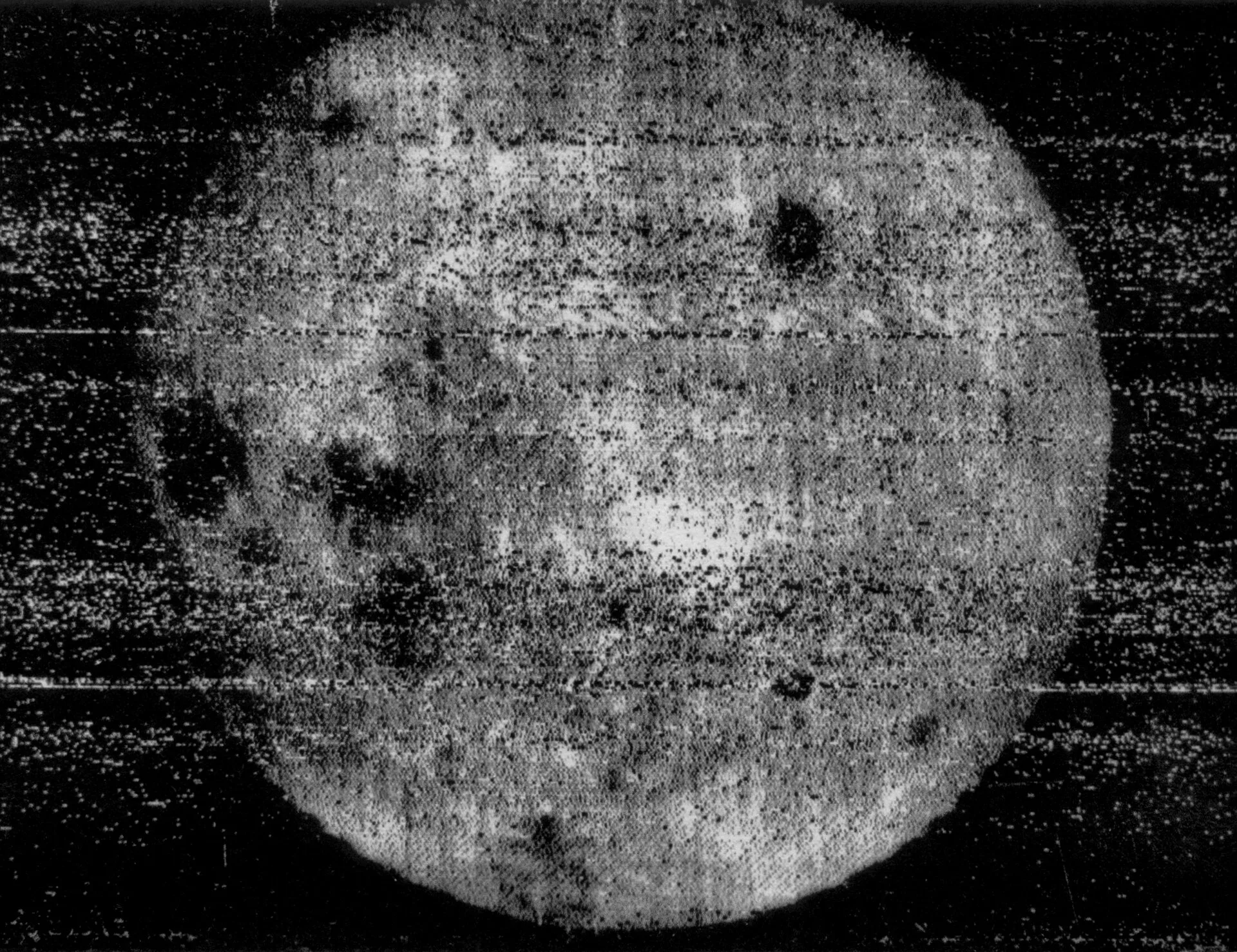
The Moon turns on its axis exactly once for each orbit of the Earth, so it always keeps the same face toward us. Until 1959 nobody had seen the other half. That hemisphere is usually called the far side, but in popular speech it became the dark side, a phrase that suggests a place permanently in shadow and, by extension, a place where things could be hidden. The first photographs of it, taken by a Soviet probe in October 1959, ended the first mystery and started a long run of legends.
What happened
Luna 3 was launched from Baikonur on October 4, 1959, two years to the day after Sputnik. Rather than strike the Moon or fly past it, it looped behind it on a path designed to bring it back toward Earth. On October 7, after passing the Moon, it turned its camera back toward the sunlit far side and over about forty minutes took 29 photographs from roughly 63,500 kilometers away. The film was developed, fixed and dried on board, then scanned and transmitted to ground stations as a television-style signal over the following days.
The pictures that reached the ground were grainy, noisy and low in resolution, but they covered around seventy percent of the far side, and they held a surprise. The near side is marked by broad, dark plains of solidified lava, the maria, that make up the face of the Man in the Moon. The far side had almost none. It was bright, rugged and crowded with craters. The Soviet Academy of Sciences named the features it could make out, including Mare Moscoviense and a crater for the rocket pioneer Konstantin Tsiolkovsky, and published the first atlas of the far side in 1960.
The legends
The name did the rest. Because the hemisphere had been invisible, it was easy to imagine it as secret, and because it was called dark, many people assumed it never saw the sun. In science fiction and later in conspiracy writing it became the natural place for hidden alien bases, abandoned cities or secret military installations. Luna 3’s blurry images, and the Soviet and American secrecy of the Cold War, made the idea that something was being withheld seem plausible.
The modern form of the claim centers on the writer Richard C. Hoagland. At a 1996 press conference in Washington, he presented computer-enhanced Apollo photographs that he said showed ancient artificial structures on the Moon, including a glittering glass-like object apparently hanging miles above the surface. A NASA spokesman said flatly that the agency had found no such structures. In a 2007 book Hoagland and Mike Bara argued that NASA hides evidence of lunar ruins; the astronomer Phil Plait showed that one featured “glass” structure was a reflection inside the camera that took the picture, shaped by its five-sided aperture. Similar claims about a pyramid or tower usually rest on heavy contrast enhancement of old film, which turns grain, lens flare and shadows into apparent shapes.
The explanations
The far side is dark only in the sense of unseen from Earth. It receives the same amount of sunlight as the near side; when the Moon is new, and looks dark to us, the far side is in full daylight, which is exactly how Luna 3 could photograph it. Nor has it stayed unseen. NASA’s Lunar Orbiter missions mapped it in the 1960s, Apollo 8’s crew became the first people to see it with their own eyes in December 1968, and NASA’s Lunar Reconnaissance Orbiter has since produced elevation maps and mosaics detailed enough to recreate Luna 3’s exact view. Chinese, Japanese and Indian spacecraft have imaged it too, and China’s Chang’e 4 landed a rover there in 2019.
Where it stands
Luna 3’s achievement is real and historic. The legend that grew around it rests on a misleading name and on enhanced images. Decades of independent observation by rival nations, each with every reason to expose the other’s secrets, show a cratered, airless landscape and nothing artificial.