
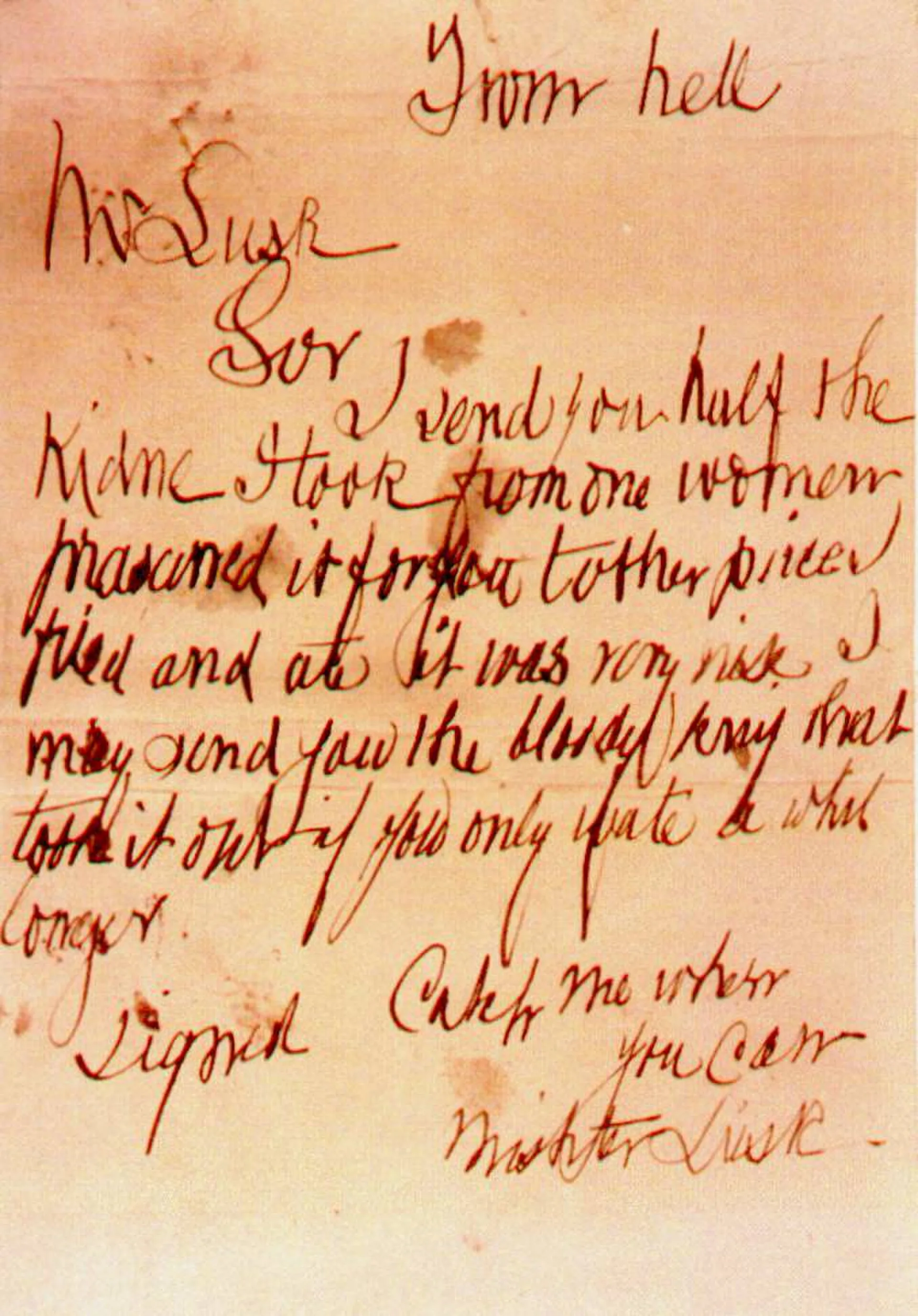
By October 1888 four women had been murdered in Whitechapel and the East End had organized itself. The Whitechapel Vigilance Committee, a group of local tradesmen who paid for patrols and petitioned the Home Office for a reward, was chaired by George Lusk, a builder who lived on Alderney Road in Mile End. On September 30 Catherine Eddowes had been killed in Mitre Square, inside the City of London, and the surgeon who examined her, Dr Frederick Gordon Brown, had told the inquest that her left kidney had been cut out and taken away.
What happened
On the evening of October 16 a small parcel arrived for Lusk by post. Inside the brown paper was a cardboard box, and inside the box was half of a kidney, preserved in spirits, and a letter. The note was headed “From hell” and addressed to “Mr Lusk.” In misspelt, half-literate English it said the writer had kept the piece of kidney for him from one woman, that he had fried and eaten the other half, and that it was very nice. It signed off with a taunt to catch him when he could, and carried no “Jack the Ripper” signature.
Lusk assumed a prank by a medical student and put the box in a drawer. Colleagues on the committee pressed him, and on October 18 the kidney was taken to a surgery on Mile End Road, where an assistant named F. S. Reed judged it human and carried it to Dr Thomas Horrocks Openshaw, curator of the pathological museum at the London Hospital. The next day’s papers, quoting committee member Joseph Aarons, had Openshaw saying it was the left kidney of a woman of about 45 who drank heavily, removed within the last three weeks. Openshaw disowned most of that within a day. He would say only that it was half a human left kidney, and that preserving it in spirits made it impossible to tell its owner’s sex or how long ago it had been removed. The committee handed the parcel to the police at Leman Street, who passed it to the City force whose case Eddowes was.
The investigation
The City of London Police photographed the letter between 20 and October 24 before returning it to Scotland Yard, and that photograph is the only record that survives. The original has been missing for decades; a facsimile was published by the pathologist Francis Camps in 1966, and a copy hangs in the Royal London Hospital’s museum. The kidney went to Dr Gordon Brown. His formal report has never been found, but in a press interview he said the specimen had been trimmed, had no renal artery attached and showed no decomposition, which made him doubt it came from the Mitre Square victim. The opposite view came much later from Major Henry Smith, the acting City commissioner in 1888, whose 1910 memoir claimed both the specimen and the kidney left in the body showed advanced Bright’s disease and that two inches of artery remained in the corpse to the one inch on the parcel. Smith’s memoir is unreliable on almost every checkable detail, yet his version is the one most often repeated.
One lead pointed to a face. The Daily Telegraph of October 20 reported the account of Emily Marsh, whose father kept a leather shop at 218 Jubilee Street. Shortly after one o’clock on Monday October 15, the day before the parcel arrived, a tall, slim man of about 45 with a sallow complexion, a dark beard and mustache and an Irish accent came in, studied the committee’s reward poster and asked for Lusk’s address, which he wrote in a pocket book. Marsh could give him the street but not the house number. The letter’s spellings of “Sor” and “Mishter” read like a stage Irishman. Lusk told the paper that nobody of that description had called on him, and the stranger was never identified. A second letter in the same ragged style reached Openshaw on October 29 and is now in the National Archives.
The explanations
In 1989 the surgeon Nick Warren went through every medical claim made about the kidney. Only one, that it was human, stood up. The age, sex, drinking habits, Bright’s disease, timing and length of artery were either unprovable from a specimen in spirits or contradicted by the better contemporary witness, Gordon Brown. That leaves the question where it started: half a human kidney, from a dissecting room or from Mitre Square, posted by a hoaxer with access to one or by a murderer with a sense of theater. Handwriting analysts describe a semi-literate writer, and the police of the day leaned toward a medical student’s joke. Historians who have spent longest with the letters, from Philip Sugden to Stewart Evans and Keith Skinner, generally agree that if any communication came from the killer it is this one, precisely because it did not borrow the Ripper name and came with a piece of someone.
Where it stands
The letter cannot be tested because it no longer exists, and the kidney was almost certainly destroyed long ago. What remains is a photograph, a contradictory press trail, and a shop assistant’s description of a man who asked the way to Alderney Road. Whether it was from the killer is a question the evidence stopped being able to answer in October 1888.