
What happened
Centralia sits on the Buck Mountain anthracite seam in Columbia County, in the coal country of east-central Pennsylvania. Coal was first dug there in 1842, the borough was incorporated in 1866, and by 1962 it had about 1,100 people, down from more than 2,700 at its peak. The mines beneath it had closed, leaving a honeycomb of abandoned workings. In May 1962 the borough council had the town dump, which occupied an old strip-mining pit on the southeast edge of town, cleaned up before Memorial Day in the usual way: by setting it alight. The pit, dug around 1935 and roughly 75 feet wide and 50 feet deep, was supposed to have been sealed from the old workings by a barrier of clay and shale. The barrier was incomplete. The fire found the coal.
Exactly how is still argued. The journalist David DeKok, who covered the fire for years and wrote the standard history, puts the burn on May 27, 1962, and blames the volunteer firefighters hired for the job for not putting it out. Joan Quigley, in her 2007 book, argues that hot ash dumped by a hauler the day before had already lit the pit. Either way, state mining officials were on site within weeks, and the first of many attempts to dig the fire out failed.
The slow emergency
For seventeen years the fire crept along the seam and the town mostly lived with it. In 1979 the owner of a gas station, who was also the mayor, lowered a thermometer into one of his underground tanks and found the gasoline at 172 degrees Fahrenheit. Carbon monoxide monitors went into homes. That year the federal Office of Surface Mining bought 34 affected properties and the state began monitoring the air. On February 14, 1981, a twelve-year-old named Todd Domboski was crossing his grandmother’s backyard when the ground opened under him. He dropped into a hole about four feet across and, by most accounts, some 150 feet deep, caught a tree root and held on for about 45 seconds until his cousin pulled him out. The steam pouring from the hole carried lethal levels of carbon monoxide. The story went national.
In 1983 the Office of Surface Mining estimated that putting the fire out would cost $663 million. The same year Route 61, the highway through town, buckled and cracked from subsidence. Congress chose the cheaper option and in 1984 appropriated $42 million to buy out anyone who wanted to leave. By the end of the decade more than 1,000 people had gone and some 500 buildings had been demolished. In January 1992 the state began condemning what was left. The post office later withdrew the ZIP code. Successive governors moved to evict the last holdouts, who sued.
Where it stands
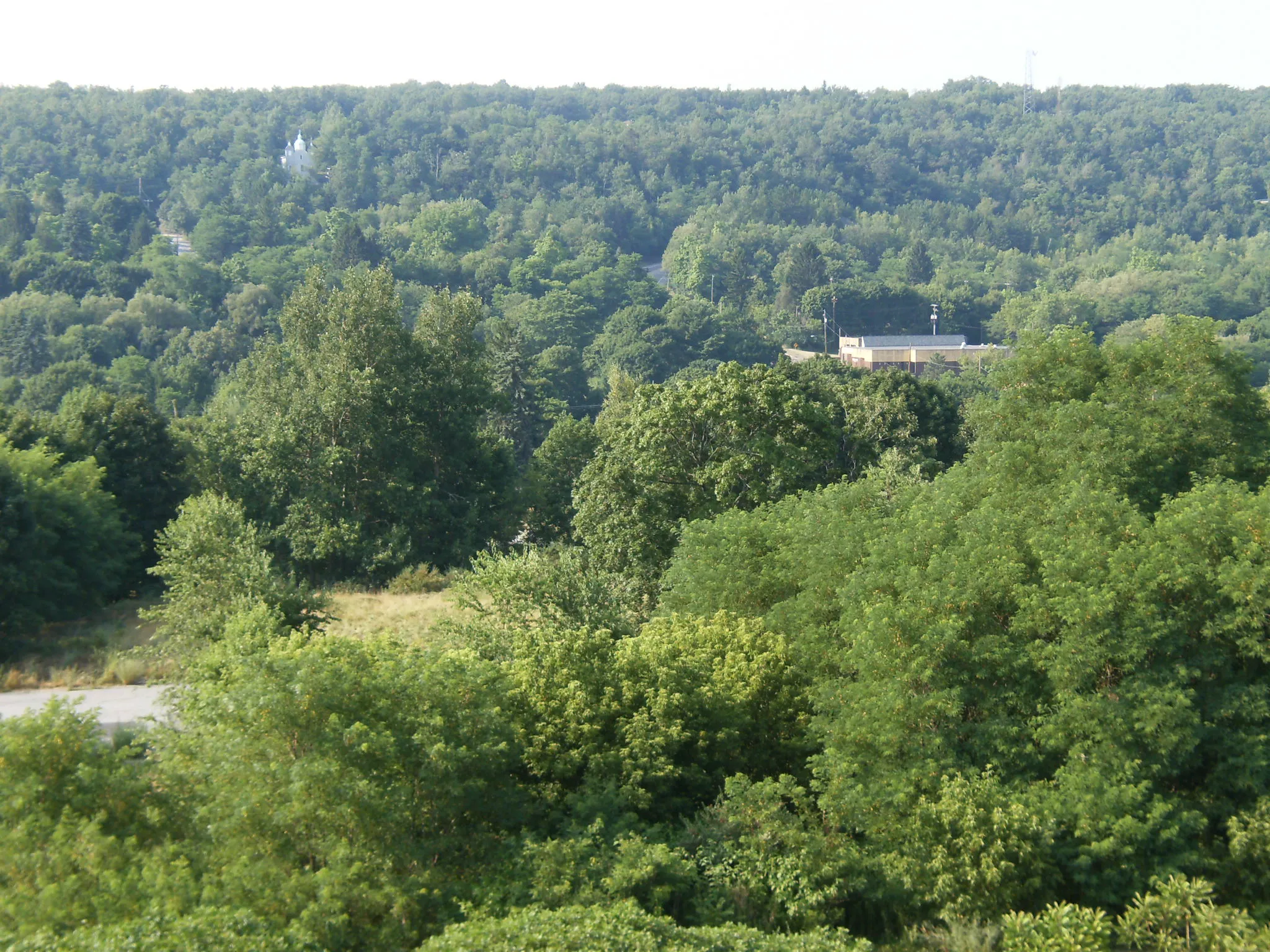
The holdouts partly won. In October 2013, after a federal lawsuit, eight remaining residents settled with the state: $349,500 between them, and the right to stay in their homes for the rest of their lives, after which the properties go to the Commonwealth. Pennsylvania’s Department of Environmental Protection counted five property owners in 2012. The borough still has a council, and on the hill above the empty street grid a church still holds services, because it stands far enough from the fire.
The fire itself is still burning, along several fronts, through hundreds of acres of old workings, and the state’s engineers think it could burn for another century if left alone, which it will be. The ground in the affected area is riddled with vents and prone to sudden collapse, and the department tells visitors to stay away. The abandoned stretch of Route 61 south of town became a canvas for graffiti and a destination in its own right until its owners buried it under dirt in 2020. A fan mythology has grown up around the place, helped by the 2006 film Silent Hill, whose writer has said the town was his model, and Centralia is now filed under ghost towns and even hauntings. It is neither, exactly. The verdict is true: a town was emptied by an underground fire that nobody could put out, and the fire is not finished.