
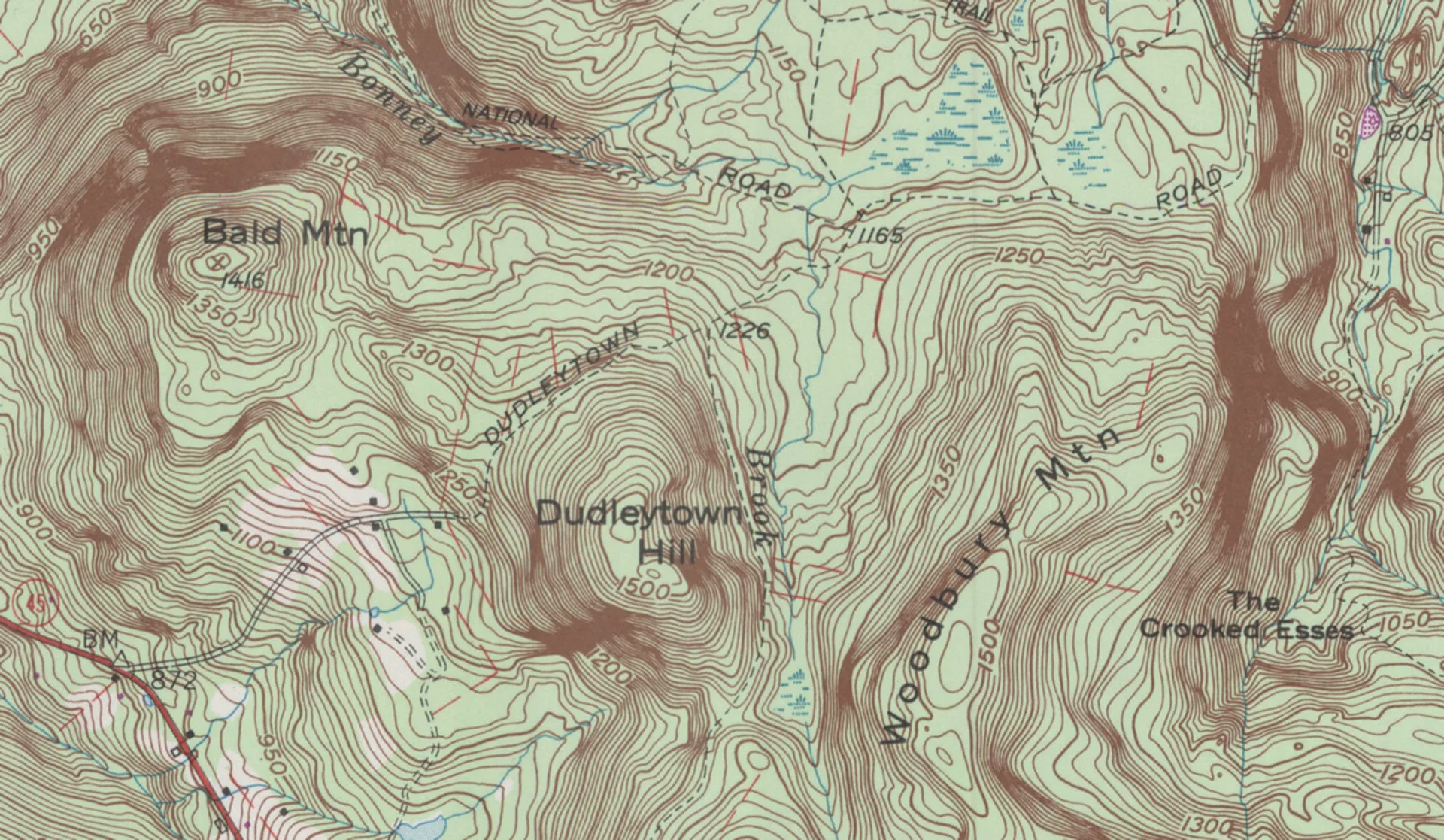
In the hills south of Cornwall Bridge in north-western Connecticut, a dirt road called Dark Entry leads into thick second-growth woods. Somewhere in there are a few stone cellar holes and tumbled walls, all that remains of the farms known as Dudleytown. Online the place is the Village of the Damned, the most haunted spot in New England. In Cornwall it is mostly a nuisance.
The real settlement
Dudleytown was never incorporated and never had a center. The name attached to a corner of Cornwall where several Dudley households farmed, among them Gideon, Abiel and Barzillai Dudley, who arrived in the 1740s alongside other families such as the Griffises. Like most of Cornwall it was cleared for crops and pasture, but it sat high up on thin, stony ground. Through the nineteenth century the local iron trade declined and better land opened in the West, and families drifted away until the hill was empty. That pattern is common across rural New England, where stone walls run through forests that were open fields 150 years ago.
In 1924 a New York physician who kept a weekend house there, Dr. Walter Clarke, formed the Dark Entry Forest Association with friends to buy up the worn-out farmland and replant it. They put in thousands of trees and for a time let a ski club and children’s riding camps use the trails. The association, later incorporated, still owns the land.
The curse
The legend reaches back to Tudor England. Edmund Dudley, a minister of Henry VII, was beheaded for treason in 1510, and his son John, Duke of Northumberland, lost his head in 1553 after trying to put Lady Jane Grey on the throne. A descendant supposedly carried the family’s doom to New England, where it fell on Dudleytown. The roll of victims usually includes Gershon Hollister, said to have been murdered in 1792; a neighbor named William Tanner who went mad; Abiel Dudley, who lost his money and his mind; Nathaniel Carter’s family, killed by Native raiders; General Heman Swift, whose wife died by lightning; Horace Greeley’s wife Mary, said to have hanged herself there in 1872; and Dr. Clarke’s wife, said to have been driven insane.
Much of this first appeared in print in Edward C. Starr’s 1926 History of Cornwall, which gave Dudleytown’s misfortunes a couple of pages. It became a curse in the 1970s, when the self-described demonologists Ed and Lorraine Warren declared the woods possessed, and grew again after The Blair Witch Project made haunted forests fashionable in 1999.
What the records show
Gary P. Dudley, a minister and genealogist descended from the Cornwall family, worked through town and church records, obituaries and newspapers and published his findings in 1999 and in a 2001 book. The Cornwall Dudleys had no traceable connection to the executed nobles. Hollister was not murdered but died in a fall from a rafter at a barn raising. Abiel Dudley lived to about ninety and grew forgetful. The Carter killings happened after the family had moved to the Delaware River wilderness of New York, far from Cornwall, and the three children survived. Swift never lived in Dudleytown. Mary Greeley died in New York City of a lung illness. Clarke’s wife did take her own life, but in New York, years after he bought the property. As for the famous hush in the woods, the New England Historical Society notes that the area was sprayed with DDT in the 1960s.
Where it stands
The haunting has had real effects. Trespassers looking for ghosts led the owners to close the forest. In a 2001 statement Dark Entry Forest, Inc. said police had been called to the area 79 times that year alone and that it would press charges against anyone found on the land. Arrests have continued since; in 2018 two young people turned themselves in on trespass warrants after being caught on a resident’s security cameras. The Cornwall Historical Society’s position is blunt: the land is private, its residents want to be left in peace, and anyone caught trespassing will be arrested. Harriet Clark, a former president of the society, put it more simply still: no ghosts, no spirits, no curse.