
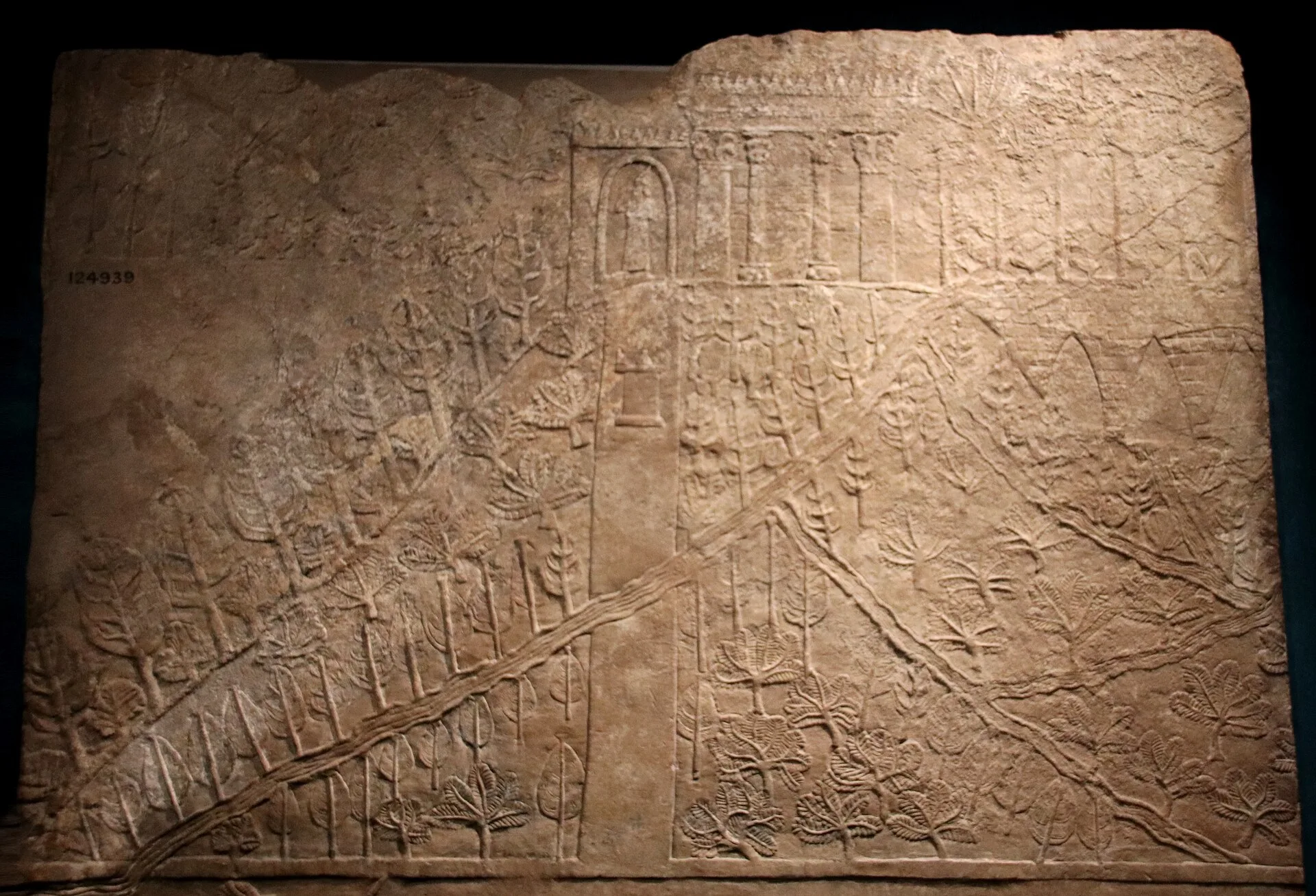
Among the ancient world’s Seven Wonders, the Great Pyramid still stands and the others left at least ruins, sculptures or a firm location behind. The Hanging Gardens of Babylon left nothing anyone has been able to point to. In the classical imagination they were a man-made mountain of greenery rising in terraces above the flat Mesopotamian plain, planted with full-grown trees and kept alive in a near-desert by some clever means of lifting river water to the top. The question is not only where they were, but whether they existed at all.
What happened
The stories reached Europe through Greek and Roman writers. Diodorus Siculus, writing in the first century BC, described tree-covered terraces stepped back like the seats of a theater. Strabo and the later Philo of Byzantium described screws or similar devices that raised water from the river. According to Archaeology magazine, these authors were working from older Greek accounts that have since been lost, many of them written by men who traveled east with Alexander the Great in the fourth century BC.
The famous origin story, in which King Nebuchadnezzar II built the gardens to console a wife homesick for the green hills of Media, comes down through the first-century Jewish historian Josephus, quoting the Babylonian priest Berossus. Josephus is the only later writer to name Nebuchadnezzar, who ruled Babylon from about 605 to 562 BC, as the builder. Other ancient writers credit a vaguely identified “Syrian” king.
The investigation
When German archaeologists led by Robert Koldewey excavated Babylon at the start of the twentieth century, the gardens were high on their list. At the northeast corner of Nebuchadnezzar’s Southern Palace they uncovered a building of fourteen vaulted rooms with unusually heavy walls, and Koldewey proposed it as the substructure that had carried the terraces. The idea did not hold up. Tablets found in the same building recorded monthly rations issued to foreign dignitaries, among them the exiled king Jehoiachin of Judah and his five sons, and the identification has been abandoned in favor of a royal storehouse.
No later work at Babylon has turned up anything better. Archaeology magazine notes that neither the ruins nor the cuneiform tablets excavated there show any trace of such a garden, Nebuchadnezzar’s lengthy building inscriptions never mention one, and Herodotus, who wrote a detailed description of Babylon in the fifth century BC, says nothing about one. The terrain is also a difficulty. Babylon stands on a dead-flat floodplain, and the Assyriologist Stephanie Dalley has pointed out how hard it would have been to raise enough Euphrates water to irrigate trees on high terraces there.
The explanations
Three broad answers are on the table. One is that the gardens were real and stood in Babylon, but were destroyed, perhaps lie under the shifting course of the Euphrates, or have simply not been found. A second is that they never existed as described, and the Greek accounts are a romantic picture of an eastern royal paradise built from rumor.
The third is Dalley’s. An Oxford scholar who reads Assyrian and Babylonian cuneiform, she spent about two decades building the case that the gardens were real but stood at Nineveh, the Assyrian capital on the Tigris some 300 miles to the north. In a 2013 book from Oxford University Press she argued that King Sennacherib, who ruled from 704 to 681 BC, laid out a palace park there. Clay prisms inscribed in his reign describe a park of fruit trees and fragrant plants shaped to look like a mountain landscape, along with bronze devices that lifted water to its terraces, which Dalley reads as an early form of the water screw. Archaeologists have traced a network of canals and aqueducts running some fifty miles from the mountains to supply the city. A relief from his palace, known today only from drawings made after Austen Henry Layard’s excavations in the nineteenth century, shows trees growing on a roofed colonnade, much as the Greek writers described. Dalley also argues that after Assyria sacked Babylon in 689 BC, Nineveh came to be treated as a new Babylon, which would explain how the wonder acquired the wrong address.
Where it stands
The historian Robin Lane Fox, reviewing the book, said it dealt heavy blows to the Babylon orthodoxy yet left him undecided about where the garden really was. Dalley herself told an interviewer she did not know how many colleagues she had persuaded. The Nineveh case rests largely on texts and drawings of a lost sculpture. Until a dig at Nineveh or Babylon produces terraces, root pits and a lifting system together, the most famous garden in history remains a description in search of a site.