
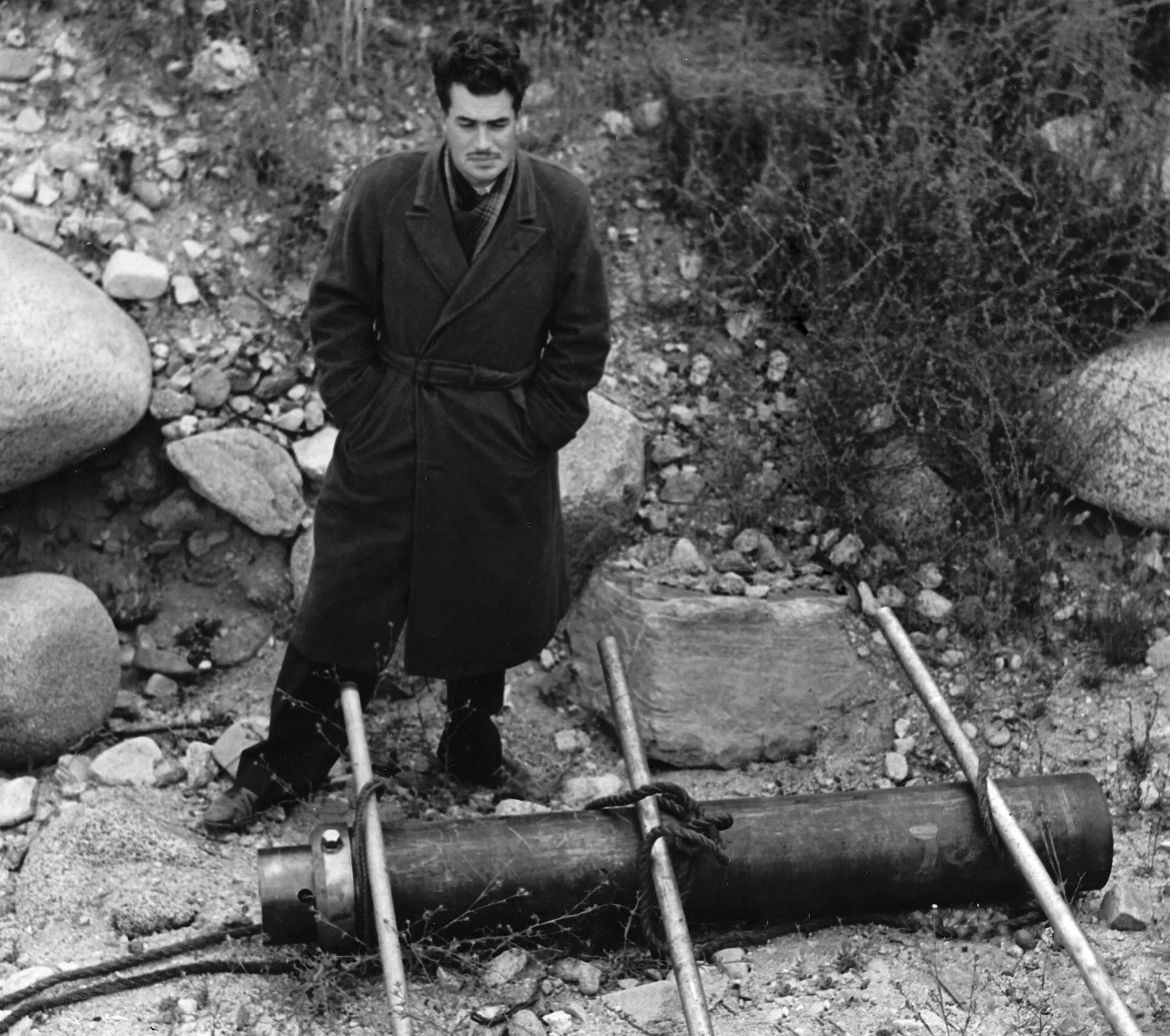
John Whiteside Parsons, known as Jack, never earned a degree, but he was one of the people who made American rocketry work. In the mid-1930s he and his friend Edward Forman, both self-taught enthusiasts, joined the Caltech graduate student Frank Malina in a project to build a liquid-fuel rocket motor. When their experiments proved too dangerous for campus, they moved to a dry wash in the Arroyo Seco north of the Rose Bowl, and on October 31, 1936 they fired their first motor there. That patch of ground became the Jet Propulsion Laboratory. Parsons’ work on solid propellants fed into wartime jet-assisted take-off rockets for aircraft, and in 1942 he was among the founders of Aerojet, the company formed to build them.
The other life
By then Parsons had a second identity. In February 1941 Parsons and his wife Helen joined the Agape Lodge of the Ordo Templi Orientis, the occult order headed by the English magician Aleister Crowley, and he soon led the lodge from a rambling Craftsman mansion at 1003 South Orange Grove Avenue that came to be called the Parsonage. Neighbors complained of strange goings-on, and the FBI opened a file. The order’s reputation and Parsons’ casual way with chemicals helped push him out of Aerojet in 1944. After the war a young navy veteran and science fiction writer, L. Ron Hubbard, moved in. Between December 1945 and March 1946 Parsons and Hubbard performed the Babalon Working, a series of rituals meant to summon a goddess in human form; soon afterward Parsons met the artist Marjorie Cameron, who became his second wife. Hubbard left with Parsons’ girlfriend and much of his money in a failed yacht-buying venture, and a court ordered him to repay only a fraction of it.
Parsons’ later career was unsteady. His security clearance was revoked after an FBI inquiry into his associations, restored, and then threatened again when the FBI investigated him for suspected espionage while he worked at Hughes Aircraft, though no charges followed. By 1952 he was making explosives and film special effects, had just left a job at the Bermite Powder Company in Saugus, and was preparing to move to Mexico with Cameron.
What happened
At about five past five on the afternoon of June 17, 1952 an explosion tore through the laboratory Parsons had set up in a converted coach house on the old Cruickshank estate at 1071 South Orange Grove Avenue. It blew out a wall and the garage doors, punched a hole through the floor beneath where he had been standing and was heard a mile away. Tenants upstairs were thrown about but unhurt. Parsons, terribly injured, was taken to Huntington Hospital and died roughly an hour after the blast; one account records his last words as a protest that he was not finished yet. His mother, Ruth, on hearing the news, swallowed a bottle of sleeping pills and died the same day.
The investigation
The Pasadena police criminalist, Don Harding, concluded that a quantity of mercury fulminate, a shock-sensitive compound used in detonators, had gone off at floor level, probably after Parsons dropped it; the coffee can he appeared to be mixing it in had been shredded into shrapnel. Harding found enough other explosives in the room, many of them experimental and stored there for months against the city fire code, to blow up half the block. Parsons had reportedly been making small batches of fulminate for sale and was filling a last order before the move. The death was ruled an accident.
The explanations
Not everyone accepted that. Bermite’s superintendent told the Los Angeles Times that Parsons was extremely safety-conscious and scrupulously neat. Cameron came to believe Howard Hughes had him killed to protect trade secrets after Parsons left Hughes Aircraft. Others noted that in 1938 Parsons had given expert testimony that helped convict Earl Kynette, a corrupt Los Angeles police captain, of a car bombing, and that Kynette was reportedly released shortly before the explosion. Some have wondered whether the military wanted to stop a rocket expert with a security file from leaving the country. Suicide has been suggested too, though the move to Mexico and his last words argue against it.
JPL’s historian Erik Conway has said he sees no evidence for murder and that an accident always made the most sense, given Parsons’ disregard for safety precautions and the hurry he was in. His biographer George Pendle leans the same way while declining to call the question closed.
Where it stands
The official finding has never been overturned, and no physical evidence has emerged to support foul play. A lunar crater is named for him. His widow spread his ashes over the Mojave, the desert where he had tested rockets, and the question of whether a man who handled fulminate for a living simply slipped remains formally open.