
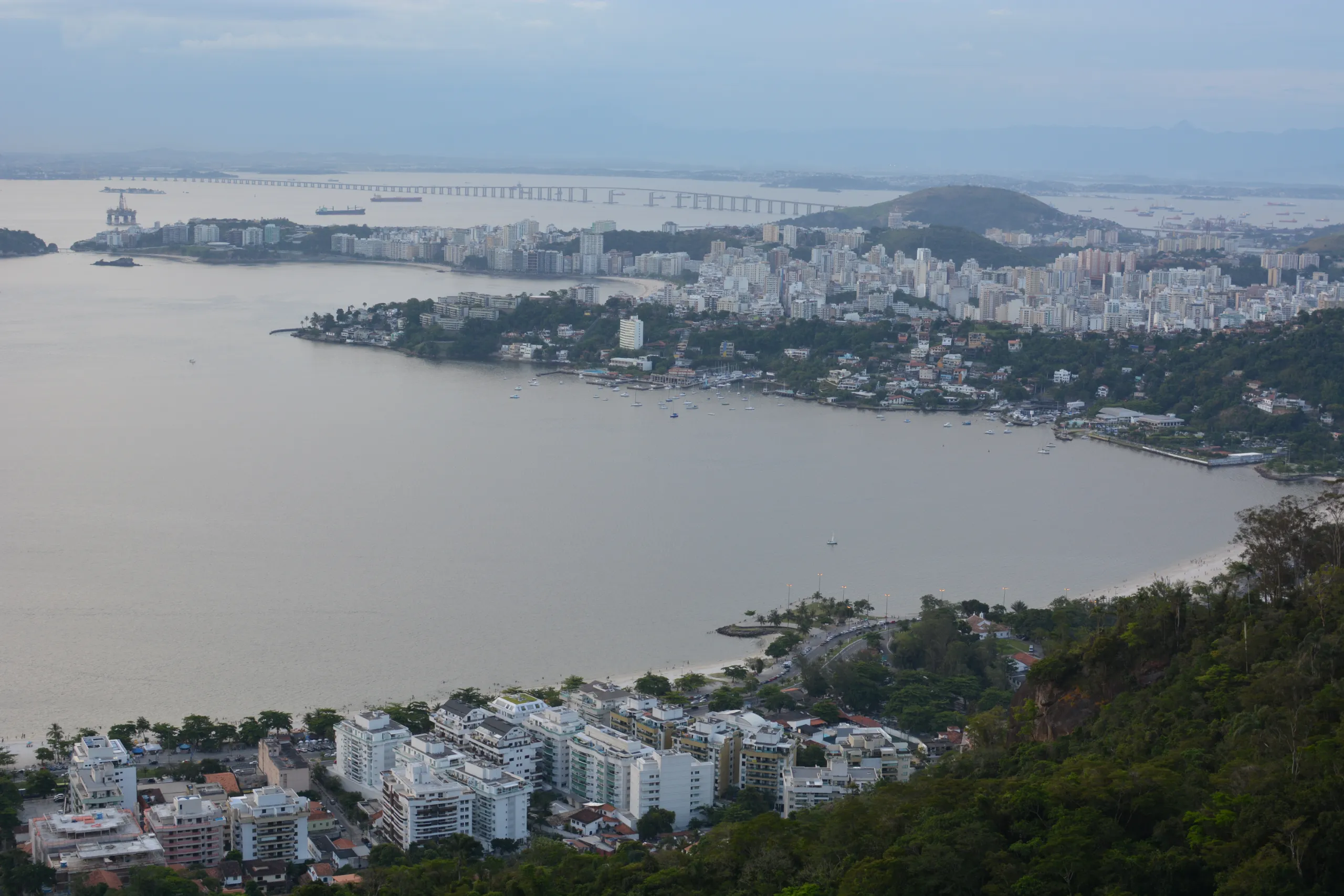
Niterói faces Rio de Janeiro across Guanabara Bay. Behind its center rises the Morro do Vintém, a scrubby hill that in 1966 was a place for children to fly kites and for nobody else to go. On the afternoon of August 20 a boy of eighteen, Jorge da Costa Alves, went up with a kite and came down to tell the police that there were two dead men in the grass. Another boy had reportedly seen them two days earlier and been dismissed as a prankster. Officers, firefighters and reporters reached the spot the next day.
What happened
The two men lay side by side, partly covered by grass, dressed in suits with waterproof coats over them. Each wore a mask of thin sheet lead, cut by hand into the shape of sunglasses, covering the eyes. Beside them were an empty water bottle and a packet containing two wet towels. There were no wounds, no sign of a struggle, no weapon. In one pocket was a notebook with a handwritten instruction: 16:30 be at the determined place; 18:30 swallow capsules; after the effect, protect metals, await mask signal. Another notebook listed codes for electronic valves.
The men were soon identified as Manoel Pereira da Cruz, 32, and Miguel José Viana, 34, electronics repairmen from Campos dos Goytacazes, some 250 kilometers up the coast. On August 17 they had told their wives they were going to São Paulo to buy parts. Instead they took a bus to Niterói, arriving about half past two, bought the raincoats at a hardware shop and a bottle of mineral water at a bar, where a waitress remembered Miguel looking at his watch and seeming anxious. Most of the cash they were believed to be carrying was never found.
The investigation
The autopsy was the point where the case was lost. The Niterói morgue was overloaded, the examination took place weeks after death, and by then the internal organs were too decomposed for reliable toxicology, so no test for poison or drugs was carried out. The bodies were checked for radioactivity, with negative results. They were exhumed in 1967 for a second look that added nothing, and about two years after the deaths the courts archived the case as unsolvable.
What the police did establish was the men’s state of mind. A friend, Elcio Gomes, described the three of them as “scientific spiritualists” who built apparatus to make contact with other planes or planets; a device they had assembled in Manoel’s garden had exploded some two months earlier. Books found in Miguel’s workshop had passages underlined about an intense luminosity that accompanies spirit manifestations, which offers one reading of the masks: not shields against radiation, which they could not have been, but protection for the eyes against a light they expected to see. A few days after the discovery a local woman told reporters she had seen an orange light rising and falling over the hill on the night of the 17th. The British journal Flying Saucer Review reported in 1967 that another electronics technician had been found dead on a different hill nearby some years earlier, also wearing a lead mask; that report has never been corroborated.
The explanations
The theories divide along familiar lines. Ufologists, led later by Jacques Vallée in his 1990 book Confrontations, treated the deaths as a contact attempt gone wrong, with the capsules as a preparation and the signal as something from the sky. A police theory at the time involved trafficking in radioactive material. A Catholic priest known for debunking the paranormal suggested an occult ritual. The explanation most investigators now favor is the plainest: two men in a small religious-technical circle took something at half past six as their instructions said, on rough ground after dark, and died of it, whether through overdose, a bad reaction or exposure. A yoga teacher told the Folha de S.Paulo at the time that local spiritist groups experimented with psychedelics.
That account fits the note, the masks, the books and the missing capsules. It cannot be proved, because the one piece of evidence that would settle it, a toxicology result, was never obtained.
Where it stands
The lead masks case remains formally unsolved and is regularly listed among Brazil’s great mysteries. The verdict here is unproven: the drug explanation is probable, the alien one is unsupported, and the state’s failure to test two bodies in 1966 means nobody will ever know which.