
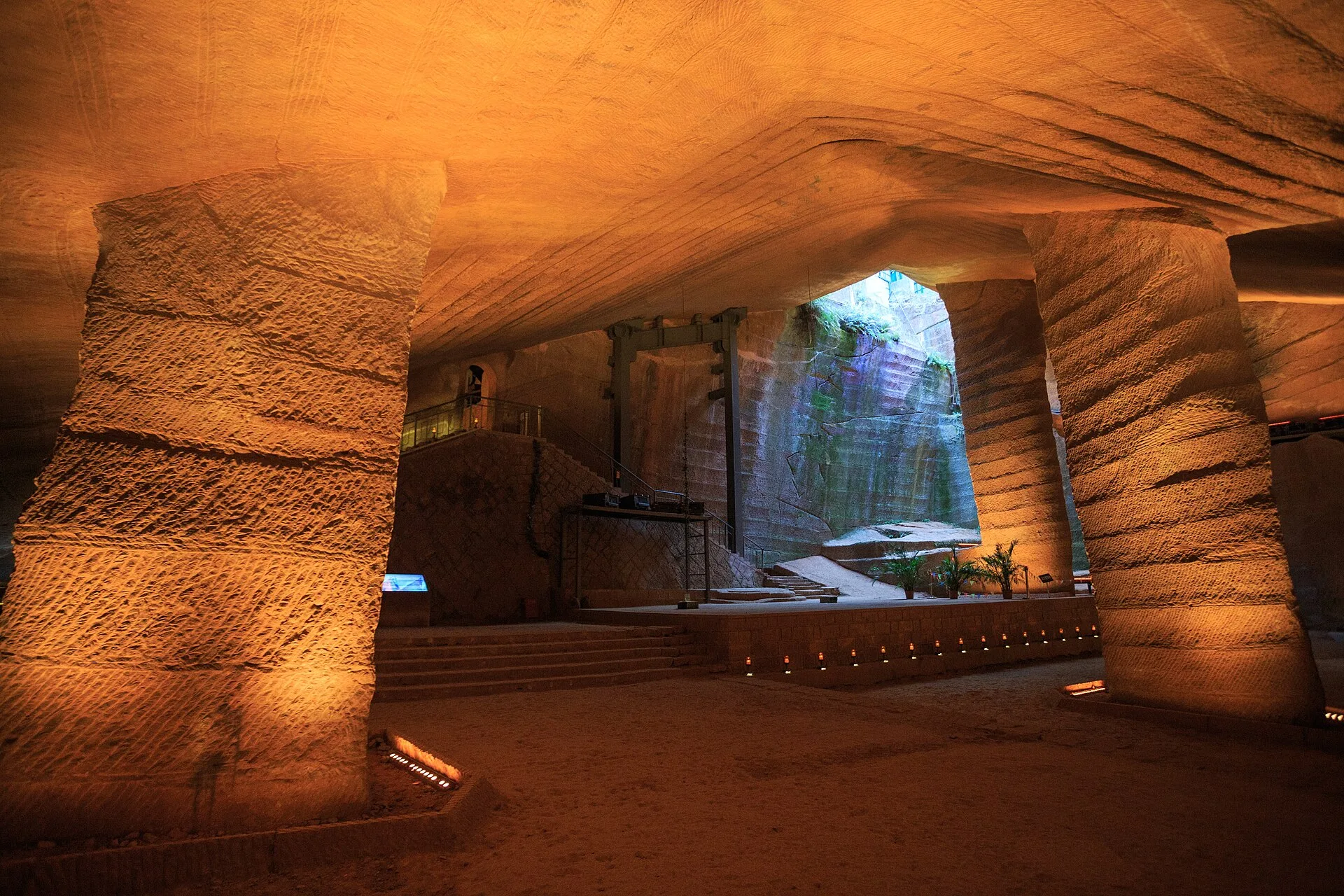
Fenghuang Hill is a low rise of red siltstone on the north bank of the Qu River, a few kilometers from the county town of Longyou in western Zhejiang. Until the 1990s it was best known locally for a cluster of deep, still ponds that villagers believed had no bottom. In June 1992 one of them turned out to be the mouth of something far stranger: a man-made hall the size of a large church, cut entirely out of the rock and full of water.
What happened
The usual account credits a villager named Wu Anai, who persuaded neighbors to club together for a pump so they could drain a pond, perhaps hoping for fish. After about seventeen days of pumping the water had gone down far enough to reveal walls that were plainly carved. The farmers kept going and emptied five ponds in all, each sitting on top of a separate chamber. Surveys of the hill then located nineteen more, and the count has since risen; a China Daily guide to the site now lists thirty-six.
The caverns follow a common plan. Each consists of one or more halls reaching as much as thirty meters below the hilltop, with flat floors, sloping ceilings and walls, and tall slender pillars of rock left standing to hold up the roof. The average chamber covers about a thousand square meters. Every surface, ceiling, wall and pillar alike, is dressed in the same way, in parallel bands roughly sixty centimeters wide filled with diagonal chisel strokes, giving the rock a woven look. Although several caves lie only meters apart, none connects to another.
The investigation
No historical text mentions their construction. The earliest text thought to allude to them is a seventeenth-century poem by Yu Xun, and it says nothing about their origin. The main physical clue to their age is pottery of the Western Han period, between about 206 BCE and 23 CE, found in silt inside the caves, which suggests they existed by then.
Since 2002 a team led by Professor Yue Zhongqi of the University of Hong Kong’s civil engineering department, working with the Chinese Academy of Sciences’ Institute of Geology and Geophysics, the China University of Geosciences and the Longyou Grottoes Institute, has studied the caverns as feats of rock engineering. In a 2011 summary of a dozen years’ work, Yang Zhifa, Yue and Li Lihui described how the builders chose suitable strata, kept the roofs shallow and inclined, left pillars at intervals, cut drainage channels and worked by surveying and chiselling by hand. They concluded that the caves survived intact for two thousand years through a lucky combination of human skill and nature: filled with slightly acidic water and surrounded by slightly alkaline rock, they were protected from collapse. Since being pumped dry, the five open caverns have developed cracks, seepage and small rockfalls, and the team warned that a complete roof collapse is a real risk in each of them.
The explanations
Because nobody recorded the work, theories have multiplied. The caves have been proposed as quarries for building stone, imperial tombs, granaries or storehouses, secret barracks, a palace, places of Taoist retreat and ritual halls. The quarry idea struggles to explain the careful finishing, the pillars and the absence of linking tunnels; the tomb idea lacks burials; the storage idea fits the scale but has no supporting finds. Online, the precision of the chisel marks is sometimes offered as evidence of lost technology or outside help, but the engineers who have measured them found nothing beyond the reach of hand tools, careful planning, organized labor and time.
Where it stands
The Longyou Grottoes are now a protected national scenic area, and part of the complex is open to visitors. That they were cut by people some two thousand years ago is well established. Who those people were, why they undertook such a vast and hidden project, and why it left no trace in a culture famous for its records remain open questions.