
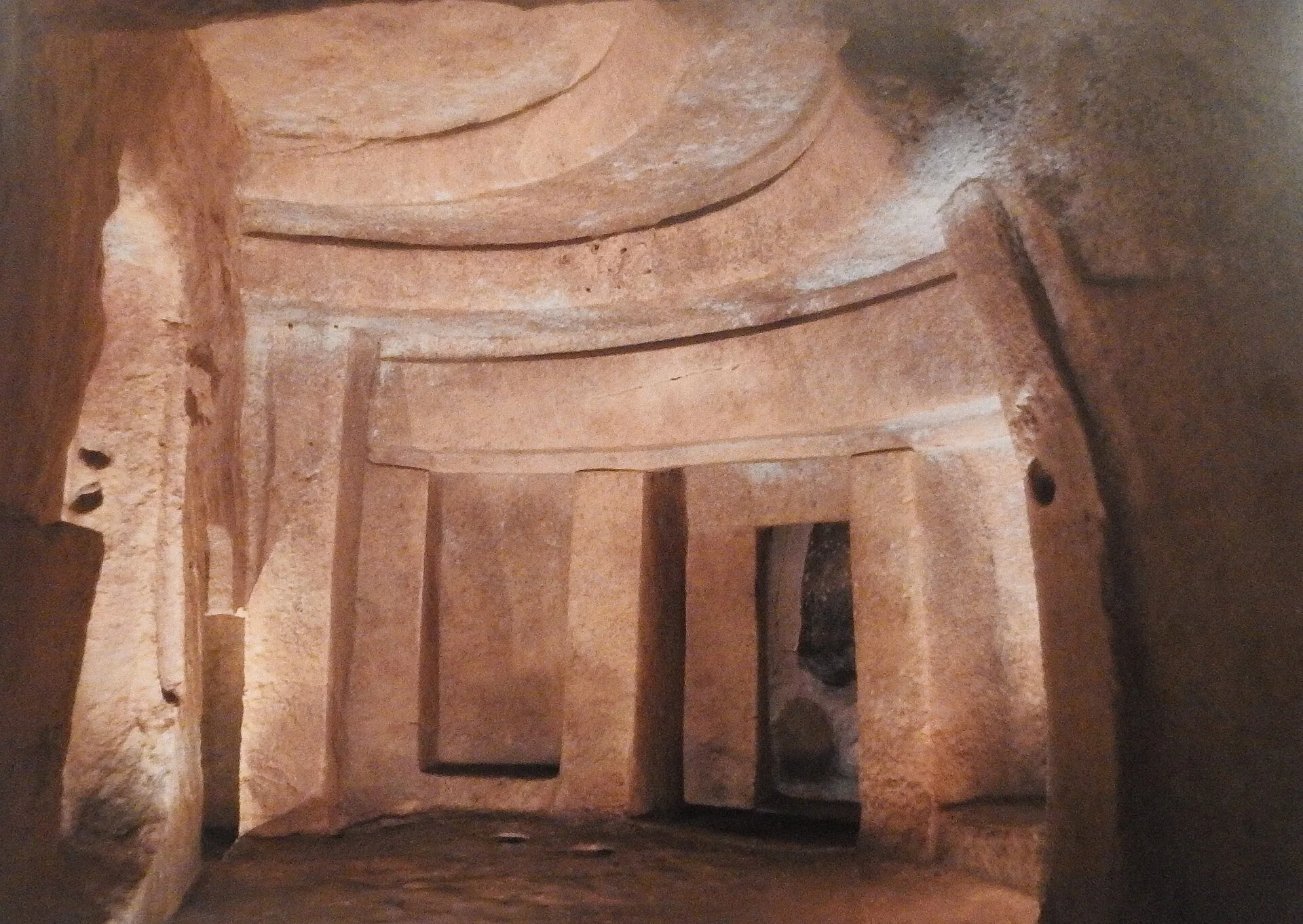
Under a residential street in Paola, a few minutes from Malta’s Grand Harbour, lies a prehistoric cemetery cut entirely out of the rock. The Ħal Saflieni Hypogeum, from the Greek for underground, is a warren of halls, cells and stairways on three levels, hollowed out of soft globigerina limestone over many centuries, with its deepest room more than ten meters below the road. Heritage Malta, which runs it, describes it as a burial complex in use from around 4000 BCE, the same culture that raised the island’s great megalithic temples. Its most famous room, though, is known for sound.
What happened
In 1902 a stonemason cutting foundations and cisterns for a row of new houses broke into the roof. The builders kept quiet and carried on, so by the time the discovery was reported most of the houses stood finished on top of it and the upper level had been badly damaged. The government acquired the site at the end of 1903. A Jesuit priest, Manuel Magri, directed the first excavation, but he died in 1907 while working abroad and his notes were never found, and much of what came out in those years was removed without a proper record. Themistocles Zammit, later director of Malta’s museums, took over, published his first report in 1910 and dug until 1911.
What survived is remarkable. Archaeologists estimate the bones of some seven thousand people were laid in the chambers, along with pottery, beads, amulets, carved animals and the clay figure known as the Sleeping Lady. Several rooms on the middle level are carved to copy the stone temples above ground, with false doorways, lintels and corbelled ceilings, and some are painted with red ochre spirals and honeycomb patterns.
The investigation
One of those painted rooms has a shallow oval niche cut into its wall at about head height. Since the early twentieth century visitors have reported that a low male voice spoken into it seems to boom through the whole complex, while a higher voice does not, and the room came to be called the Oracle Room. Zammit himself described low notes resounding near the niche.
Interest revived with the new field of archaeoacoustics. In 2009 the Old Temples Study Foundation, an American group devoted to Malta’s temples, publicized the idea that the island’s stone rooms resonate at 110 or 111 Hz. It tied this to Princeton engineering tests in the 1990s that found resonances between 95 and 120 Hz in chambered tombs such as Newgrange, and to a 2008 UCLA experiment in which tones near 110 Hz changed volunteers’ brain activity on EEG. The suggestion that visitors were being pushed into a trance followed naturally. A study published in 2015 by the Italian researcher Paolo Debertolis, the archaeologist Fernando Coimbra and the foundation’s president, Linda Eneix,, based on fieldwork in 2014, reported a double resonance in the room at about 70 and 114 Hz that a male voice could excite, and cited laboratory work on the effect of such frequencies on the brain.
The music technologist Rupert Till of the University of Huddersfield measured the site in a different way, playing calibrated sine sweeps through loudspeakers at fixed positions and recording the responses, and published the results in Antiquity in 2017. He found that earlier studies had lacked rigour, partly because voices and instruments cannot be repeated exactly. His measurements confirmed powerful bass resonance and very long reverberation, up to about sixteen seconds at low frequencies, and showed that sound made in the Oracle Room carries strongly into neighboring spaces. But the room’s main resonances came out at about 41, 72 and 76 Hz, the main hall resonated lower and more strongly than the Oracle Room, and the boost near the niche was inconsistent and could be produced near other walls as well.
The explanations
Hard rock walls, low ceilings and connected chambers will resonate at low frequencies whether or not anyone planned it, and few soft surfaces absorb the energy. Till concluded that the acoustics must still have mattered to the people who used the Hypogeum, perhaps in chanting or drumming at funerals, and that the niche and its painted decoration might mark a spot of acoustic interest, or might simply have held a statue, as Zammit thought. No measurement can show what the builders intended, and the claim that the room was tuned to alter consciousness rests on laboratory studies of other sites rather than on anything found at Ħal Saflieni.
Where it stands
The Hypogeum is a World Heritage Site and one of the best-preserved prehistoric burial places in Europe. It was closed for most of the 1990s for conservation, and visitor numbers are now strictly limited, with a climate-control system installed in 2017. The sound effects are real and worth hearing; the idea of a deliberately tuned brain-altering chamber remains speculation.