
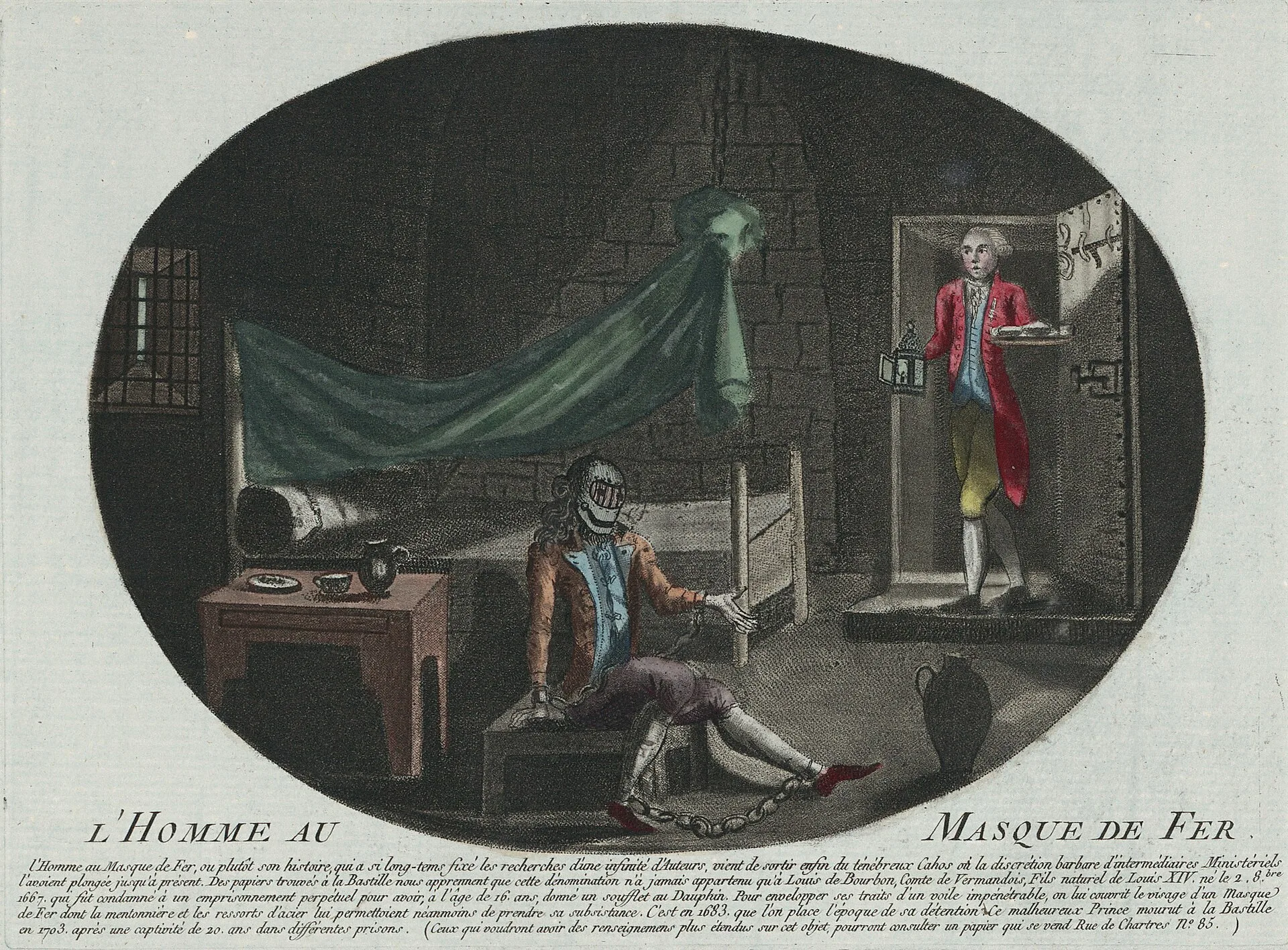
For more than three decades under Louis XIV, one prisoner of state was moved from fortress to fortress in the care of the same jailer, Bénigne Dauvergne de Saint-Mars, and was kept from talking to anyone. He died in the Bastille in Paris in November 1703. Half a century later Voltaire gave him an iron mask and, eventually, a royal bloodline. The legend that grew from those two details has outlived almost every fact in the file.
What happened
The paper trail starts on July 19, 1669, when the war minister, the Marquis de Louvois, told Saint-Mars, then governor of the fortress of Pignerol in the Alps, to expect a prisoner called Eustache Dauger. A cell with several doors was to be made ready so that no one outside could hear him. Saint-Mars alone would bring him food, once a day, and the man was to be warned that he would be killed if he spoke about anything except what he needed. He would not need much, Louvois added, because he was only a valet. Dauger was seized on the Channel coast at the end of July and brought to Pignerol in late August.
He stayed with Saint-Mars for the rest of his life. For a time he was allowed to serve the disgraced finance minister Nicolas Fouquet, another of Saint-Mars’s prisoners, under strict conditions that kept him away from the courtier Lauzun, who was expected to be freed one day. After Fouquet died in 1680, Lauzun was told that Dauger had been released. In fact he was moved with Saint-Mars to Exilles in 1681, then to the island of Sainte-Marguerite off Cannes in 1687, and finally to the Bastille, which Saint-Mars was given to govern in 1698.
The Bastille’s royal lieutenant, Étienne du Junca, kept a register of arrivals and deaths. His entry for September 18, 1698 notes a prisoner from Pignerol whom Saint-Mars kept masked at all times and whose name was not given. On November 19, 1703 he recorded that the unknown prisoner, still wearing a mask of black velvet, had died suddenly after mass. The parish register of Saint-Paul buried him the next day as “Marchioly,” aged about 45.
The investigation
There was no inquiry at the time; secrecy was the point. The story spread through court gossip and then print. In 1751 Voltaire, who had himself been held in the Bastille, wrote in his Age of Louis XIV that a tall, handsome young prisoner had been taken to Sainte-Marguerite wearing a mask with a steel-sprung chin piece, under orders to kill him if he uncovered his face. Two decades later, in his Questions on the Encyclopedia, he went further and implied that the prisoner was an elder half-brother of the king, son of Anne of Austria. Alexandre Dumas made him Louis’s identical twin in the last of his Musketeers novels, and the iron mask became fixed in the public mind.
Historians went to the archives instead. The letters between Saint-Mars and his ministers, and du Junca’s registers kept at the Arsenal library, were published in the 19th century. They show the velvet mask, and they show that it was worn when the prisoner traveled between prisons or attended mass, not around the clock. Frantz Funck-Brentano, an archivist at the Arsenal, argued in 1899 that “Marchioly” pointed to Count Mattioli, the Mantuan envoy kidnapped after he betrayed a secret French deal to buy the fortress of Casale. Andrew Lang, working through the same correspondence in 1903, concluded that the prisoner was Dauger, a servant caught up in a Huguenot plot.
The explanations
More than fifty candidates have been put forward, from Fouquet and the Duke of Beaufort to a son of Oliver Cromwell. Most collapse on dates. Mattioli was taken in 1679, ten years after Dauger, and most historians accept that he died on Sainte-Marguerite in 1694. That leaves Dauger as the only prisoner who followed Saint-Mars all the way from Pignerol to Paris. The burial name may have been a deliberate false trail; Saint-Mars was known to enjoy the mystery, which made his custody look more important.
That still leaves the question of who Dauger was and what he knew. A 1932 theory that he was the nobleman Eustache Dauger de Cavoye fell apart when family letters published in 1953 placed Cavoye elsewhere. In 2016 Paul Sonnino of the University of California, Santa Barbara, argued that Dauger had been a valet in the household of Cardinal Mazarin’s treasurer, and that he was locked away because he knew how Mazarin had enriched himself at the expense of the exiled English royal family, at a moment when Louis XIV was courting Charles II.
Where it stands
Most historians now agree on the outline: the man was called Eustache Dauger, he was a servant rather than a prince, and his mask was cloth. Why a valet merited thirty-four years of guarded silence is still not settled, and no document names his offense. The iron mask and the royal twin belong to Voltaire and Dumas.