
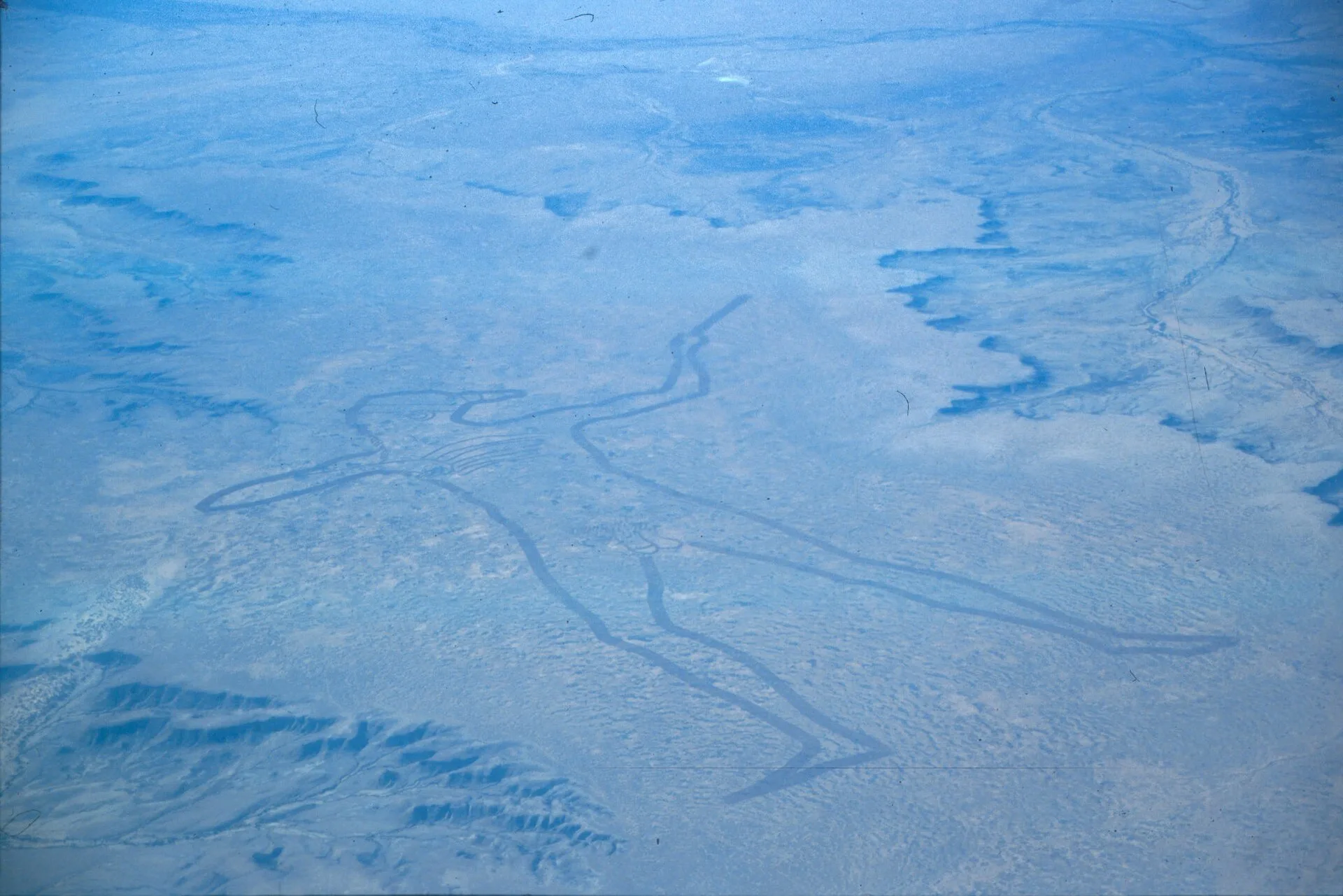
About 60 kilometers west of the railway town of Marree, in the far north of South Australia, a flat gibber plateau near Finniss Springs carries the outline of a naked man poised to throw a stick. The figure is so big that it can only be taken in from an aircraft or a satellite. Its length is usually given as 4.2 kilometers, though published measurements vary, and its outline runs for roughly 28 kilometers. Nobody has ever admitted to making it.
What happened
On June 26, 1998 Trec Smith, a charter pilot on the run from Marree to Coober Pedy, looked down and saw the figure cut into the red ground. The lines were shallow trenches, some tens of meters wide, scraped through the surface. Satellite images later showed the plateau untouched in late May and the drawing complete by mid-June, so the whole thing had been laid out and dug in a few weeks without anyone noticing.
Within weeks anonymous faxes began arriving, first at businesses in Marree and the outback hotels and then at The Advertiser in Adelaide. They described the drawing in miles and feet, used American spellings and spoke of “Aboriginal reservations” and “your State of SA,” which led many readers to suspect American authors. One message named it “Stuart’s Giant,” after the explorer John McDouall Stuart. Searchers at the site found a small jar holding a satellite photograph and a note carrying a United States flag and a reference to the Branch Davidians.
In January 1999 another fax gave precise directions to a buried plaque south of the figure’s nose. Police dug there and found it: a chipboard panel bearing a small American flag, a faint impression of the Olympic rings and a line of text later traced to the naturalist Hedley Finlayson’s 1946 book The Red Centre, from a passage about hunters of the Pitjantjatjara people. The faxes promised to explain who and why. They never did.
The investigation
Police and journalists chased the American angle first. The Woomera Prohibited Area, used by Australian and US forces, lies just to the south, and the faxes pointed that way. Both militaries denied any part in it, and many people who followed the case came to think the American flavor was planted to mislead.
The other leading name is Bardius Goldberg, an Alice Springs artist who had made large ground drawings before and who reportedly told friends he had been paid $10,000 for a work that could be seen from space. Goldberg died in 2002 without confirming it. A friend later said he had made a kind of confession from a hospital bed, but nothing documentary has surfaced. Locals have also suggested a mining contractor, since crews building water lines for the Olympic Dam mine had the machinery nearby.
How it was done is part of the puzzle. In 1998 accurate GPS was not yet available to the public, yet the figure’s proportions are clean and consistent. Restorers later found about 250 bamboo garden stakes along the old outline, set roughly every ten meters, suggesting it was surveyed on foot and then cut with an earthmover. In 2018 the businessman Dick Smith offered a $5,000 reward for information on who made it, and argued that the job needed professional skill and satellite positioning.
The explanations
The site sits on land that was the subject of contested native title claims when the figure appeared; native title was granted to the Arabana people in 2012. Arabana leaders have said the figure is an Aboriginal hunter but not one of theirs, with hair and headband in a style from much farther northwest. Some have read the drawing as a statement in that dispute; others as a stunt aimed at tourists, which is what one of the faxes said it was meant to be. Neither reading has been tied to a named person.
Where it stands
By the 2010s wind and rain had worn the figure nearly away. In August 2016 the Marree publican Phil Turner, with the agreement of the Arabana Aboriginal Corporation, hired a grader and recut the outline using surveyed coordinates. The state environment department investigated the clearing of native vegetation, and the matter was dropped in 2018. The Marree Man is back and drawing visitors. Who made it, and why, remain unknown.