
What is there
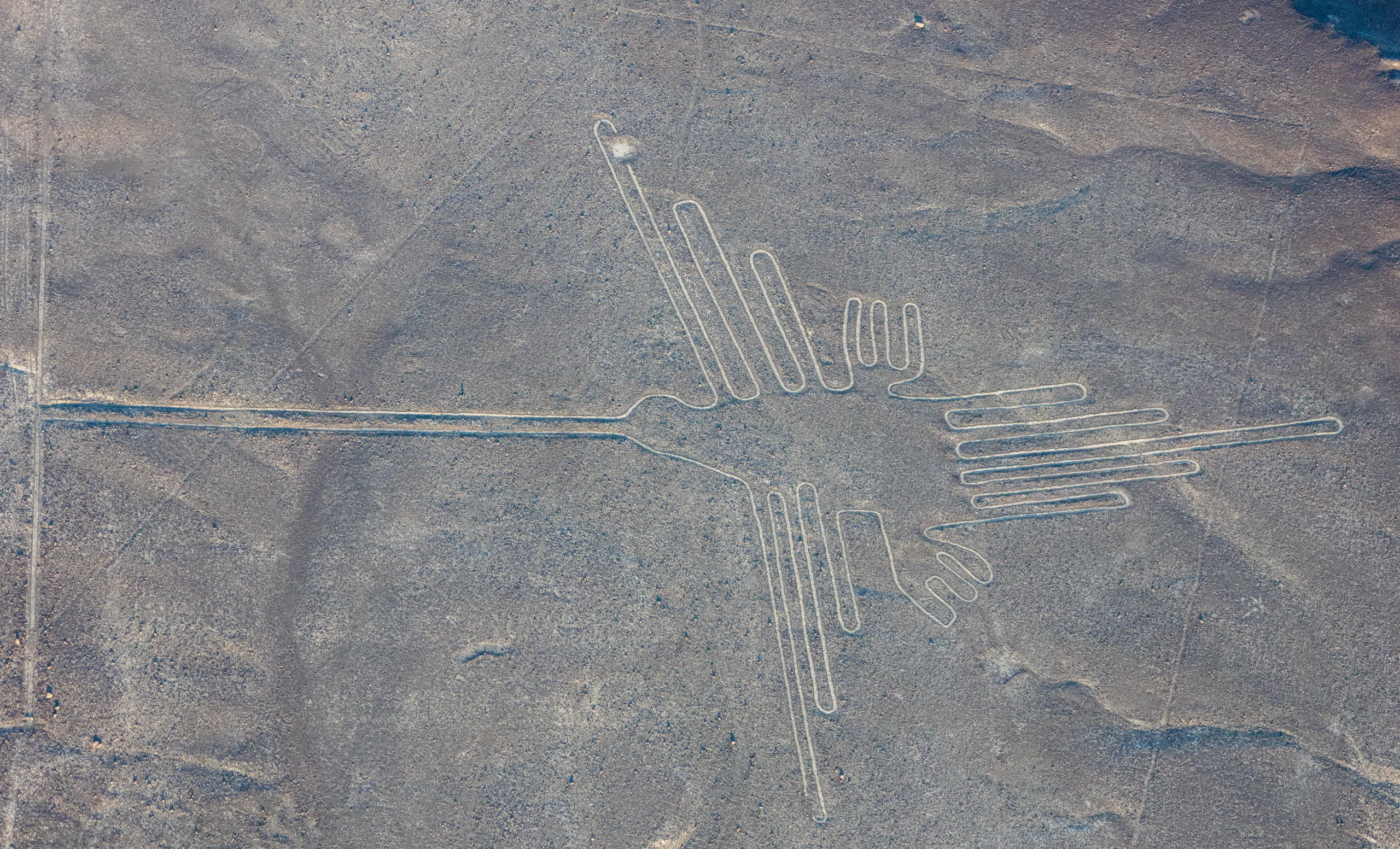
Between the towns of Nazca and Palpa, on a high desert plateau about 400 kilometers south of Lima, the ground is marked with lines. Some run straight for kilometers; others sweep into trapezoids, spirals and zigzags; and a smaller group draws animals and plants: a hummingbird, a monkey with a spiral tail, a spider, a condor, a lizard, a tree. The figures range from around 15 meters to more than 300 meters across. UNESCO, which inscribed the site in 1994, puts the protected area at roughly 450 square kilometers and dates the work to between 500 BCE and 500 CE. The Paracas culture began it; the Nasca culture, which flourished in the first seven centuries CE, made most of it.
The technique is simple. The desert floor is a pavement of dark, iron-oxide-stained stones over paler sand and clay. Rake the top foot or so of stones aside into a low ridge and a light line appears. The region has almost no rain and little wind, so a line scraped two thousand years ago still shows. Surveyors’ stakes have been reported at the ends of some lines.
The claim
The lines entered popular culture through the Swiss writer Erich von Däniken, whose 1968 book Chariots of the Gods? presented the long straight bands as runways for the spacecraft of visitors who had been mistaken for gods. The argument was that the figures can only be appreciated from the air, so whoever made them must have been able to fly or must have been signaling to someone who could. A later variant proposed that the Nasca themselves flew; in the 1970s a hot-air balloon made from materials of the period was launched over the pampa to demonstrate it, and it did get off the ground.
The investigation
Serious study began in the 1940s. Paul Kosok, an American historian, noticed in 1941 that one line pointed to the sunset on the winter solstice and called the pampa the largest astronomy book in the world. His assistant, the German-born mathematician Maria Reiche, spent the next four decades mapping the lines, sweeping them clean and guarding them from traffic, and she developed the calendar theory. Later archaeoastronomers tested it, and by 1990 Gerald Hawkins and Anthony Aveni had concluded that no more lines pointed at astronomical targets than chance would predict.
Johan Reinhard, working in the 1980s, tied the lines to the thing the Nasca lacked most: water. Mountain and water worship runs through Andean religion, and he read the straight lines as ceremonial paths walked toward places where water was petitioned, with the animal figures standing for fertility and rain. Aveni, after surveying hundreds of line centers, came to a similar conclusion, with the lines as pathways used in ritual rather than as a calendar. In 2024 a team from Yamagata University, working with IBM Research, used an AI model to screen aerial imagery and found 303 previously unknown figurative geoglyphs in six months, nearly doubling the count. The large line-type animals cluster along the networks of straight lines and trapezoids, consistent with community ceremonies; the smaller relief-type figures, showing people, severed heads and domesticated camelids, sit beside foot trails where small groups would pass.
The explanations
The idea that the figures could not have been laid out without flight was tested in 1982. Joe Nickell, then teaching at the University of Kentucky, and five relatives reproduced the 440-foot condor in a Kentucky field in a little over a day, using a center line, knotted cords and a T-shaped wooden square to plot 165 points from a small drawing and then marking the lines with lime. Nothing was used that the Nasca did not have. Photographed from a plane, the result was close enough that a wildlife biologist who knew nothing of the project identified it as a condor. From the ground the figures can be followed as paths, and the hillsides around the pampa give an elevated view of many of them.
As for runways, the straight bands run across soft ground and up and over ridges; nothing has ever landed on them, and nothing could.
Where it stands
Who made the lines, when and how are settled. Why is not. The current reading, that they were walked, staged and viewed as part of rituals bound up with water and the agricultural year, is well supported but will never be certain, because the Nasca left no writing. The claim that extraterrestrials were involved explains nothing the evidence requires, and it takes credit from the people who did the work.