
Friday October 9, 1992 was a clear autumn evening across the eastern United States, and in towns from North Carolina to Ohio people were at high-school football games with the new household camcorders of the time. At 23:48 Universal Time, 7:48 pm on the East Coast, a fireball appeared over West Virginia and moved north-east. It was distinctly green, it reached a brightness comparable to the full moon, and it stayed in view for more than forty seconds while covering a ground path of 700 to 800 kilometers. Dozens of cameras swung up from the field to follow it.
What happened
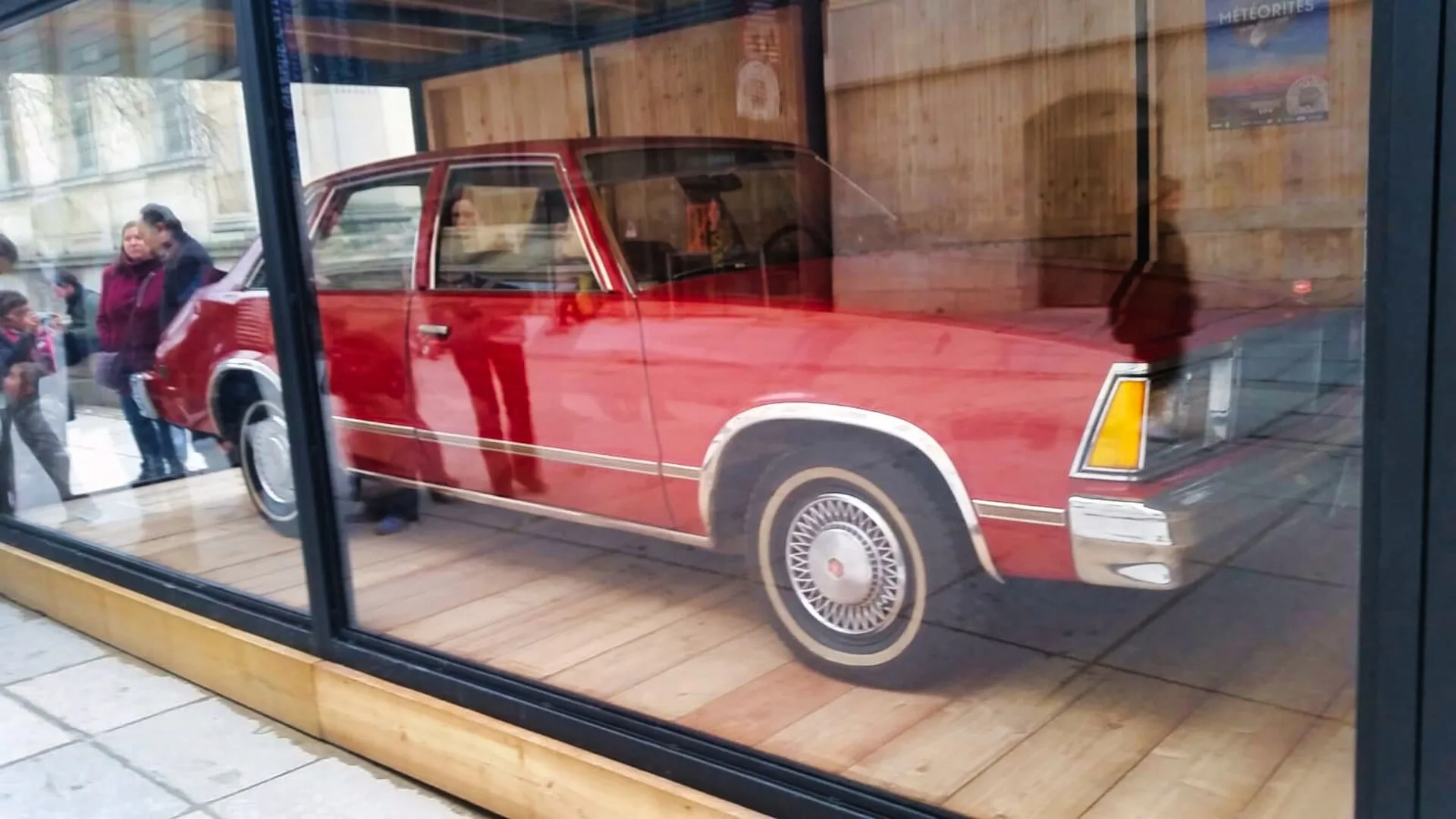
Four minutes’ drive from the Hudson in Peekskill, New York, 18-year-old Michelle Knapp was on the sofa in her parents’ living room at 207 Wells Street when she heard what she described as a three-car crash in the driveway. Outside, the right rear corner of her car, a 1980 Chevrolet Malibu bought from her grandmother for $400 a few weeks earlier, was smashed in. Under the bumper, in a crater six inches deep, lay a rock the size of a football, hot to the touch. She called the Peekskill police, who at first suspected vandalism. The police in turn called William Menke, a Columbia University geophysicist on an emergency list of earth scientists, who wondered whether it might be aircraft debris or a fragment of a nuclear-powered satellite.
Menke and his colleague Mark Anders drove to Peekskill the next morning. The rock weighed about 25 pounds, 12.4 kilograms, with a brown fusion crust broken away at the end that had struck the car and a gray stony interior flecked with metal. It had punched through the decklid and the trunk floor and grazed the fuel tank, which was leaking a little petrol. A Geiger counter showed only background radiation. Edmond Mathez, a curator at the American Museum of Natural History, confirmed a stony meteorite, later classified as an H6 monomict breccia, an ordinary chondrite from the asteroid belt. The small crater puzzled reporters; Menke explained that the atmosphere had slowed the stone from several miles a second to the speed of a dropped rock.
The investigation
What made Peekskill matter to science was the video. A team led by Peter Brown of the University of Western Ontario with Zdeněk Ceplecha of the Ondřejov Observatory collected sixteen tapes, shot in places including Fairfax, Virginia, from a Burger King car park; Johnstown and Pittsburgh in Pennsylvania; Willoughby, Ohio; Raleigh, North Carolina; and Altoona, where a newspaper photographer at the Mansion Park stadium caught the fragment train on still film. From four of the tapes they reconstructed the flight. When the record begins the meteoroid was 46.4 kilometers up and moving at 14.7 kilometers a second; at about 41.5 kilometers it broke up extensively, and drag spread the fragments more than 20 kilometers along the track. Their paper in Nature on February 17, 1994 reported the first orbit of a recovered meteorite ever derived from video, placing its origin in the asteroid belt. The parent body, they estimated, had been of the order of 20 tonnes; the stone in Michelle Knapp’s driveway was almost certainly one of several survivors, the rest lost in the wooded hills of the Hudson valley.
The explanations
Because the fall came during the Draconid meteor shower, reporters asked whether the two were linked. They were not: the Draconids are icy cometary dust that never reaches the ground, and the timing was coincidence. The green color, the fragmentation, the long shallow path and the warm stone are all ordinary features of a large meteoroid entering at a low angle. Nothing about the event was unexplained, which is the point: Peekskill is the fall against which fireball reports are measured, because for once every stage of it was recorded.
Where it stands
Michelle Knapp sold the meteorite for $50,000 to a group of three collectors and the car for $10,000. The Malibu, still with its crumpled trunk, has been exhibited in Paris, Munich, New York and Tokyo and is one of the most traveled cars in the world; pieces of the stone are in museum collections including the American Museum of Natural History. The house on Wells Street has new owners. Thirty years on, the Peekskill Herald noted that the town is still known for the night a rock from space chose it.