
The Phoenix Lights are often described as the most widely witnessed UFO event in American history. On the evening of Thursday, March 13, 1997, people from the Nevada border down to Tucson phoned police, airports and news desks about lights in the sky. Videotape of one part of the display played on national television for weeks. The case is usually told as a single mystery, but the record shows two separate events about ninety minutes apart, with different explanations.
What happened
The first sightings came from northern Arizona around 8pm and moved south. Observers described five or more lights in a V or boomerang shape, crossing the sky slowly and without sound. Some people were certain the lights were fixed to one enormous dark object that blotted out the stars; others saw only separate points of light. The V passed over the Phoenix area at roughly 8:30pm and continued toward Tucson.
The second event is the one on the videotapes. At about 10pm a line of bright amber orbs appeared low over the southwest edge of the metropolitan area. They seemed to hang in place for several minutes, then went out one by one. Because so many people were outside with camcorders by then, this was the part of the night that was recorded and broadcast, and the footage became the public image of the whole incident.
The investigation
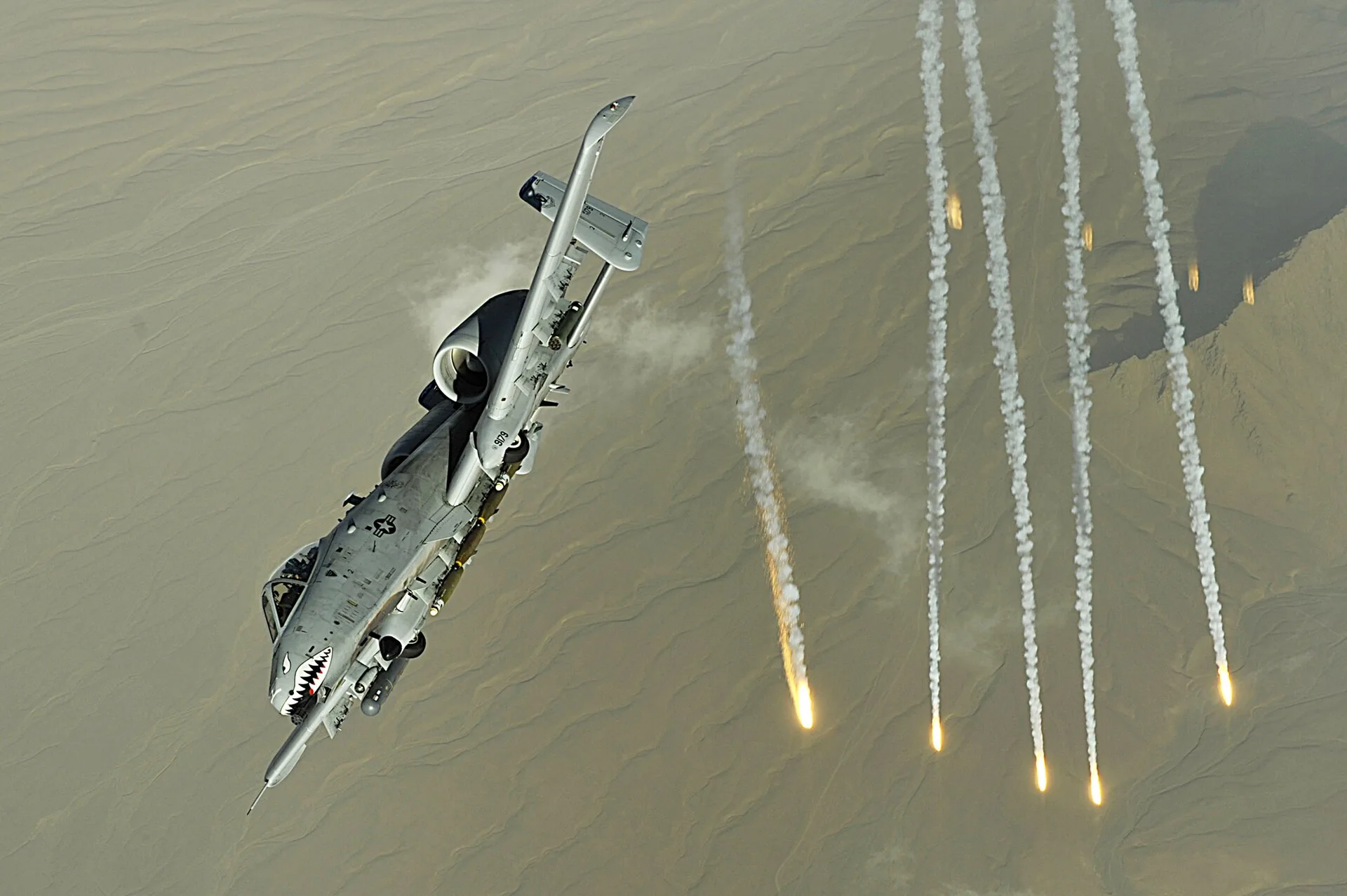
No federal agency opened a formal investigation. The detailed work was done by local reporters. Within days the Tucson Weekly reported that A-10 attack jets of the Maryland Air National Guard, in Arizona for a winter training deployment known as Operation Snowbird, had been flying over the Barry M. Goldwater gunnery range that night. Tony Ortega of the Phoenix New Times later reported that an Arizona National Guard spokeswoman had established that the jets dropped illumination flares at about 10pm over the range’s North Tac area, southwest of Phoenix, from an unusually high 15,000 feet. Parachute flares of that kind burn brightly for several minutes while drifting slowly down. Seen from the city, they would sink toward the Sierra Estrella, a mountain range between Phoenix and the range, and wink out as they passed behind the ridgeline. Video of the display shows each light going out at the line of the ridge rather than in open sky.
For the earlier V, the strongest single observation came from Mitch Stanley, an amateur astronomer in Scottsdale who turned a large telescope on the lights as they passed. Under magnification, he said, each light resolved into a pair on the wingtips of an airplane, and the formation was flying high. Because nobody requested the Federal Aviation Administration’s radar data before it was routinely erased, the planes were never formally identified.
The explanations
The flare explanation for the 10pm lights is well supported: the timing, location, altitude and behavior match, the Guard confirmed the drop, and a television station later filmed a similar flare drop that looked much the same. The V is weaker territory. Witnesses who describe a solid craft the size of several football fields are sincere, but a formation of lights against a dark sky is easily read as one object, since the mind fills in the shape between points. The two events were also blended in public memory, so that the confirmed flare footage was used to illustrate the unexplained V and the Air Force’s flare explanation was mocked as a cover story for something it was never offered to explain.
Governor Fife Symington added a political chapter. In the summer of 1997, with the sightings a running story, he called a press conference, announced that the culprit had been found, and brought out his chief of staff, Jay Heiler, dressed as an alien. Ten years later, out of office, Symington told reporters and a documentary maker that he had seen an enormous craft himself that night, and that he had kept quiet to avoid alarming the public.
Where it stands
The 10pm lights are explained. The 8:30pm V is best explained as aircraft in formation, though without radar records that identification rests on one observer and the circumstantial evidence. The case remains a fixture of Arizona folklore and is marked by anniversary coverage every March.