
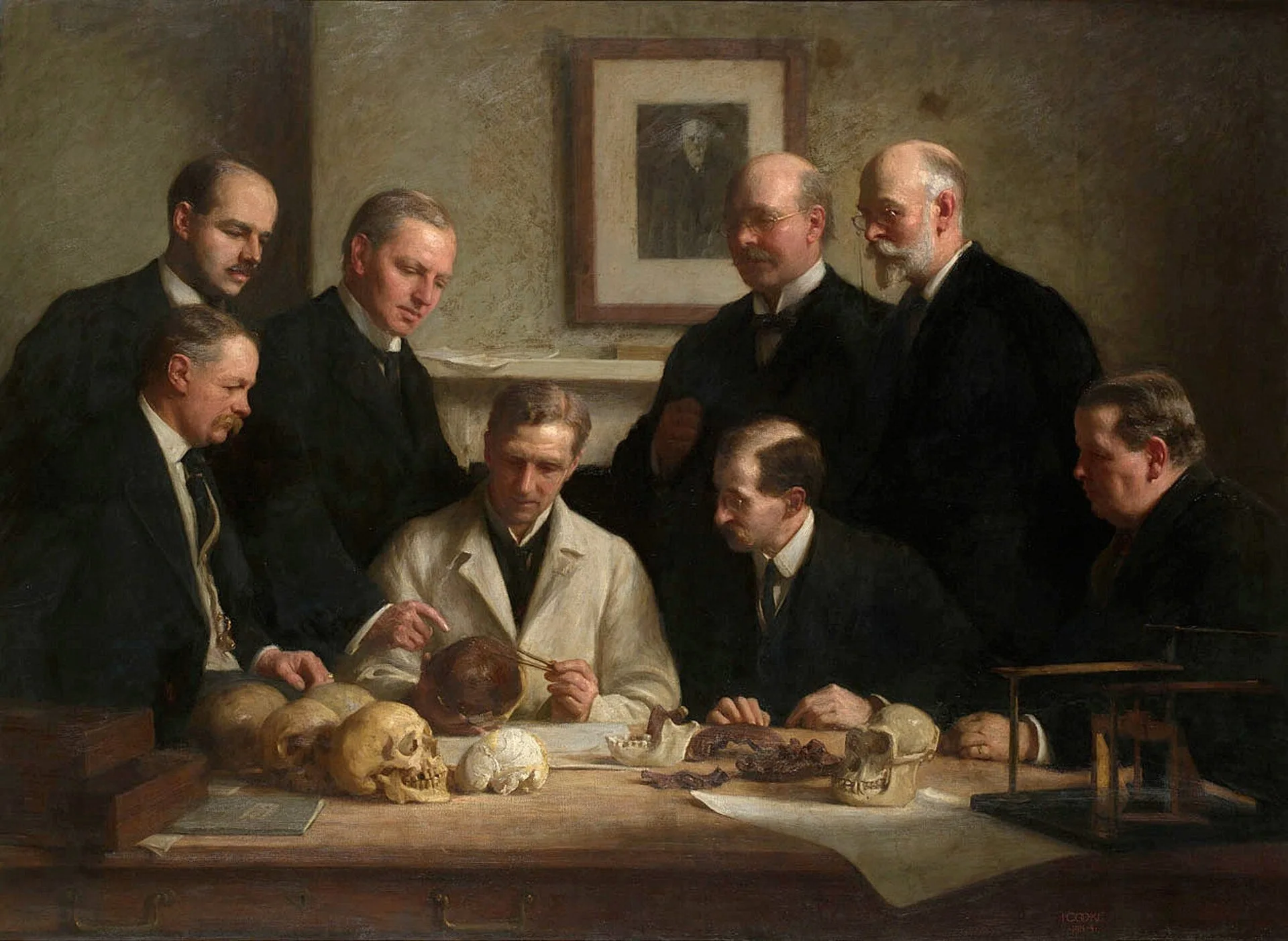
Charles Dawson was a solicitor in Uckfield, East Sussex, and a busy amateur antiquarian with a reputation for remarkable finds. Early in 1912 he wrote to Arthur Smith Woodward, who ran the geology department of the British Museum (Natural History), to say that laborers digging gravel at Barkham Manor near the village of Piltdown had given him pieces of an unusually thick human skull. That summer the two men, joined at times by a young French Jesuit and naturalist, Pierre Teilhard de Chardin, sifted the pit and its spoil heaps.
What happened
They produced more skull fragments, half of a lower jaw holding two molars, flint tools and the teeth of extinct animals such as hippopotamus and elephant. On December 18, 1912 Dawson and Woodward presented the finds to a packed meeting of the Geological Society of London. Woodward’s reconstruction combined a large, rounded, human-looking braincase with a jaw that was almost entirely apelike, and he named the creature Eoanthropus dawsoni, Dawson’s dawn man, perhaps half a million years old. It suited a widely held belief that the big human brain had evolved first, and it gave Britain an ancestor to set beside Germany’s Neanderthals and Heidelberg jaw.
More came, always through the same circle. In 1913 Teilhard found a canine tooth in the spoil, worn down in just the way Woodward had predicted. In 1914 the pit yielded a carved slab of elephant bone shaped, as many noticed, rather like a cricket bat. In 1915 Dawson reported fragments of a second individual from another site a couple of miles away, which he never precisely identified. That second find persuaded many doubters, since an ape jaw and a human skull coming together once might be chance, but twice seemed unlikely. Dawson died in August 1916, and nothing new was found at Piltdown again.
The investigation
Doubts were raised from the beginning. In 1913 the anatomist David Waterston of King’s College London argued in Nature that the jaw belonged to an ape and the skull to a human, and over the next decade American, French and German specialists said much the same. But the bones were kept in the British Museum, and outside researchers were mostly allowed to see casts. Meanwhile real fossils from Africa and Asia, beginning with the Taung child in 1924, showed early humans with apelike skulls and humanlike teeth, the opposite pattern, and Piltdown became an awkward misfit.
The end began with chemistry. Buried bone gradually absorbs fluorine from groundwater, so the amount offers a rough relative age. In 1949 the museum geologist Kenneth Oakley found that the Piltdown remains held far too little fluorine to be ancient. In 1953 the Oxford anatomist Joseph Weiner, working with Oakley and Wilfrid Le Gros Clark, showed why. Under magnification the molars bore scratches from an abrasive file, applied to make their flat wear look human. The jaw was a recent ape’s, colored on the surface only, and it contained chromate even though Woodward had watched it come out of the ground and only the first skull pieces had ever been treated with that chemical. Under the canine’s black coating, a paint-like film, the dentine was as white as a modern tooth’s. The museum published the findings on November 21, 1953, and further work over the next two years showed that the animal fossils had been brought in from elsewhere and the bone tool shaped with a steel knife.
The explanations
The forgery was proved; the forger was not. Suspects over the years have included Dawson, Woodward, Teilhard de Chardin, the anatomist Arthur Keith, the museum volunteer Martin Hinton, whose trunk of experimentally stained bones turned up long after his death, and even Arthur Conan Doyle. The archaeologist Miles Russell later documented dozens of other dubious objects that had passed through Dawson’s hands.
In 2016 a team led by Isabelle De Groote reported the results of an eight-year re-examination of every Piltdown specimen using CT scanning, spectroscopy and ancient DNA. The jaw, the molar from the second site and the canine all appear to come from a single orangutan, probably from southwest Sarawak in Borneo, combined with skull pieces from at least two humans. The same techniques recur across the whole assemblage: a brown stain, cavities packed with gravel from the pit, and repairs in the same putty. One person made both sets of finds, and only Dawson knew where the second site was.
Where it stands
Piltdown is the best-known scientific fraud in palaeontology and a standard lesson in how expectation can blind experts. The specimens remain in the Natural History Museum in London. The case is closed as to what was done and, on the 2016 evidence, very probably as to who did it.