
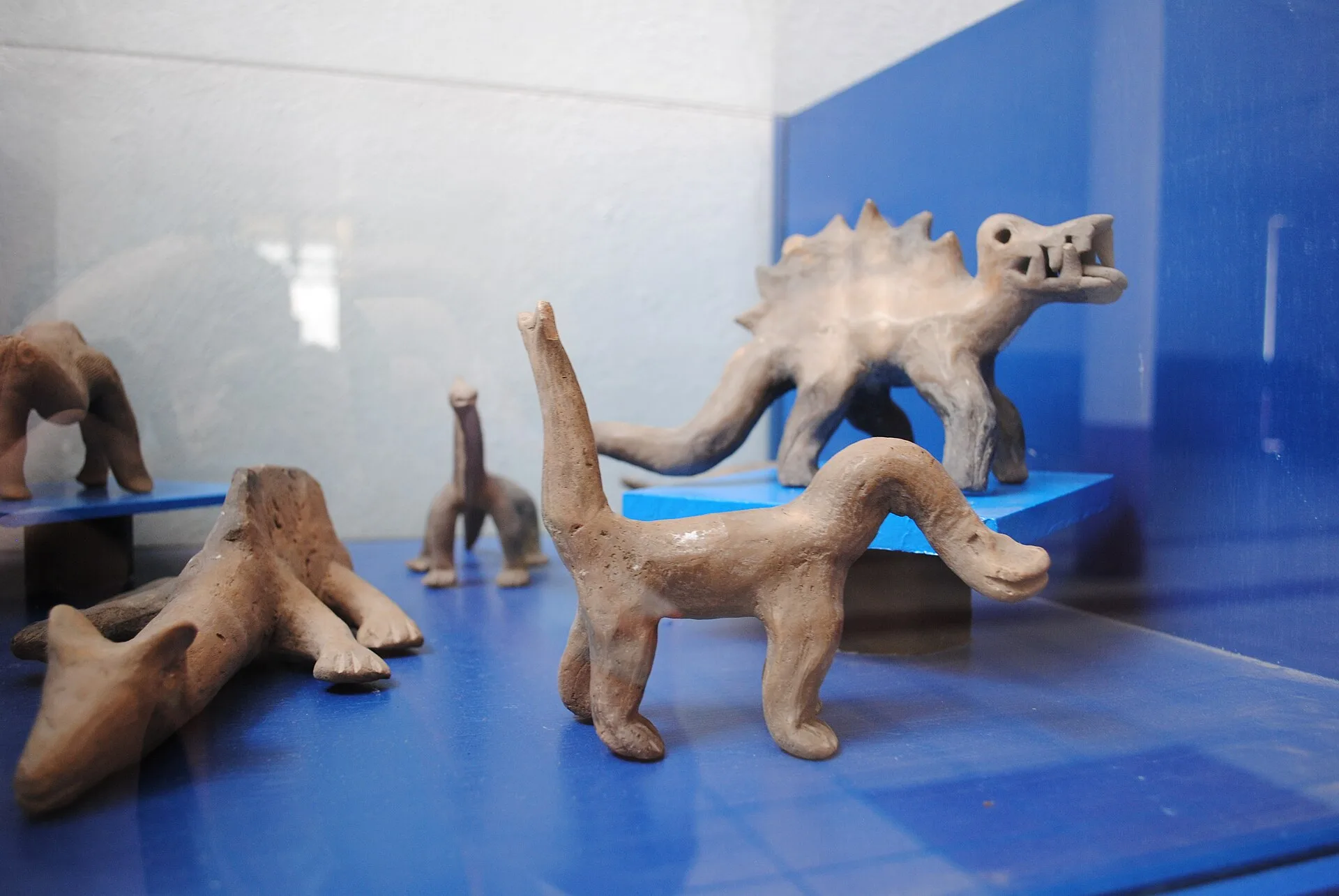
Acámbaro is a market town in the southern part of the Mexican state of Guanajuato. In a museum there, named after a German-born merchant called Waldemar Julsrud, shelves hold clay figurines of long-necked, spined and crested animals that look to many visitors very much like dinosaurs. Julsrud amassed more than 32,000 such pieces in the 1940s and 1950s, and for seventy years they have been offered as proof that people once lived alongside the great reptiles. Archaeologists who examined them reached a very different conclusion.
What happened
The story told by Julsrud’s supporters begins in July 1944, when he is said to have spotted pottery fragments in the ground while out riding near the hill of El Toro on the edge of town. He hired a local man to dig, paying him a peso for each intact figure brought in, and the deliveries never stopped. By the early 1950s the collection filled the rooms of his house. When the archaeologist Charles C. Di Peso described it in 1953 he listed figures resembling Brontosaurus, Tyrannosaurus, Stegosaurus and Dimetrodon alongside horses, cows, an elephant, a hippopotamus, dogs, rabbits, human figures and small coffins in an Egyptian style. Julsrud attributed them to an unknown ancient people; later promoters linked them to the Chupícuaro culture, which flourished in the region roughly between 800 BCE and 200 CE.
The investigation
Di Peso, of the Amerind Foundation in Dragoon, Arizona, went to Acámbaro in 1952. He looked over the collection and then watched two of Julsrud’s diggers at work. His short report in American Antiquity in April 1953 was blunt. The figures had crisp, fresh surfaces with none of the patina or crust of soluble salts that genuinely old pottery from the same ground carries. Sharp edges in the modeling were unworn. Breaks looked deliberate and clean, and nothing seemed to be missing from the broken pieces. There was no packed soil in the crevices. The hole he saw being worked had been freshly dug and refilled with a jumble of earth from different layers, which, according to later summaries of his notes, included fresh manure. The ruin itself belonged to the much later Tarascan period, not to the Chupícuaro. He also learned that a family nearby had been making figurines and selling them to Julsrud since 1944, drawing their ideas from films at the local cinema, comic books, newspapers and trips to the national museum in Mexico City.
Supporters were not persuaded. In 1955 Arthur M. Young asked Froelich Rainey, director of the University of Pennsylvania Museum, to look into the matter. That winter the museum’s American Section mounted a small exhibit titled “Genuine Ancient or Comic Book Art?”, placing figurines beside the comic-book drawings thought to have inspired them. The geologist Charles Hapgood, known for his theory of shifting continents, became the collection’s most energetic advocate, and the crime novelist Erle Stanley Gardner devoted a chapter of a 1970 travel book to it.
The explanations
The one test that seemed to favor great age came from the Penn Museum’s own laboratory. Between 1969 and 1972 its Applied Science Center for Archaeology, MASCA, ran thermoluminescence measurements on several figures and arrived at a date near 2500 BCE, a result Rainey publicly accepted. Thermoluminescence measures the light released when fired clay is reheated, which builds up again after the original firing, and the method was still young. A fresh analysis of samples from the collection, by Gary Carriveau and Mark Han, appeared in American Antiquity in 1976. It showed that the early dates were invalid: the samples failed the standard plateau test, and the way the signal regenerated pointed to firing only a few decades before the figures were dug up. Further work in 1978 found that the earlier readings had picked up chemiluminescence, a chemical glow that says nothing about age.
Other problems are simpler. No dinosaur fossils are known from the area, no other Mexican culture left images of such animals, and a people able to describe dinosaurs would have needed to see them some 65 million years after they died out. Young-earth creationist writers, who reject that timescale, are now the collection’s main champions and treat the dating disputes as an open question.
Where it stands
The figurines remain on display in the Museo Waldemar Julsrud in Acámbaro, and they continue to circulate online as evidence of ancient knowledge. The record does not support that reading. The only archaeologist to watch the excavations found signs of recent burial, a local source of manufacture was identified, and the dating that once suggested antiquity was withdrawn by the methods that produced it. Even the start date wavers: Penn Museum’s history places the bulk of Julsrud’s purchases from around 1950, while his supporters say 1944.