
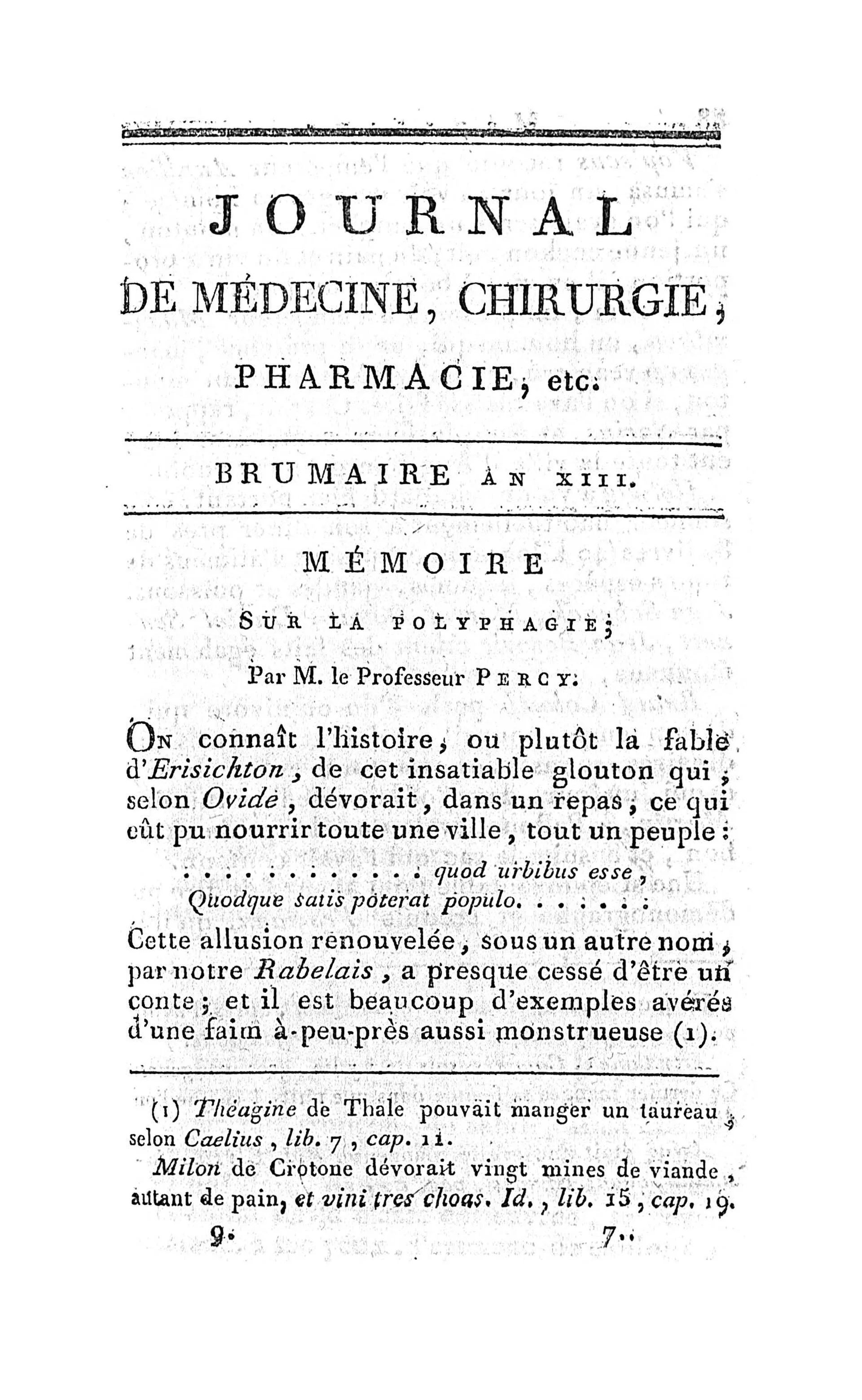
Almost everything known about the man called Tarrare comes from one surgeon. Pierre-François Percy, later chief surgeon of Napoleon’s armies, knew him in an army hospital in Alsace in the 1790s and found him again on his deathbed at Versailles. In 1805 Percy published a “Mémoire sur la polyphagie” in the Paris Journal de médecine, chirurgie, pharmacie, and it is that paper, not later retellings, that sets the limits of the story.
What Percy recorded
Percy did not know whether Tarrare was a real name or a stage name; he thought it might have come from a popular opera of the day. The boy came from the countryside near Lyon and ran away from home young, living by begging and theft until he attached himself to a fairground show. His act was to challenge the crowd to fill him. He would eat a basket of apples in minutes and swallow pebbles and corks. Percy heard from him that at seventeen, weighing about a hundred pounds, he could get through a quarter of a bullock of his own weight in a day. The act sent him more than once to the Hôtel-Dieu in Paris with violent colic, and he once tried to swallow his surgeon’s watch and chain.
When the Revolutionary wars began in 1792 he enlisted. He did chores for comrades in exchange for their rations, still went hungry, and was taken in a state of collapse to the field hospital at Soultz, between Wissembourg and Haguenau. There the surgeon Courville recognized him as the stone-swallower of the Hôtel-Dieu and kept him for study. He was put on a quadruple ration and still raided the dispensary for poultices. Percy describes him killing and eating a live cat in front of the army’s chief physician and bringing up the fur half an hour later, eating snakes alive, swallowing an eel whole, and clearing in moments a dinner laid out for fifteen German laborers: four bowls of curdled milk and two great dishes of salted dumplings.
The swallowed message
Courville had him swallow a small boxwood case holding a sheet of paper, which came through the next day intact. The idea reached General Alexandre de Beauharnais, then commanding the Army of the Rhine. After eating about thirty pounds of raw liver and lungs in front of a group of officers, Tarrare swallowed the case again, this time carrying a note for a French colonel held by the Prussians near Landau. The note, Percy says, only asked the colonel to send news back the same way. Tarrare was caught at an outpost, searched without result, beaten, and held under guard. After thirty hours he managed to pass the case unseen and swallow it again, took a third beating, and was sent back across the lines. Later versions with a gallows and a last-minute reprieve go beyond Percy.
Expulsion and death
Back at Soultz he asked to be cured. Acids, opium and tobacco pills all failed, and Percy suspected Tarrare did not much want them to work. Left to feed himself, he raided farmyards and kitchens and competed with dogs at butchers’ refuse. Orderlies then said they had seen him drink the blood of patients being bled and eat in the dead-house, and when a fourteen-month-old child went missing, suspicion fell on him. Percy reports these as accusations, not observations. Tarrare was driven out in 1794.
Percy lost track of him until the late summer of 1798, when the chief surgeon at the Versailles hospital, Tessier, told him the man had been admitted two months earlier in a wasting state. Tarrare insisted his illness came from a silver fork he had swallowed two years before. He died some months later of consumption, with a purulent diarrhea. Tessier opened the body despite its rapid decay and found the abdominal organs bathed in pus, an enlarged liver and gall bladder, and a huge, ulcerated stomach filling most of the abdomen. There was no fork. Retellings make it gold; Percy says silver.
What was wrong with him
Percy gave his age at death as about twenty-six. He described a slight, timid young man with fine blond hair, a very wide mouth, cheeks that stretched to hold a dozen eggs, a body that was always hot, sweating and foul-smelling, and abdominal skin that hung in folds when he was empty. No diagnosis fits neatly. Modern writers have pointed to an overactive thyroid, which drives hunger, heat, sweating and weight loss, or to damage in the parts of the brain that regulate appetite. The tuberculosis that killed him may also have been present for years. The medical historian Jan Bondeson, who has written the fullest modern account, notes that nothing closely resembling Tarrare or his contemporary Charles Domery has appeared in modern neurology, so a firm diagnosis is out of reach.
Where it stands
Percy was a senior, careful military surgeon writing about a patient he had seen with colleagues, and his memoir was absorbed into the medical literature, including Gould and Pyle’s Anomalies and Curiosities of Medicine. The core of the case, an insatiable eater who swallowed a dispatch case for the army, rests on that eyewitness record. The most gruesome parts, the corpses and the missing child, were hospital rumors that Percy repeated without endorsing, and the cause of Tarrare’s hunger remains unknown.