
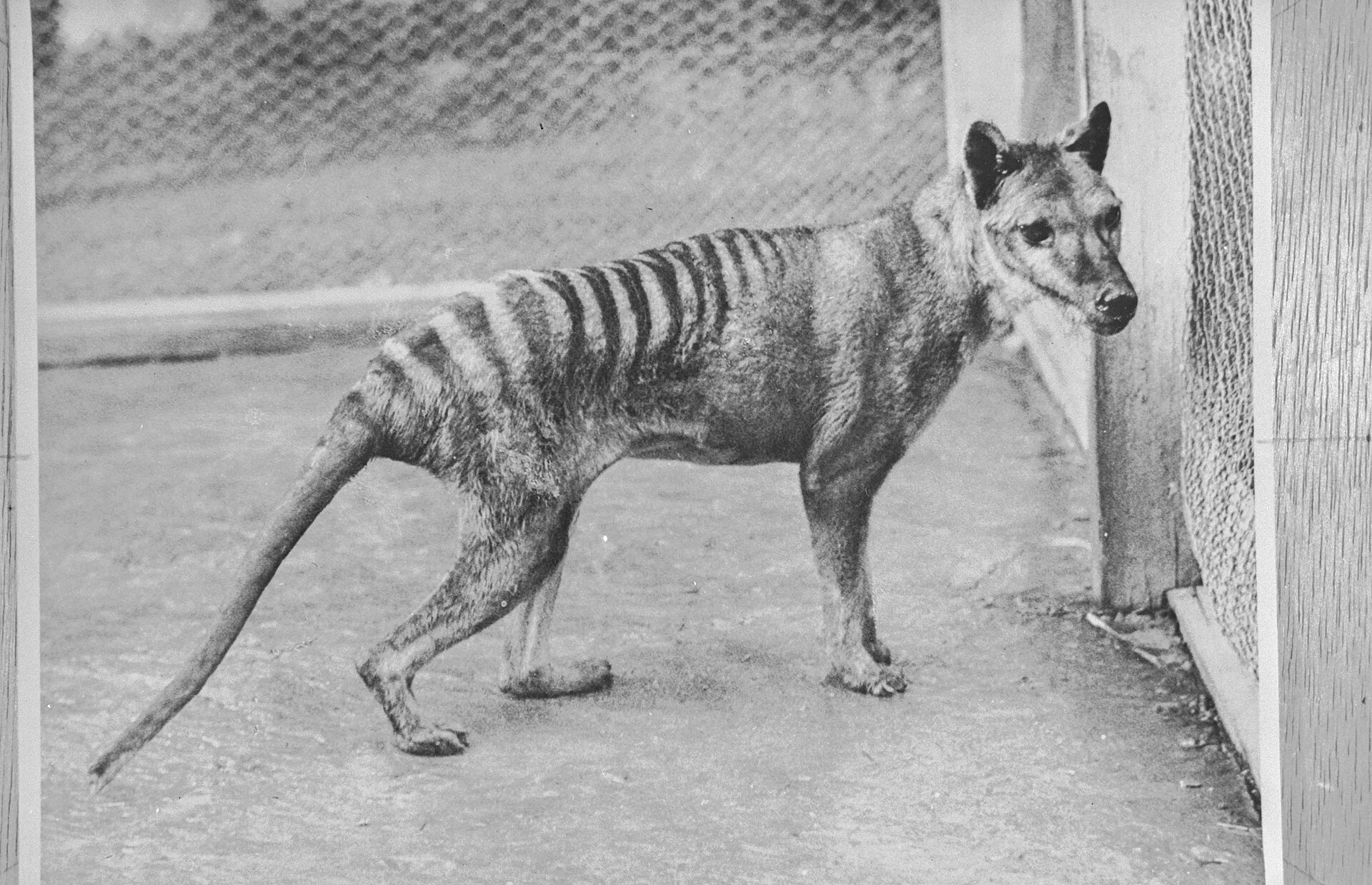
The thylacine, the striped, dog-shaped marsupial predator Tasmanians called the tiger, has an exact official end date. On the night of September 7, 1936 the last known animal died in its enclosure at Beaumaris Zoo, on the Queens Domain in Hobart. Fifty-nine days earlier the state had finally added the species to its list of protected wildlife. Ever since, people have kept reporting thylacines in the Tasmanian bush, and occasionally on the mainland, and the question of when the species really vanished has never quite been closed.
How it got there
Thylacines had disappeared from mainland Australia thousands of years earlier but remained widespread in Tasmania when Europeans arrived. Settlers blamed them for killing sheep. The Van Diemen’s Land Company paid bounties from 1830, and in 1888 the Tasmanian parliament put a price of one pound on each thylacine’s head; by the time the government scheme ended in 1909 it had paid out 2,184 bounties. By the 1910s the animals were rare enough that zoos around the world competed to buy them. Hunting, the fragmenting of habitat and a distemper-like disease are generally given as the causes of the collapse. The last thylacine known to have been killed in the wild was shot by the farmer Wilf Batty in the northwest in 1930.
The last captive animal
Even the endling is contested. Film shot at Beaumaris Zoo in 1933 is often described as showing the last thylacine, and for decades the last animal was said to be a male that was shut out of its sleeping quarters on a cold night and died from the neglect. In 2022 the researcher Robert Paddle and Kathryn Medlock, curator of vertebrate zoology at the Tasmanian Museum and Art Gallery, announced that they had identified the endling’s skin and skeleton in the museum, where the skin had long been used as a touring education specimen. They argued it was an elderly female the zoo bought in May 1936, the filmed male having died earlier. In 2023 Gareth Linnard and Stephen Sleightholme disputed that, arguing in the same journal that the evidence favors a male snared by the Delphin family of Waratah in 1930, and that the neglect story has no support. The date of death is the only point everyone shares.
The sightings
Reports began almost at once and never stopped. Searches followed them: an expedition under Sergeant Summers in 1937 that recorded many recent sightings between the Arthur and Pieman rivers, naturalist David Fleay’s search for footprints in 1945, the zoologist Eric Guiler’s expeditions, a major effort by Jeremy Griffith, James Malley and Bob Brown from 1968, and camera surveys by the Parks and Wildlife Service in 1980. In 1982 a parks officer, Hans Naarding, reported seeing one near the Arthur River, which prompted an extensive but unsuccessful search led by the wildlife officer Nick Mooney. A study by the wildlife officer Steven Smith of 320 sightings from 1934 to 1980 rated just under half as good. None produced a body, a photograph that held up, or hair or droppings that could be confirmed. The international conservation body listed the species as extinct in 1982, and Tasmania followed in 1986.
The 2023 modeling
In 2023 a team led by Barry Brook of the University of Tasmania published the most thorough attempt to date a disappearance from such evidence. They compiled 1,237 reports from 1910 onward, from confirmed kills to anonymous sightings, rated each for reliability, and ran extinction-date models under different assumptions. Using only physical specimens, the species was gone by about 1941. Adding the best-rated sightings by trappers, bushmen and wildlife staff pushed the likely date to somewhere in the 1940s to 1970s. Weighting the entire record by quality, the window moved to the late 1980s through the early 2000s, with the last holdouts most likely in the remote southwest and a small chance of survival beyond. High-quality reports fell from 32 in the 1960s to one in the 2000s.
Critics, Mooney among them, have questioned how much weight unverified sightings can bear. Mooney has also made the ecological argument: with fewer competitors, more prey and more den sites than in the 1930s, a surviving population should have become obvious by now.
Where it stands
Every serious assessment agrees the thylacine is extinct; what remains open is when. The 1936 date marks the last confirmed animal, not necessarily the last animal, and both the state museum’s curator and the 2023 modeling allow that small groups may have hung on in western Tasmania for years or decades. That decades-long tail is plausible. A living population in the 2020s, after nearly ninety years of searching, is not supported by any physical evidence. The sightings themselves continue to arrive.