
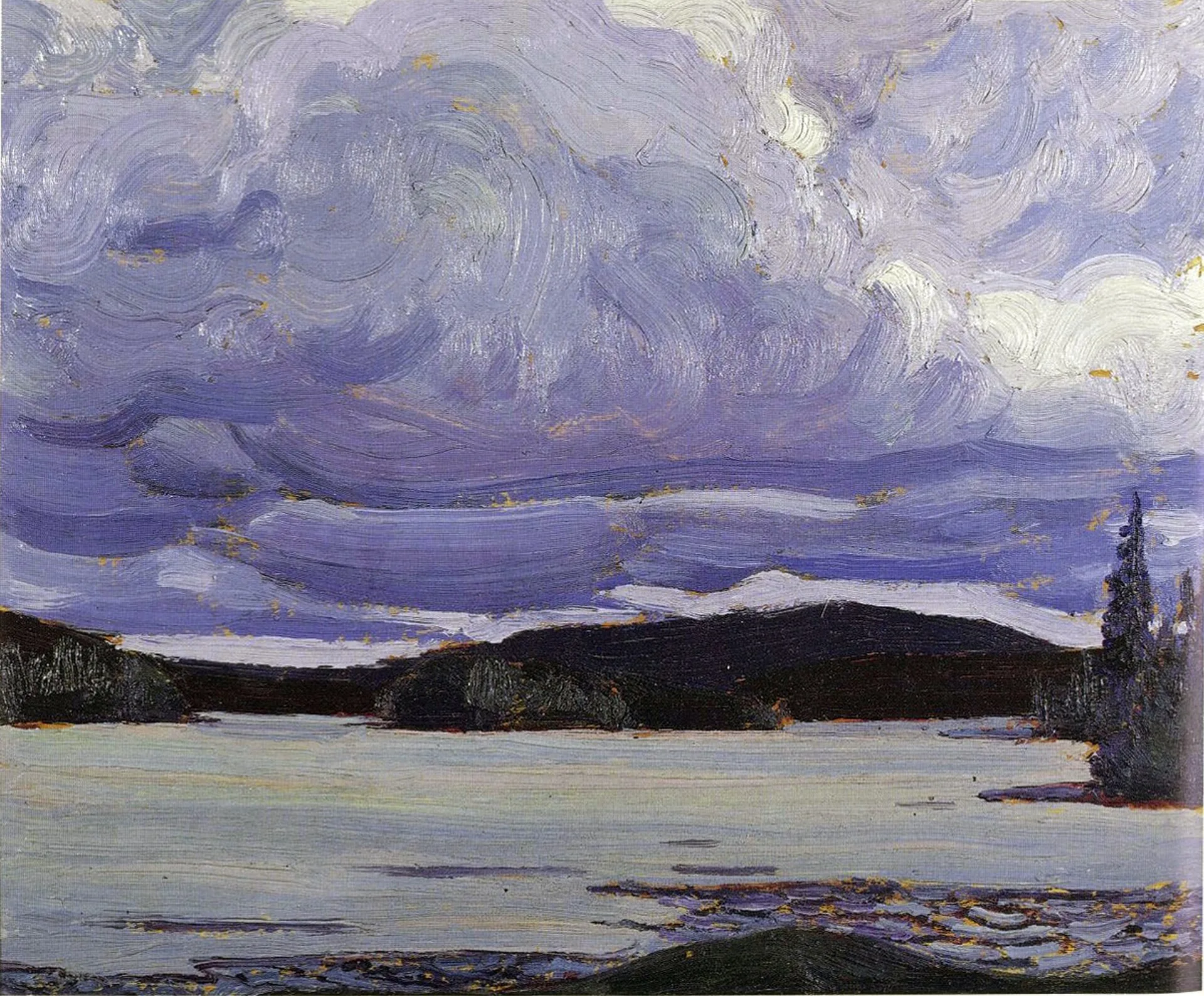
Tom Thomson had been painting seriously for barely five years when he died, but in that time the Ontario artist produced pictures, The West Wind and The Jack Pine among them, that came to stand for the Canadian landscape. He drowned in Canoe Lake in Algonquin Park in July 1917, aged 39, an experienced canoeist on a calm lake. The coroner called it an accident. Within a few years people were saying he had been killed, and later that his body had never left the park.
What happened
Thomson spent most of each year in Algonquin, guiding, fishing and sketching, and often stayed at Mowat Lodge, a boarding house on Canoe Lake run by Shannon Fraser. On Sunday July 8, 1917 he was seen with Fraser near the Joe Lake dam. The park ranger Mark Robinson recorded in his diary that Thomson set off from Fraser’s dock after 12:30 that afternoon, bound for Tea Lake Dam or West Lake. Later in the afternoon Martin Blecher and his sister Bessie, cottagers on the lake, passed an upturned canoe and left it where it was. It was Thomson’s. His supplies were still aboard and his paddles were lashed in place, and at first friends thought it had simply drifted off while he was ashore.
His body surfaced on the morning of July 16. Dr. G. W. Howland, a Toronto physician staying on the lake, saw it and had it brought ashore, and the next day swore that the body, badly decomposed, showed a four-inch bruise on the right temple and some bleeding from the right ear, with no other marks, and that death was due to drowning. Fraser wrote to Thomson’s father that the doctor believed Tom had fallen and hurt himself. The body was buried on July 17 in a small graveyard on a hill above the lake. The coroner, Dr. Arthur Ranney, returned a finding of accidental drowning.
The investigation
The family wanted Tom at home in Leith, near Owen Sound, and an undertaker from Huntsville, F. W. Churchill, was sent to move him. By his own account, given in 1956, he dug up the coffin, transferred the remains to a sealed metal box, put the empty coffin back in the grave, and shipped the box to Owen Sound, where it was buried in the family plot. Robinson did not believe it. Around 1930 he told a visitor to the park, William Little, that the undertaker had sent an empty coffin to Leith and that the body was still in the grave above Canoe Lake. In a 1956 interview he also recalled details that were not in the 1917 record: fishing line wrapped neatly sixteen or seventeen times around the left ankle, no water in the lungs, and a mark on the left temple, as if from the edge of a paddle.
In the autumn of 1956 Little, by then running the Ontario reformatory at Brampton, and three friends went to the old graveyard to prove Robinson wrong. In the third depression they dug, they found a coffin and a skeleton with a hole in the left side of the skull. The Ontario Provincial Police called in Dr. Noble Sharpe of the attorney general’s crime laboratory. His report described a man of about five feet eight, aged roughly 20 to 30, whom a University of Toronto anatomist judged to be Indigenous, and identified the hole as a surgical trephine opening rather than a wound. Thomson had been over six feet tall and nearly 40. The attorney general, Kelso Roberts, announced that the bones were not Thomson’s.
The explanations
Sharpe himself noted that the coffin seemed too costly for a casual laborer and that the grave did not look secret, which kept doubters going. Theories of murder usually begin with rumors of a quarrel at the lodge the night before Thomson vanished; various people at the lake have been named as suspects, and a rumored engagement to Winifred Trainor, whose parents owned a summer place at Canoe Lake, has been folded into several versions. Suicide has also been suggested, though nothing in his life or the condition of his body points that way. The biographer David Silcox prefers the simplest account: Thomson probably rose to his feet in the canoe, toppled, hit his head on the way down and drowned. The journalist Roy MacGregor, in a 2010 book, argued from forensic study of the 1956 skull that it was Thomson’s after all and that he may have been murdered.
Where it stands
No scientific test has ever tied either the Leith grave or the bones from Canoe Lake to Thomson. The 1917 evidence fits an accidental fall, the later testimony of ranger Robinson fits something worse, and the surviving records cannot decide between them.