
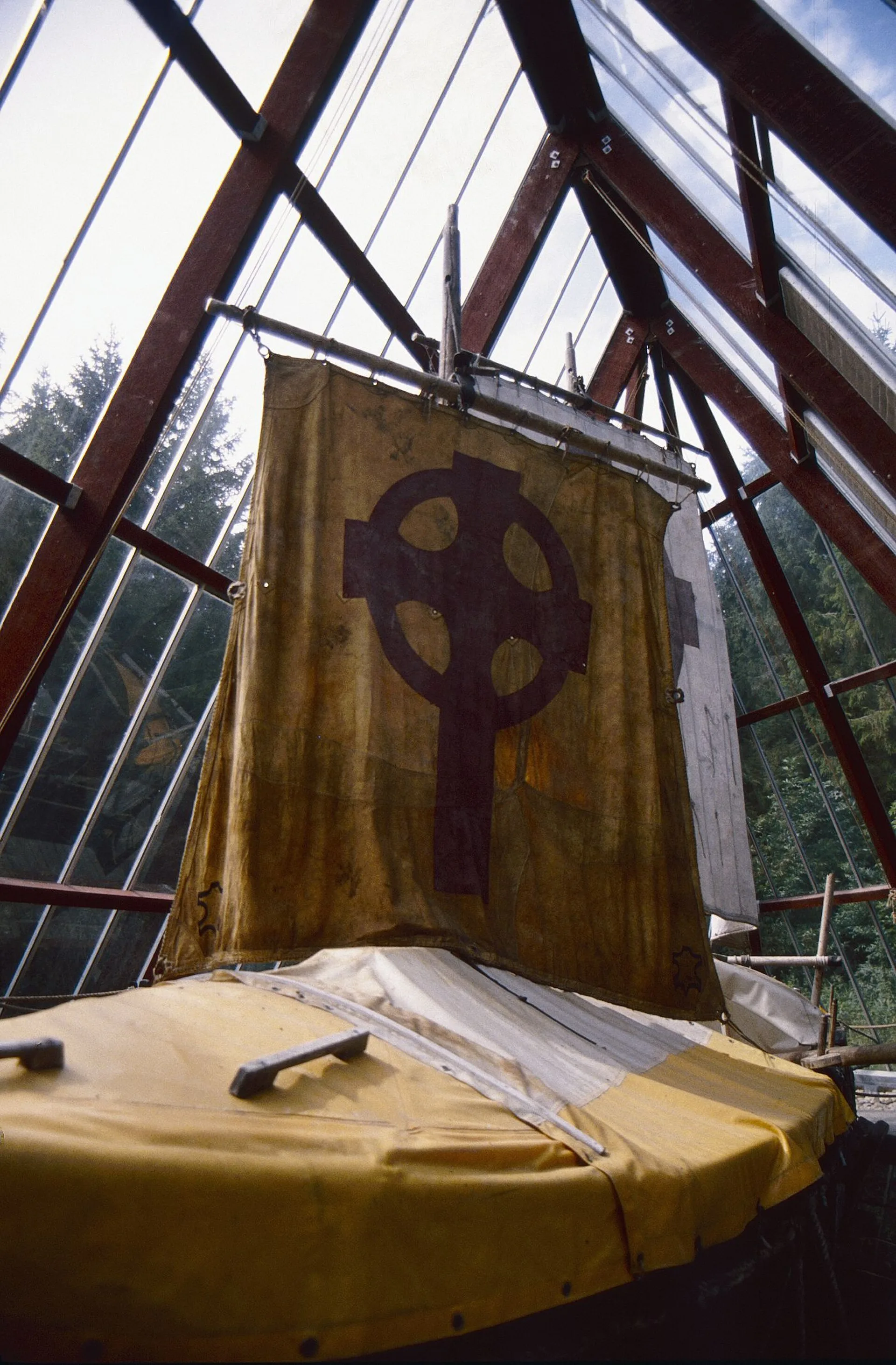
Brendan of Clonfert was a real sixth-century Irish abbot, remembered in the annals as the founder of monasteries at Ardfert, Annaghdown and Clonfert and as a man who traveled by sea to Scotland and Wales. What made him famous across medieval Europe, though, was a Latin book written centuries after his death: the Navigatio Sancti Brendani Abbatis, the Voyage of Saint Brendan the Abbot. Since the nineteenth century people have asked whether that book records a real Atlantic crossing, perhaps as far as North America, long before the Norse or Columbus.
What the Navigatio says
The story opens with another monk, Barinthus, describing a Promised Land of the Saints that lies across the western ocean. Brendan chooses fourteen companions, fasts with them, and builds a boat of wooden frames covered in oak-tanned hides, greased against the sea. Three latecomers talk their way aboard, and Brendan foretells that none of them will come home.
For seven years the monks sail from island to island, returning to the same places at the same feasts of the Church calendar. They find an island of huge sheep, an island of birds that sing the monastic hours, and a silent community of monks. Each Easter they celebrate Mass on the back of Jasconius, a great fish they first took for land. They pass a column of crystal standing in the sea, are pelted with burning slag by the smiths of an island of fire, and meet Judas Iscariot on a rock, granted a day’s relief from hell. At last they reach the Promised Land, stay briefly, and sail back to Ireland.
Scholars date the composition of the Navigatio to somewhere between the late eighth and the tenth century, and well over a hundred manuscripts of it survive. It belongs to an Irish genre of sea-voyage tales called immrama, and its rhythm of fasting, feast days and psalms reads much like a guide to the monastic life. Medieval mapmakers nevertheless took it at face value, and an island of Saint Brendan wandered across Atlantic charts for centuries, placed anywhere from the Canaries to the far west.
The leather boat
In 1976 the British explorer and writer Tim Severin set out to see whether the voyage was at least possible. Working from the Latin text, he had a 36-foot, two-masted boat built at Crosshaven in County Cork: ash frames and oak, lashed with nearly three kilometers of leather thong and covered with some four dozen ox hides, the whole skin dressed with wool grease. He named it Brendan.
The boat left Brandon Creek on the Dingle Peninsula on May 17, 1976, the day after the saint’s feast. Following the stepping-stone route through the Hebrides and the Faroes, the crew reached Iceland after about two months, laid the boat up for the winter, and sailed again from Reykjavík in May 1977. Because her square sails could not work into the wind, contrary weather sometimes left her going in circles, and off Labrador pack ice tore a hole in the leather bow that the crew had to patch and sew overnight. On June 26, 1977, fifty days out of Iceland, Brendan made landfall at Peckford Island off the north coast of Newfoundland and was towed into Musgrave Harbour.
Severin and his crew came to think that much of the Navigatio matched what they saw. The sheep islands answered to the Faroes, whose very name refers to sheep; the island of birds to their seabird cliffs; the crystal column to an iceberg; and the smiths hurling slag to the volcanoes of Iceland. What they had experienced, he told a National Geographic reporter on arrival, was too close to the saint’s account to be a coincidence.
Where it stands
Severin proved that a skin boat of early medieval type can cross the North Atlantic by the northern route. He did not prove that Brendan did. Severin himself said what was missing was physical evidence, and none has turned up: no Irish site, object or burial of the right age has been found anywhere in the Americas. The parallels he found suggest the author knew something of the northern islands, which Irish seafarers of the period could plausibly have visited. The rest of the book, including the Promised Land itself, is best read as what it was written to be: a religious story, told in the form of a voyage. Severin’s boat is now displayed at Craggaunowen in County Clare.