
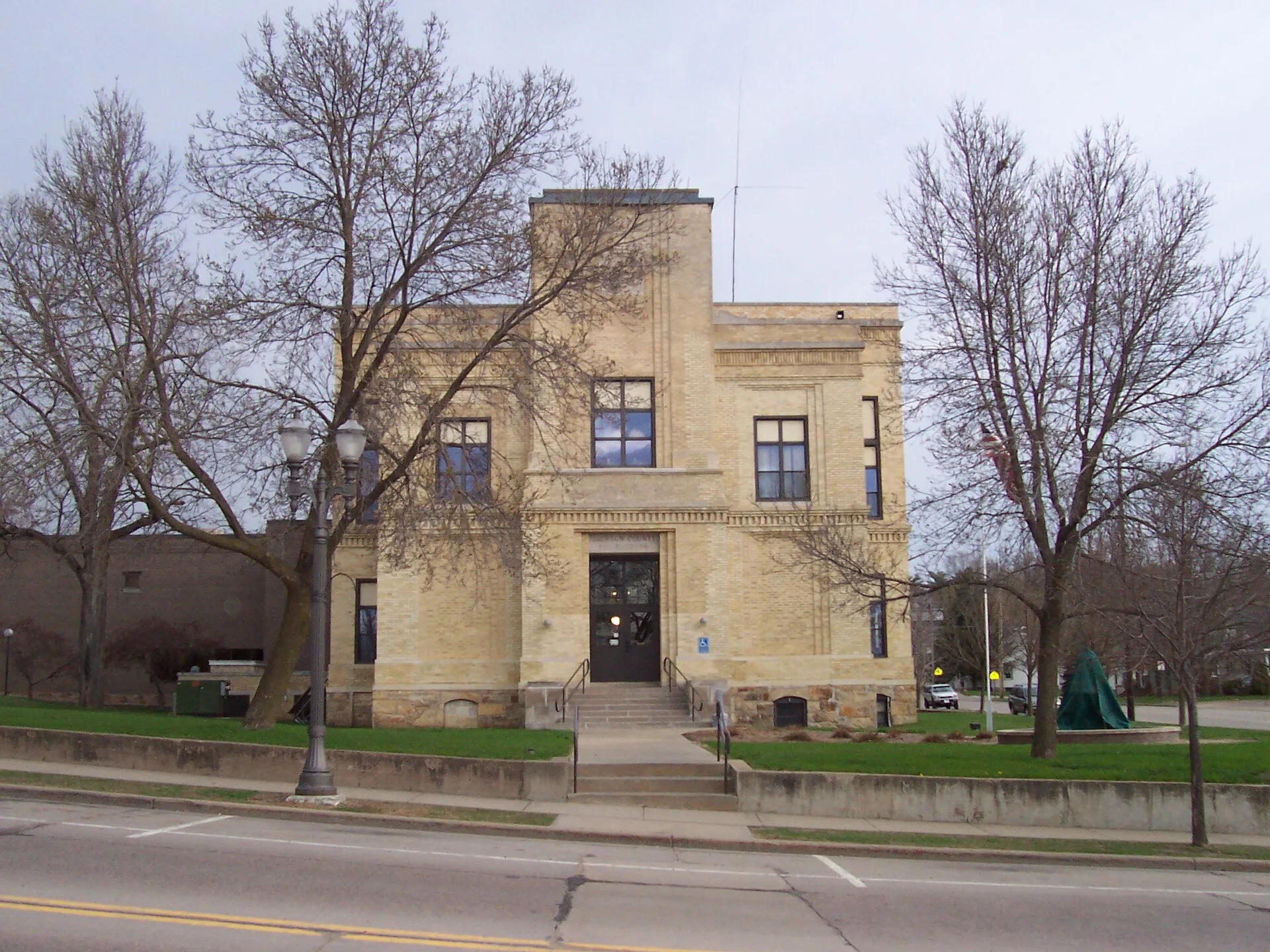
Black River Falls is the county seat of Jackson County, Wisconsin, a small town on the Black River in the western part of the state. In the 1890s its residents were mostly recent arrivals from Norway, Germany and Sweden, working farms and lumber camps. In 1973 a graduate student published a book that made the place a byword for small-town madness, assembled entirely from the town’s own photographs and newspaper columns.
The book
Michael Lesy came from Ohio to the University of Wisconsin in Madison for a master’s degree in American history. Wandering into the Wisconsin Historical Society, he was shown a collection of glass-plate negatives by Paul Vanderbilt, the society’s first curator of iconography. The plates were the work of Charles Van Schaick, who ran a portrait studio in Black River Falls from 1885 until 1940 and whose surviving negatives the society holds, more than 8,000 of them.
Van Schaick photographed what a town photographer photographs: families stiff in front of painted backdrops, horses, lumber crews, storefronts. He also made memorial portraits of dead infants in their coffins, a standard commission at the time. Lesy went looking for the town behind the faces and spent long stretches on microfilm readers with the local weekly, the Badger State Banner, edited by Frank Cooper and later his son George. Between the church suppers and engagements he found a dense run of calamity: suicides, arson, epidemic diphtheria and smallpox, poisonings with carbolic acid and the insecticide Paris green, commitments to the state asylum, children lost, farms foreclosed.
He chose about 130 of the 1890s images and set them against clippings from the Banner and case notes from the Mendota State Hospital for the Insane. The book, his doctoral thesis at Rutgers in another form, was published by Pantheon in 1973 as Wisconsin Death Trip. Images were cropped, flipped and inverted, captions withheld, and the photographs run without identification or context. The effect is cumulative and deliberately disorienting. Lesy later explained that a death trip was what users of psychedelics in his own era had called a hallucination of death and rebirth.
What the record shows
The documents Lesy quotes are real, and so are the photographs. The question critics raised was whether the arrangement supported the conclusion. His framing presents Black River Falls as the site of a collective psychic crisis, the local symptom of a national breakdown in the depression that followed the financial panic of 1893.
State figures do not single the town out. In 1900 roughly one person in 472 in Jackson County was certified insane, slightly below the Wisconsin average, and local suicide rates tracked the state’s. The grim material was not unique to Black River Falls; it was what a rural Midwestern weekly printed in the 1890s, and a thorough reader of any such paper would find a comparable catalog. The Wisconsin Historical Society’s own account of the collection notes that historians have remained unhappy with Lesy’s method while the public has stayed fascinated by it.
The circumstances behind the misery are not mysterious. The 1893 panic closed banks, bankrupted businesses and foreclosed farms across the region. Diphtheria, smallpox and cholera moved through communities with no vaccine or antibiotic to stop them. Winters were long, medical care was thin, and the asylum was the only institution available for mental illness. Lesy drew on the Mendota records to show a pattern in what patients feared: that neighbors, relatives and officials were conspiring to ruin them. He argued, in the book’s conclusion, that some of those patients had grasped something true about their position.
Where it stands
Wisconsin Death Trip has stayed in print for more than fifty years and became a cult object well outside history departments. James Marsh adapted it as a film in 1999. Stephen King has said it fed his story “1922”; the novelist Robert Goolrick credited it as the seed of A Reliable Wife. Van Schaick’s wider body of work has fared better than Lesy’s reputation among historians: in 1994 the Jackson County Historical Society gave the Wisconsin Historical Society the remaining plates from the studio, many of them portraits commissioned by Ho-Chunk families, which were published in 2011 as People of the Big Voice. The whole collection is now cataloged and online.
What is unexplained here is not an event but an impression. Nothing supernatural happened in Black River Falls, and nothing statistically remarkable either, as far as the state’s own numbers go. The book’s power comes from a method: strip the context from a hundred ordinary photographs of ordinary people, interleave them with the worst week of a hundred different lives, and a quiet county seat reads as a place in the grip of something. Whether that is history or an artifact of the editing is the argument the book has never stopped provoking.