
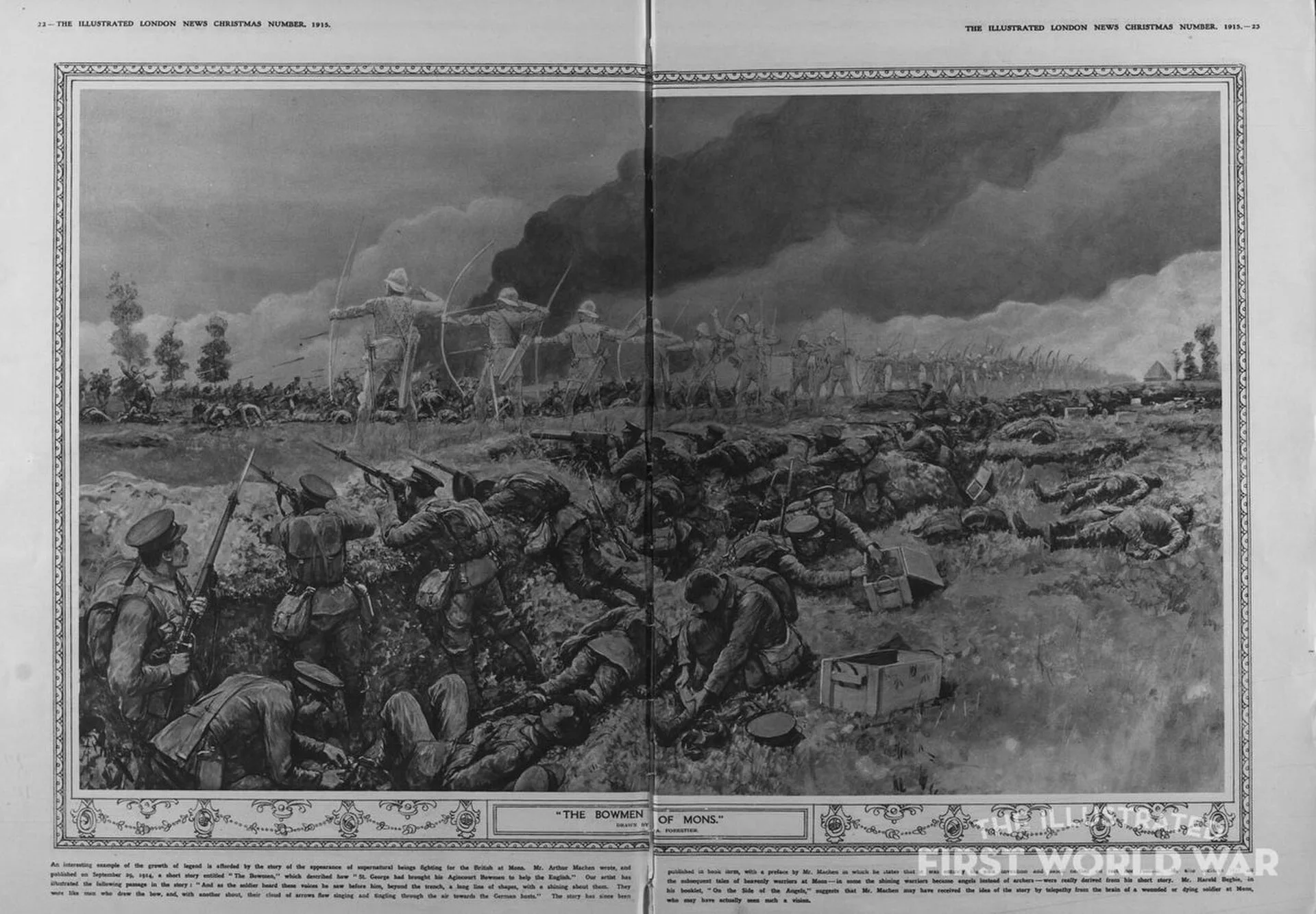
Mons, a mining town in the Belgian province of Hainaut, was where the British Expeditionary Force first met the German army in the First World War. On August 23, 1914 the outnumbered British inflicted heavy losses with rifle fire over two days of fighting and then withdrew south in a long retreat. No military record from either side mentions anything supernatural. The angels arrived later, in print.
What happened
Arthur Machen was a Welsh writer of supernatural fiction working as a journalist on the London Evening News. He read a grim account of the retreat in a Sunday paper at the end of August and soon afterward worked out the plot of a short story, “The Bowmen”, published in the Evening News on September 29, 1914, the feast of St Michael. In it a British soldier under fire mutters an appeal to St George, and a long line of shadowy archers, “with a shining about them”, answers from the Agincourt past and cuts down the German advance. Machen thought it a weak piece and expected it to be forgotten.
It was not. Within days the editors of two spiritualist journals, The Occult Review and Light, wrote to ask whether the tale had any basis. Machen told them it had none. Over the winter several parish magazines asked to reprint it, and in the spring the priest of one of them wrote back to say the issue had sold out, to ask for Machen’s authorities for a pamphlet edition, and finally to insist that the essential facts must be true. Machen replied that there were no authorities because he had invented the whole thing.
The investigation
By then the story was mutating. Machen collected versions in which St George appeared in person, German corpses were found with arrow wounds, and a luminous cloud came between the armies. He suspected that the word shining was the bridge to the final form: in May 1915 a writer in The Occult Review reported that soldiers had seen a row of shining beings, and to most readers shining figures meant angels. Brian Dunning’s account for Skeptoid traces the first printed mention of angels to the Hereford Times of April 3, 1915, which relayed a story told second-hand by a Miss Marrable. She later said she had been misquoted.
The new version spread through sermons and newspapers, and its defenders went into print. Harold Begbie’s On the Side of the Angels, published in 1915, argued for real intervention, suggested Machen might have picked up a dying soldier’s vision by telepathy, and said witnesses were being kept quiet, though he named none. That August a writer named Phyllis Campbell described, in The Occult Review, nursing a Lancashire Fusilier and an artilleryman who said they had seen St George on a white horse. Machen took her account apart in a postscript to his own book: neither man was named, the soldiers knew where the vision had appeared and then could not say, and the saint they described did not match the figure on the coin they claimed to recognize him from.
The last important witness appeared in 1931. Brigadier-General John Charteris, a senior intelligence officer at British headquarters during the war, published a book of wartime letters including one dated September 5, 1914 that mentioned the angel story, which would put it before Machen’s tale. The historian David Clarke, who has written the most detailed study of the legend, found no such letter among Charteris’s surviving letters to his wife and concluded it was added afterward.
The explanations
Clarke’s research found no reliable account of angels or bowmen dated before “The Bowmen” appeared. Some writers, notably Kevin McClure in 1992, have argued that troops were already passing rumors of a protecting cloud or vision, but none of the published testimony traces back to a named soldier who saw anything himself. Clarke also noted a coincidence that shows how natural the idea was. Edgar Rice Burroughs wrote phantom bowmen into a Mars novel in the spring of 1914, months before Mons, and neither author could have read the other.
Carl Jung later used the Angels of Mons as an example of a visionary rumor, a story that spreads because a frightened public needs it and that keeps itself alive through reported sightings.
Where it stands
Machen’s book, published in 1915 with his introduction setting out how the tale was born, sold well, and the legend outlived him. It still appears in collections of wartime miracles and on street art in Mons itself. As history the trail ends where it began: in a newspaper short story that its author never claimed was true.