
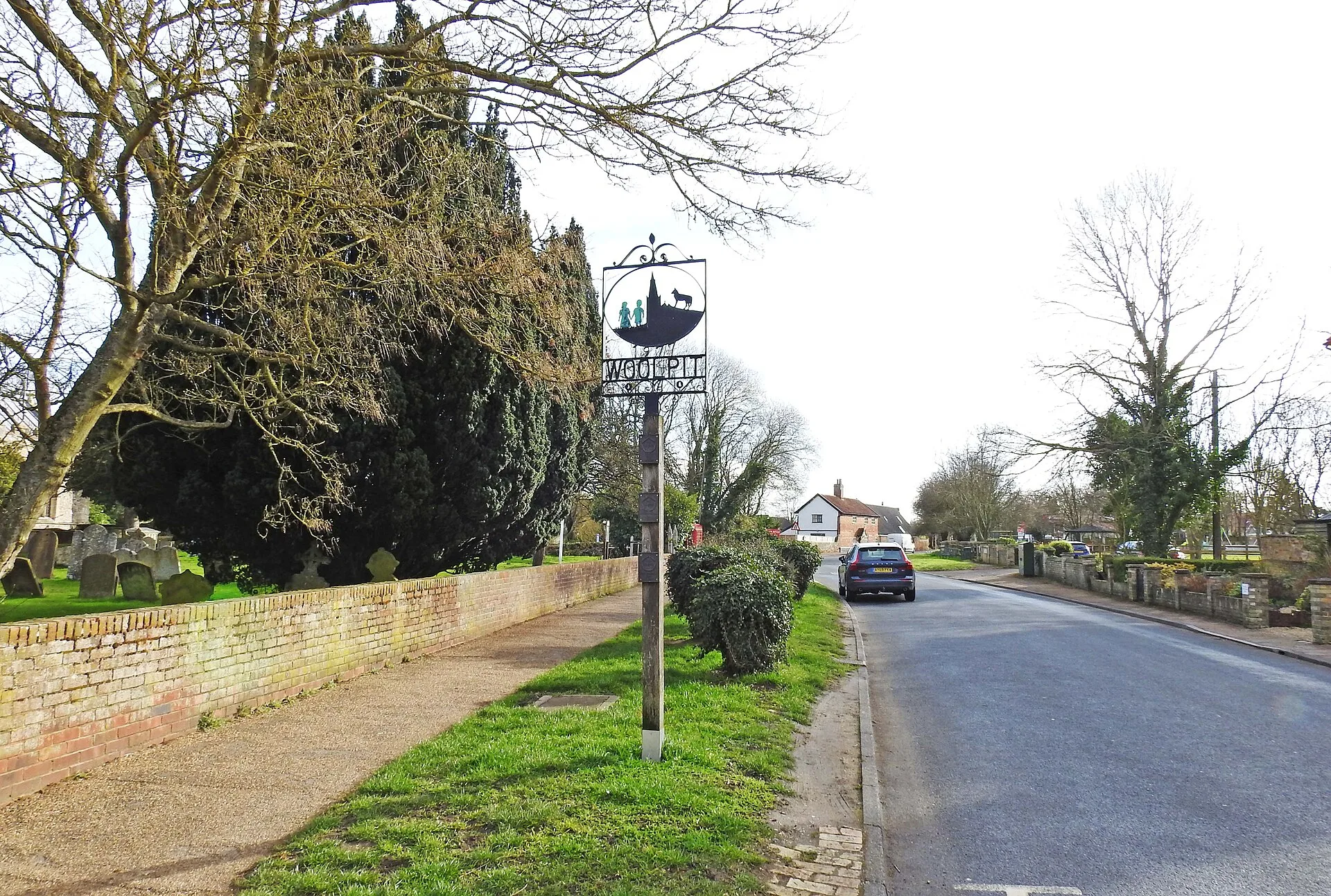
Woolpit is a village in Suffolk a few miles east of Bury St Edmunds. Its name is usually taken to come from pits once dug there to trap wolves. Two monastic writers of the late twelfth and early thirteenth centuries recorded that, some decades earlier, two children with green skin had appeared beside those pits.
What happened
The earlier account is by William of Newburgh, a canon of an Augustinian priory in Yorkshire, in his history of English affairs written in the 1190s. He sets the event in the reign of King Stephen, between 1135 and 1154. At harvest time, he says, reapers near the pits found a boy and a girl who were green all over and wore clothes of an unfamiliar color and material. Taken into the village, the pair refused every food offered to them for several days until someone brought in beans still on the stalk. They searched the stalks, cried when they found nothing inside, and ate hungrily once a bystander shelled the beans for them. They lived on beans for months before they learned to eat bread, and their green color gradually faded. Both were baptized, and the boy, who seemed the younger, died soon afterward. The girl learned English, grew to look like any local woman, and was reported to have married at King’s Lynn.
Asked where they came from, the girl named St Martin’s Land, a Christian country with churches where the sun never rose and the light was a permanent dusk. She and her brother had been tending their father’s flocks, she said, when they heard a loud sound like the bells of Bury and suddenly found themselves among the reapers. William admits that he doubted the story for a long time and accepted it only because so many credible people vouched for it.
The second account comes from Ralph of Coggeshall, abbot of an Essex monastery, writing in the 1220s. He names his informant as Richard de Calne of Wykes, in whose household the girl worked for years, and adds that everything in her homeland was green and that the children had followed their animals into a cavern before coming out into daylight. Ralph describes the girl in her later life as forward and wanton. The two versions agree in outline and differ in particulars.
The investigation
There is nothing to examine beyond the two texts. No charter, parish record or other chronicle mentions the children, and both authors wrote long after the reign in which they set the story. Scholars therefore treat the accounts as literature as much as history. A 2020 study by the Polish historian Michał Madej compares them closely and argues that, despite small differences in detail, the story served a different purpose in each chronicle. Historians also doubt that either writer had read the other.
The explanations
The best-known historical reading was put forward by Paul Harris in 1998. He suggested the children came from a community of Flemish immigrants at Fornham St Martin near Bury St Edmunds, and were lost or orphaned after Flemish soldiers were killed at the Battle of Fornham in 1173 or in later persecution under Henry II. Speaking only Flemish, they would have sounded foreign to Suffolk villagers, their green tint could have been chlorosis, an old name for a sickly pallor caused by poor diet, and St Martin’s Land could be a garbled Fornham St Martin. The theory has weak points. It moves the event out of Stephen’s reign, and the writer Brian Haughton has noted that an educated household would probably have recognized Flemish. John Clark, who has published several studies of the story, has also challenged how Harris used his evidence.
Other readings treat the story as folklore. Entry from a twilight world through a cave or pit, accompanied by the sound of bells, is a familiar pattern in medieval tales of the otherworld. Later writers imagined the children as visitors from the moon or from beneath the earth, and in the twentieth century the writer Duncan Lunan proposed that they were extraterrestrials. Clark has argued against attempts to link the story with the feasts of St Martin.
Where it stands
Woolpit’s village sign shows the two children, and the story has inspired fiction and music, including Herbert Read’s 1935 novel The Green Child. As history it rests on two chroniclers writing from hearsay, and none of the explanations can be tested against independent evidence. It is a legend, though an unusually well recorded one.