
The Greenbrier is a resort hotel in White Sulphur Springs, in the Allegheny Mountains of southeastern West Virginia, about 250 miles southwest of Washington, DC. In 1956, as the Eisenhower administration drew up plans to keep the federal government running through a nuclear war, officials approached the Chesapeake and Ohio Railway, which owned the hotel, with a proposal for an emergency relocation center on its grounds where the entire United States Congress could reassemble. The project went by several code names over the years, among them Project X, Casper and, in the 1980s, Project Greek Island.
What happened
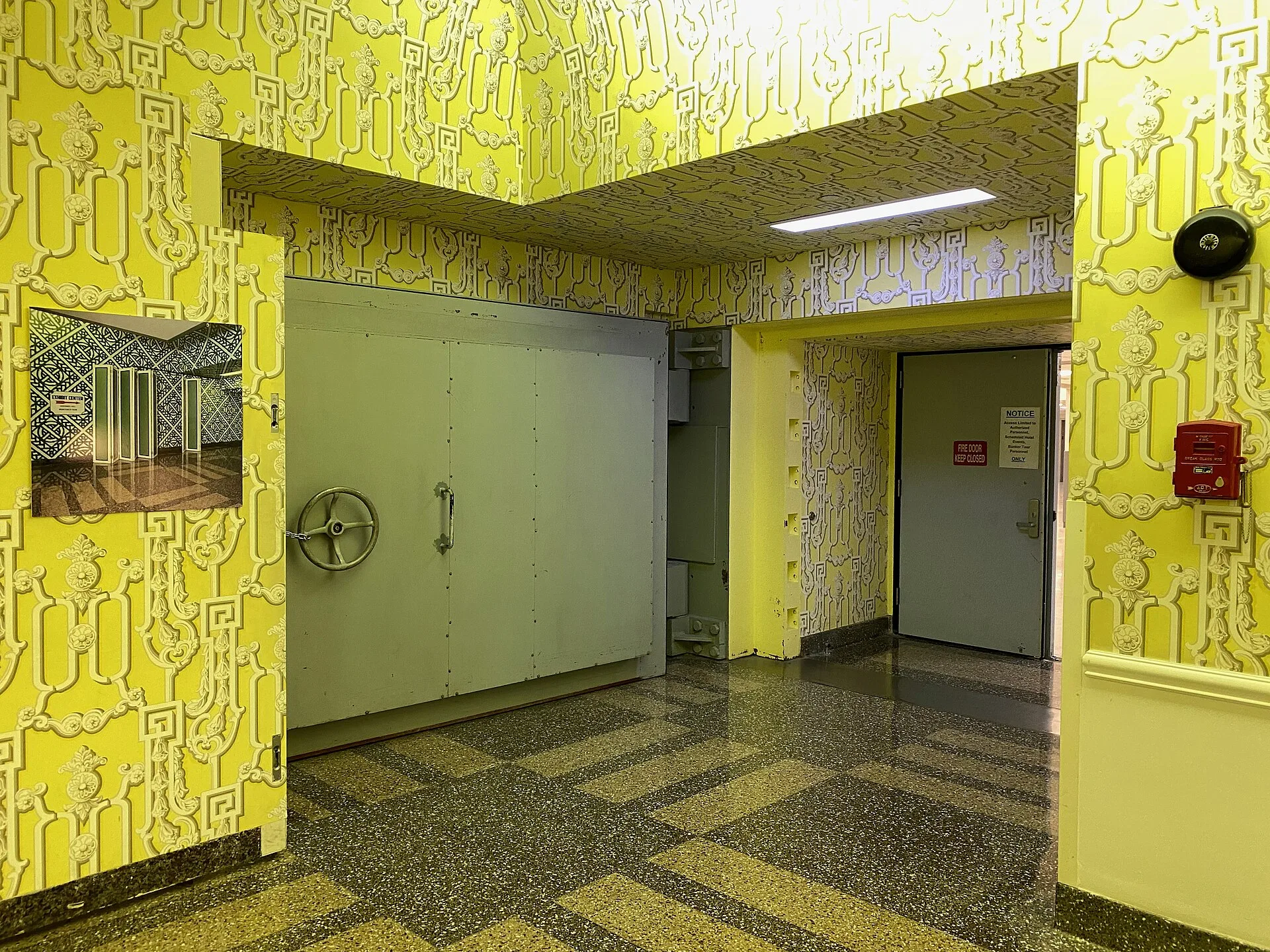
In 1958 the hotel agreed to build a new wing, announced to the public as the West Virginia Wing, and the government built its bunker beneath and beside it. Work began at the end of 1958 and took about two and a half years and 50,000 tons of concrete; wing and bunker were both finished by mid-1962, in time for the Cuban Missile Crisis that October, at a combined cost of around 14 million dollars. The result was a structure of about 112,000 square feet with steel-reinforced concrete walls two feet thick, dug into the hillside and sitting about twenty feet below ground. Four blast doors sealed it; the largest stands fifteen feet high and twelve feet wide, is nineteen and a half inches thick and weighs about 28 tons.
Inside were separate chambers for the House of Representatives and the Senate and a larger hall for joint sessions, plus a twelve-bed clinic, a kitchen and eighteen dormitories with bunks for about 1,100 people, enough for the 535 members and their staff. Three 25,000-gallon water tanks and three 14,000-gallon diesel tanks fed the plant, and food and supplies were kept stocked and rotated for thirty years. It was a fallout shelter rather than a fortress, built to ride out an attack on Washington, not a direct strike.
The cover was the hotel itself. The Exhibit Hall and the two auditoriums were used by the Greenbrier for conventions and trade shows, with the blast doors concealed behind wallpaper and false partitions. A company called Forsythe Associates, nominally an Arlington, Virginia, firm that serviced the hotel’s televisions, employed the government technicians who kept the generators, filters and supplies ready; for thirty years, as the state encyclopedia puts it, the resort was one phone call from becoming the seat of the legislative branch.
The investigation
The secret held for more than three decades, through the 1962 crisis and beyond, and the bunker was never put to use. It ended on May 31, 1992, when the Washington Post published Ted Gup’s article “The Ultimate Congressional Hideaway” on page W11 of its Sunday magazine, describing the facility, its cover company and its purpose. The Greenbrier lost its government contract and the bunker was decommissioned within months. The paper’s decision drew criticism from those who said it had wasted a working asset; Gup and others replied that by 1992 missile flight times were measured in minutes, which made a shelter hours from the Capitol of little use.
The explanations
The Greenbrier was one piece of a larger continuity-of-government network that was itself only partly secret. Mount Weather, a Federal Emergency Management Agency site near Bluemont, Virginia, about fifty miles west of Washington, had an underground complex completed in 1959 as the relocation point for the executive branch. Its existence became public knowledge on December 1, 1974, when TWA Flight 514 crashed into the mountain, killing 92 people. Mount Weather was used again on September 11, 2001, when congressional leaders were flown there by helicopter. The Greenbrier’s distinction is not that it existed but that a hotel, a town and a workforce kept it quiet for so long.
Where it stands
Once the government had gone, the resort turned the bunker into an attraction. Visitors today take a ninety-minute walk through the blast doors, dormitories and chambers, with cameras and phones left at the desk. As a conspiracy, the story is unusual: the suspicion that the government maintained a secret hideaway for Congress was not paranoia but a reasonable description of what sat under the West Virginia Wing from 1962 to 1992.