
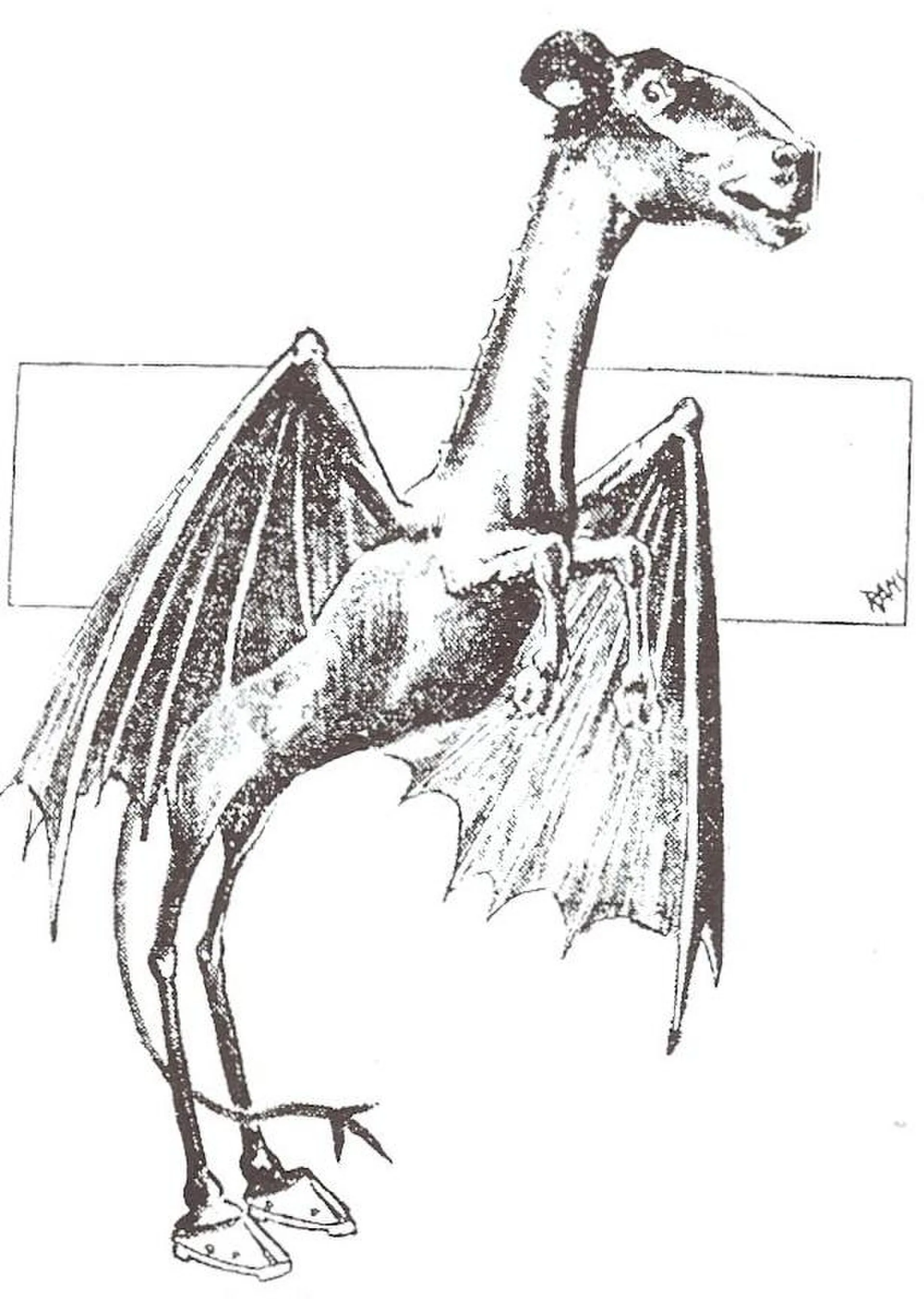
The Pine Barrens are a flat, sandy country of pitch pine, cedar swamp and cranberry bog that fills much of southern New Jersey. They have been thinly settled since colonial times, and they have one famous resident: a creature with a horse-like head, bat wings, clawed hands and cloven hooves, known first as the Leeds Devil and later as the Jersey Devil.
The legend
The common version is set in 1735 near Leeds Point, on the bay north of what is now Atlantic City. A woman known only as Mother Leeds, already the mother of twelve, learned she was pregnant again and wished that this child would be the Devil’s. The baby was born normal, then changed shape, grew wings and a tail, and escaped up the chimney into the pines. Tellings disagree on the year, the town and the mother’s name, and some researchers have tried to match her to Deborah Leeds, whose husband Japhet named twelve children in his 1736 will.
The Leeds family
The Leeds family itself is real, and historians now think the legend grew out of its quarrels rather than out of any birth. Daniel Leeds arrived in Burlington, West Jersey, in 1677 and in 1687 began publishing an almanac. Its astrology offended his fellow Quakers, who ordered unsold copies destroyed. Leeds left the Friends, wrote tracts attacking them, and in 1702 became a councillor to the unpopular royal governor Lord Cornbury. A Quaker reply titled Satan’s Harbinger Encountered cast him as the Devil’s servant. He had acquired land at Great Egg Harbor in the 1690s, the area later called Leeds Point.
His son Titan took over the almanac in 1716, and from 1728 its masthead carried the family crest, a shield bearing three winged, dragon-like wyverns. In 1733 Benjamin Franklin’s new Poor Richard’s Almanack predicted, by astrology, that Titan would die that October, and when he did not, Franklin joked that the attacks on him were the work of Titan’s ghost. Titan died in 1738, close to the date the legend gives for the monster’s birth. Brian Regal of Kean University found no colonial newspaper, pamphlet or broadside mentioning a Leeds Devil, and in a 2018 book with Frank Esposito he argued that a family accused of serving Satan, mocked as a ghost, and displaying winged beasts on its almanac drifted in memory into a monster. A reviewer in the Rutgers journal NJS judged the case convincing.
January 1909
The legend became a national story in the week beginning January 16, 1909, when papers in Philadelphia and South Jersey printed hundreds of reports. On January 21 the New York Sun described armed groups searching the pines and towns for the Leeds devil, tracks like a pony’s with split hooves that seemed to clear six-foot fences, and reports from Woodbury, Salem, Gloucester, Clayton, Williamstown and Glassboro. Prints were said to have turned up on Philadelphia streets. Nelson Evans, a paperhanger in Gloucester City, told police that he and his wife had watched the thing on their shed roof at about two in the morning: around three and a half feet tall, with a head like a collie’s, a face like a horse’s, short wings, and long hind legs ending in hooves.
Over the week, schools closed in some towns and workers stayed home. Police in Camden and in Bristol, Pennsylvania, said they had fired at it, and a rumored $10,000 reward from the Philadelphia Zoo encouraged pranks. The best known was staged by Norman Jeffries, publicist for a dime museum on Arch Street in Philadelphia, who with an animal trainer fitted a kangaroo with fake claws and wings and exhibited it as the captured Devil. Jeffries admitted the stunt about twenty years later, and at least one man later confessed to faking footprints.
The explanations
No animal was caught and no physical evidence survives beyond newspaper descriptions of tracks, several of them resembling ordinary horse or pony hooves. Sociologists, among them Robert Bartholomew, treat the week as a classic case of mass hysteria. A ready-made name, competing newspapers and fresh snow that held every odd track gave readers a monster to look for, and many found one. Regal argues that the 1909 coverage also fixed the creature’s modern look, combining wings, horse head and hooves into the single image still used today.
Where it stands
Sightings in the Pine Barrens have been reported every few decades since, usually as noises or tracks. The creature has given its name to New Jersey’s professional ice hockey team and remains the state’s best-known piece of folklore. As history, the Leeds family, its almanacs and the 1909 newspaper scare are well documented; the monstrous birth is a legend.